Faster EV Adoption and India's Import Bill
#GS-3 #Economy #Infrastructure #Growth #Environment #Sustainable Development #Science & Technology #Energy #Current Events #National #Electric Vehicles #Energy Security
Key takeaways
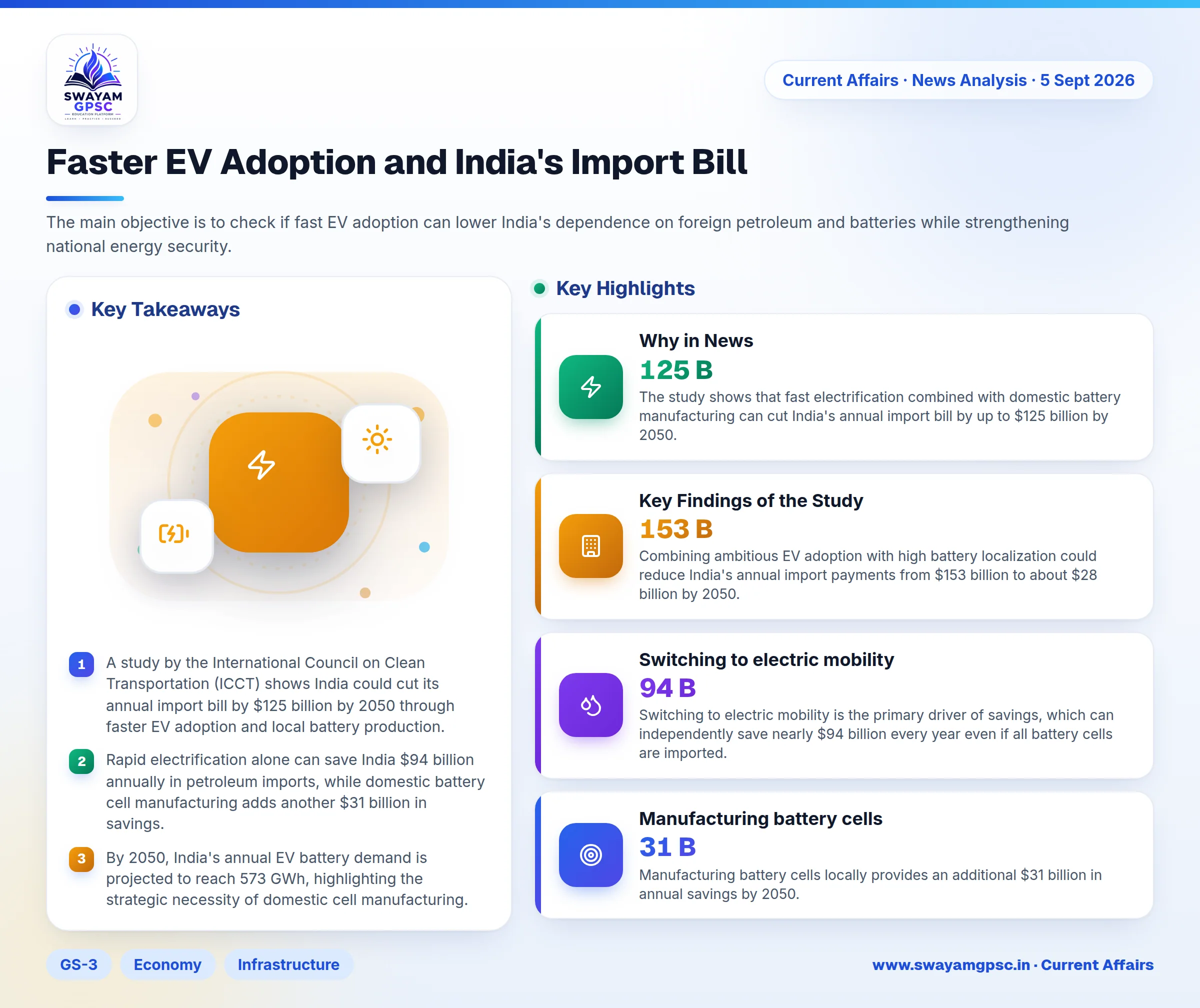
- A study by the International Council on Clean Transportation (ICCT) shows India could cut its annual import bill by $125 billion by 2050 through faster EV adoption and local battery production.
- Rapid electrification alone can save India $94 billion annually in petroleum imports, while domestic battery cell manufacturing adds another $31 billion in savings.
- By 2050, India's annual EV battery demand is projected to reach 573 GWh, highlighting the strategic necessity of domestic cell manufacturing.
- Shifting to electric transport will lower India's overall import costs from $153 billion to $28 billion while strengthening the Atmanirbhar Bharat mission.
Why in News
- A new study by the International Council on Clean Transportation (ICCT) highlights the massive economic benefits of rapid electric vehicle adoption in India.
- The study shows that fast electrification combined with domestic battery manufacturing can cut India's annual import bill by up to $125 billion by 2050.
Scope and Objectives of the Study
- The ICCT report analyzes how different levels of electric vehicle adoption and battery cell production will affect India's import expenses between 2024 and 2050.
- It evaluates three pathways named Baseline, Momentum, and Ambitious, alongside varying levels of local battery cell manufacturing.
- The main objective is to check if fast EV adoption can lower India's dependence on foreign petroleum and batteries while strengthening national energy security.
Key Findings of the Study
- Combining ambitious EV adoption with high battery localization could reduce India's annual import payments from $153 billion to about $28 billion by 2050.
- Switching to electric mobility is the primary driver of savings, which can independently save nearly $94 billion every year even if all battery cells are imported.
- Manufacturing battery cells locally provides an additional $31 billion in annual savings by 2050.
- Annual demand for EV batteries in India could reach 573 GWh by 2050 under rapid adoption pathways, making local battery cell manufacturing strategically crucial.
- Replacing fossil fuels with electric vehicles protects the national economy from unpredictable price shocks in global crude oil markets.
Significance for India
- Accelerating electric vehicle adoption reduces reliance on imported crude oil and protects the economy from global geopolitical risks.
- Local battery cell production strengthens the Atmanirbhar Bharat mission by expanding domestic supply chains, technological capabilities, and industrial manufacturing.
- Cutting fossil fuel consumption in the transport sector lowers overall greenhouse emissions and accelerates India's journey toward its net-zero transition goals.