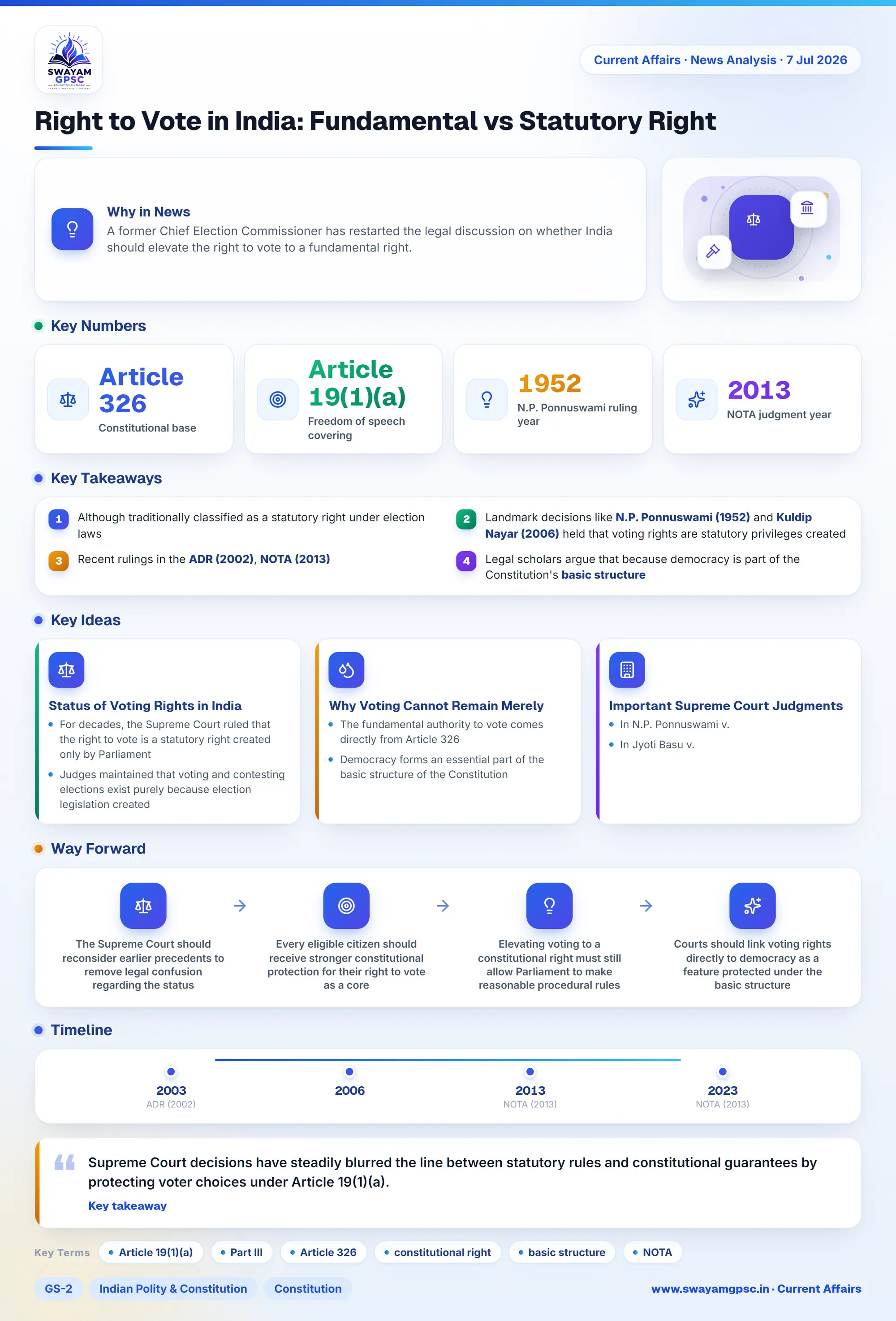
Right to Vote in India: Fundamental vs Statutory Right
#GS-2 #Indian Polity & Constitution #Constitution #Judiciary #Current Events #National #Right to Vote #Fundamental Rights
Key takeaways
- Although traditionally classified as a statutory right under election laws, the right to vote gets its constitutional origin directly from Article 326.
- Landmark decisions like N.P. Ponnuswami (1952) and Kuldip Nayar (2006) held that voting rights are statutory privileges created by Parliament.
- Recent rulings in the ADR (2002), NOTA (2013), and Anoop Baranwal (2023) cases expanded voting rights as protected freedom of expression under Article 19(1)(a).
- Legal scholars argue that because democracy is part of the Constitution's basic structure, the right to vote must be elevated to a fundamental constitutional right.
Why in News
- A former Chief Election Commissioner has restarted the legal discussion on whether India should elevate the right to vote to a fundamental right.
- Courts currently treat voting as a statutory right, but the Supreme Court has protected key parts like informed choice, ballot secrecy, and NOTA under Article 19(1)(a).
Status of Voting Rights in India
- For decades, the Supreme Court ruled that the right to vote is a statutory right created only by Parliament through ordinary laws.
- Judges maintained that voting and contesting elections exist purely because election legislation created these options.
- Because voting is not listed under Part III of the Constitution, Parliament retains full power to set qualifications and disqualifications.
- Article 326 serves as the core constitutional foundation by guaranteeing universal adult suffrage for Lok Sabha and state assembly elections.
- Recent Supreme Court decisions show a clear shift toward recognizing voting as a fundamental constitutional right.
Why Voting Cannot Remain Merely a Statutory Right
- The fundamental authority to vote comes directly from Article 326, while acts like the Representation of the People Acts only set procedural rules.
- Democracy forms an essential part of the basic structure of the Constitution, which requires constitutional protection for voters.
- The Supreme Court protects the right to reject candidates through NOTA under Article 19(1)(a), so denying similar status to choosing candidates creates an obvious logical contradiction.
- Voting is the main process through which We, the People exercise sovereign power and hold elected governments accountable.
- Removing eligible citizens wrongfully from voter rolls damages a constitutional entitlement rather than revoking a simple statutory privilege.
Important Supreme Court Judgments
- In N.P. Ponnuswami v. Returning Officer (1952), the Supreme Court held that voting and contesting elections are statutory rights created by parliament.
- In Jyoti Basu v. Debi Ghosal (1982), the court reaffirmed that electoral rights come from legislation rather than fundamental constitutional guarantees.
- In Kuldip Nayar v. Union of India (2006), a Constitution Bench stated that while democracy is part of the basic structure, individual voting rights depend on statutes.
- In the ADR (2002) and PUCL (2003) cases, the court recognized a voter's fundamental right under Article 19(1)(a) to know candidate background details.
- In the NOTA (2013) and Anoop Baranwal (2023) rulings, the court protected candidate rejection as political speech and highlighted voting as a constitutional right.
Way Forward
- The Supreme Court should reconsider earlier precedents to remove legal confusion regarding the status of voting rights.
- Every eligible citizen should receive stronger constitutional protection for their right to vote as a core democratic guarantee.
- Elevating voting to a constitutional right must still allow Parliament to make reasonable procedural rules for elections.
- Courts should link voting rights directly to democracy as a feature protected under the basic structure of the Constitution.
- Legal interpretations should view citizens as active participants who drive democracy rather than mere users of election statutes.
Conclusion
- Supreme Court decisions have steadily blurred the line between statutory rules and constitutional guarantees by protecting voter choices under Article 19(1)(a).
- The judiciary should now clear this legal paradox by formally declaring the right to choose candidates a fundamental constitutional right.