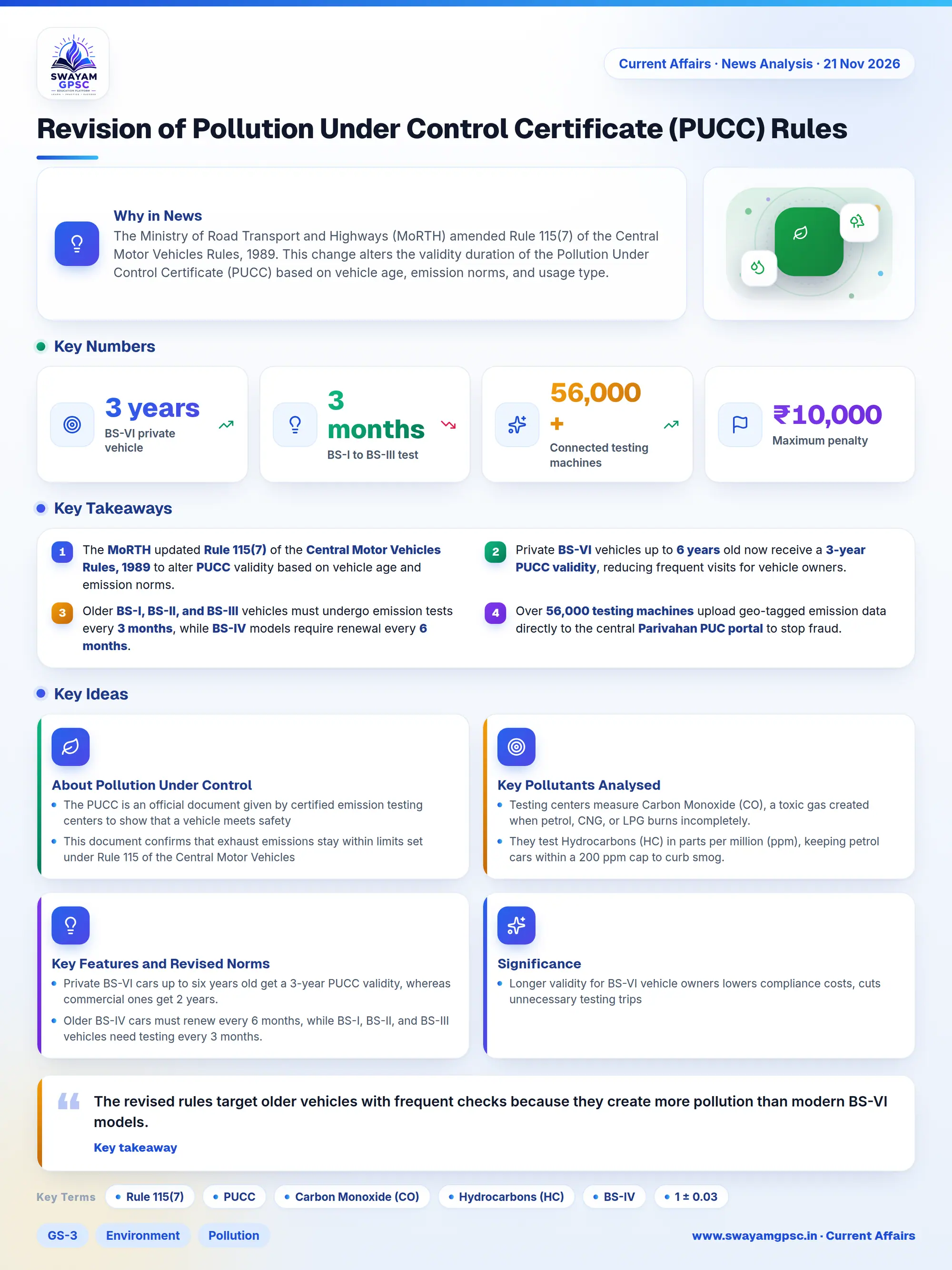
Revision of Pollution Under Control Certificate (PUCC) Rules
#GS-3 #Environment #Pollution #Governance & Social Justice #Regulatory Bodies #Transport Sector #Current Events #National
Key takeaways
- The MoRTH updated Rule 115(7) of the Central Motor Vehicles Rules, 1989 to alter PUCC validity based on vehicle age and emission norms.
- Private BS-VI vehicles up to 6 years old now receive a 3-year PUCC validity, reducing frequent visits for vehicle owners.
- Older BS-I, BS-II, and BS-III vehicles must undergo emission tests every 3 months, while BS-IV models require renewal every 6 months.
- Over 56,000 testing machines upload geo-tagged emission data directly to the central Parivahan PUC portal to stop fraud.
- Fines for driving without a valid certificate are set at ₹1,000 for the first violation and up to ₹10,000 for repeat offences.
Why in News
- The Ministry of Road Transport and Highways (MoRTH) amended Rule 115(7) of the Central Motor Vehicles Rules, 1989.
- This change alters the validity duration of the Pollution Under Control Certificate (PUCC) based on vehicle age, emission norms, and usage type.
About Pollution Under Control Certificate
- The PUCC is an official document given by certified emission testing centers to show that a vehicle meets safety limits.
- This document confirms that exhaust emissions stay within limits set under Rule 115 of the Central Motor Vehicles Rules, 1989.
- The Ministry of Road Transport and Highways (MoRTH) supervises the entire certification process across the country.
- The main objective is to cut vehicle pollution by setting easier rules for new cars and stricter checks for older ones.
Key Pollutants Analysed
- Testing centers measure Carbon Monoxide (CO), a toxic gas created when petrol, CNG, or LPG burns incompletely.
- They test Hydrocarbons (HC) in parts per million (ppm), keeping petrol cars within a 200 ppm cap to curb smog.
- Diesel vehicles undergo smoke density tests for soot, where BS-IV and BS-VI engines must stay below 62 m⁻¹.
- Tests also measure the Lambda (Air-Fuel Equivalence Ratio) at 1 ± 0.03 to ensure catalytic converters run effectively.
Key Features and Revised Norms
- Private BS-VI cars up to six years old get a 3-year PUCC validity, whereas commercial ones get 2 years.
- Older BS-IV cars must renew every 6 months, while BS-I, BS-II, and BS-III vehicles need testing every 3 months.
- Renewing within 10 days before expiry keeps the original renewal date, but late renewals set a new timeline from the test day.
- More than 56,000 testing devices automatically send emission data and photos to the national Parivahan PUC portal.
- Driving without a valid certificate brings a ₹1,000 fine for the first offence and up to ₹10,000 for repeat violations.
Significance
- The revised rules target older vehicles with frequent checks because they create more pollution than modern BS-VI models.
- Longer validity for BS-VI vehicle owners lowers compliance costs, cuts unnecessary testing trips, and standardizes rules nationwide.