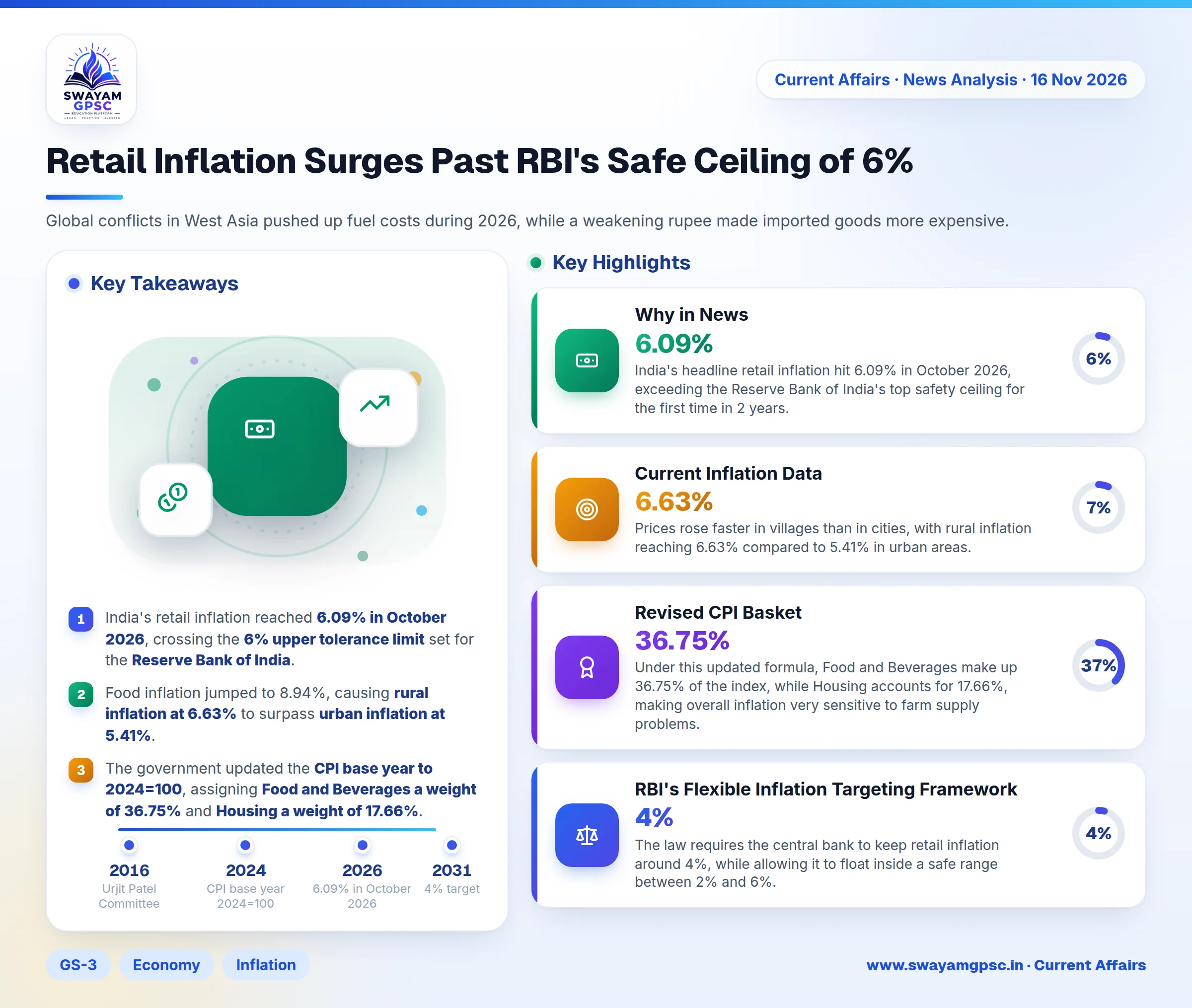
Retail Inflation Surges Past RBI's Safe Ceiling of 6%
#GS-3 #Economy #Inflation #Banking #Monetary Policy #Current Events #National
Key takeaways
- India's retail inflation reached 6.09% in October 2026, crossing the 6% upper tolerance limit set for the Reserve Bank of India.
- Food inflation jumped to 8.94%, causing rural inflation at 6.63% to surpass urban inflation at 5.41%.
- The government updated the CPI base year to 2024=100, assigning Food and Beverages a weight of 36.75% and Housing a weight of 17.66%.
- The government reconfirmed the 4% inflation target with a 2% to 6% tolerance band for the period from 1st April 2026 to 31st March 2031.
- The Monetary Policy Committee responded by increasing the benchmark repo rate by 25 basis points to 5.50% in October 2026.
Why in News
- India's headline retail inflation hit 6.09% in October 2026, exceeding the Reserve Bank of India's top safety ceiling for the first time in 2 years.
- A sudden rise in basic food prices and fuel costs caused most of this price increase.
Current Inflation Data
- Retail inflation measured by the Consumer Price Index (CPI) increased to 6.09%, while food inflation rose sharply to 8.94%.
- Prices rose faster in villages than in cities, with rural inflation reaching 6.63% compared to 5.41% in urban areas.
Key Drivers of Inflation
- High food prices over a long period remain the biggest cause of this inflation spike.
- Global conflicts in West Asia pushed up fuel costs during 2026, while a weakening rupee made imported goods more expensive.
Revised CPI Basket
- The government calculated these figures using the updated CPI base year 2024=100 series.
- Under this updated formula, Food and Beverages make up 36.75% of the index, while Housing accounts for 17.66%, making overall inflation very sensitive to farm supply problems.
RBI's Flexible Inflation Targeting Framework
- India adopted the flexible inflation targeting system in 2016 based on suggestions from the Urjit Patel Committee under Section 45ZA of the RBI Act, 1934.
- The law requires the central bank to keep retail inflation around 4%, while allowing it to float inside a safe range between 2% and 6%.
- The central government extended this exact 4% target and 2% to 6% band for another five years, running from 1st April 2026 to 31st March 2031.
Statutory Accountability Rules
- According to Section 45ZN of the RBI Act, if inflation stays outside the 2% to 6% band for three quarters in a row, the central bank must write an official explanation to the government detailing why it failed and how it plans to fix the issue.
Monetary Policy Action
- The six-member Monetary Policy Committee increased the key interest rate, known as the repo rate, by 25 basis points to 5.50% during October 2026 to slow down price increases.