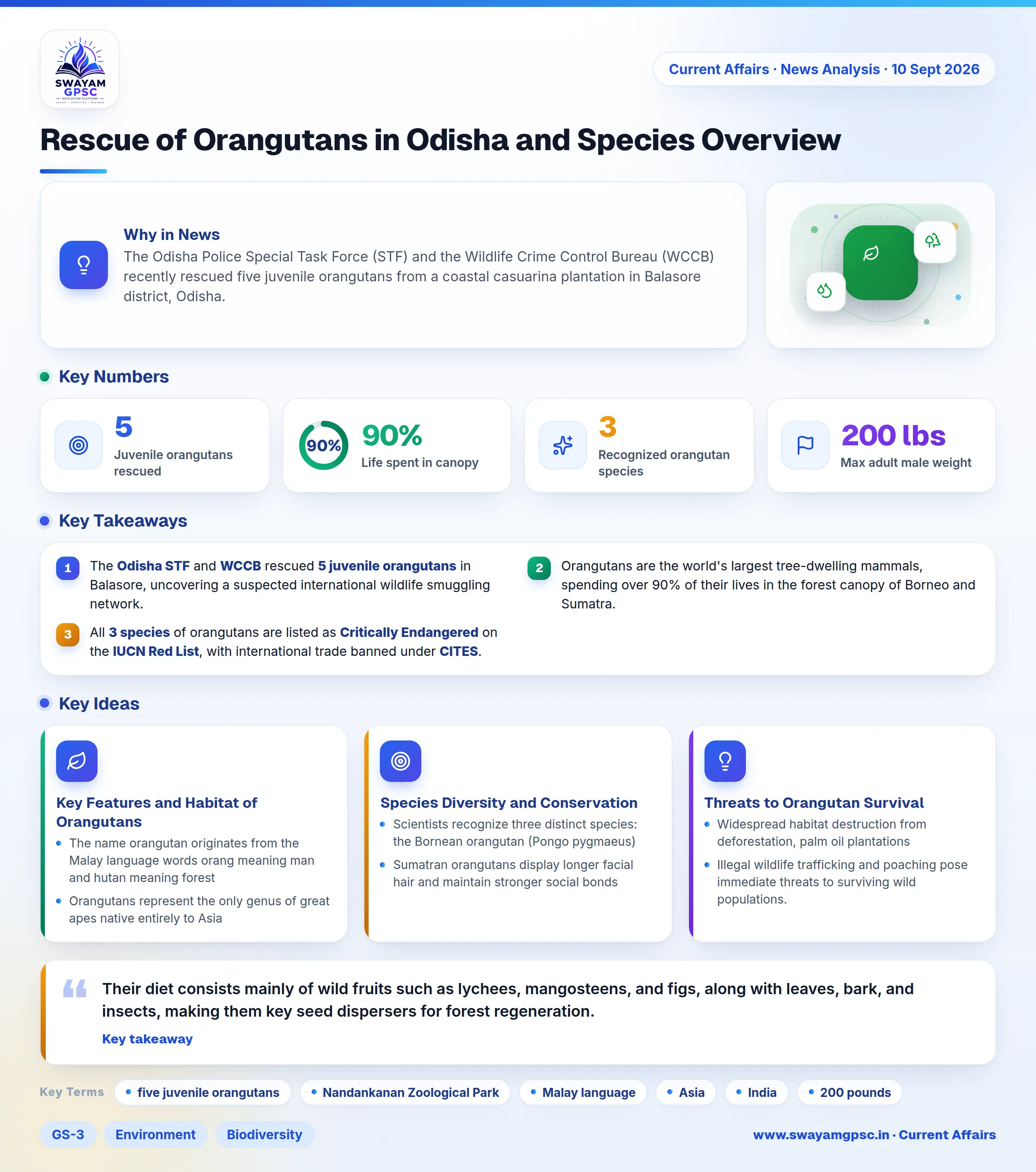
Rescue of Orangutans in Odisha and Species Overview
#GS-3 #Environment #Biodiversity #Wildlife Conservation #CITES #IUCN Red List
Key takeaways
- The Odisha STF and WCCB rescued 5 juvenile orangutans in Balasore, uncovering a suspected international wildlife smuggling network.
- Orangutans are the world's largest tree-dwelling mammals, spending over 90% of their lives in the forest canopy of Borneo and Sumatra.
- All 3 species of orangutans are listed as Critically Endangered on the IUCN Red List, with international trade banned under CITES.
Why in News
- The Odisha Police Special Task Force (STF) and the Wildlife Crime Control Bureau (WCCB) recently rescued five juvenile orangutans from a coastal casuarina plantation in Balasore district, Odisha.
- Officials initiated a joint investigation to probe suspected international wildlife trafficking networks involved in smuggling these primates.
- Authorities shifted the rescued orangutans to Nandankanan Zoological Park in Bhubaneswar and sought required clearances from the Central Zoo Authority (CZA) for their care.
Key Features and Habitat of Orangutans
- The name orangutan originates from the Malay language words orang meaning man and hutan meaning forest, translating to man of the forest.
- Orangutans represent the only genus of great apes native entirely to Asia, belonging scientifically to the genus Pongo.
- These primates do not live naturally in India and exist exclusively in the primary tropical rainforests and lowland peat-swamp forests of Borneo and Sumatra.
- As the world's largest arboreal mammal, orangutans spend over 90% of their life in the high forest canopy, using long muscular arms and hook-like feet for climbing.
- Orangutans lead a solitary or semi-solitary life to avoid competition for food across their extensive home ranges, forming associations mostly during mating.
- Adult males can weigh up to 200 pounds, and dominant flanged males develop distinct cheek pads and throat sacs to produce loud long calls.
- Their diet consists mainly of wild fruits such as lychees, mangosteens, and figs, along with leaves, bark, and insects, making them key seed dispersers for forest regeneration.
- These intelligent primates build fresh sleeping nests daily in trees and actively use sticks and leaves as tools for feeding and self-protection.
Species Diversity and Conservation Status
- Scientists recognize three distinct species: the Bornean orangutan (Pongo pygmaeus), the Sumatran orangutan (Pongo abelii), and the Tapanuli orangutan (Pongo tapanuliensis).
- Sumatran orangutans display longer facial hair and maintain stronger social bonds, while Bornean orangutans travel on the ground more frequently.
- The IUCN Red List classifies all three species as Critically Endangered, with the Tapanuli orangutan recognized as the most threatened great ape species globally.
- International commercial trade in orangutans is strictly prohibited under CITES Appendix I regulations.
Threats to Orangutan Survival
- Widespread habitat destruction from deforestation, palm oil plantations, and mining activities severely fragments rainforest ecosystems.
- Illegal wildlife trafficking and poaching pose immediate threats to surviving wild populations.
- A slow reproductive rate makes population recovery extremely difficult after losses occur.