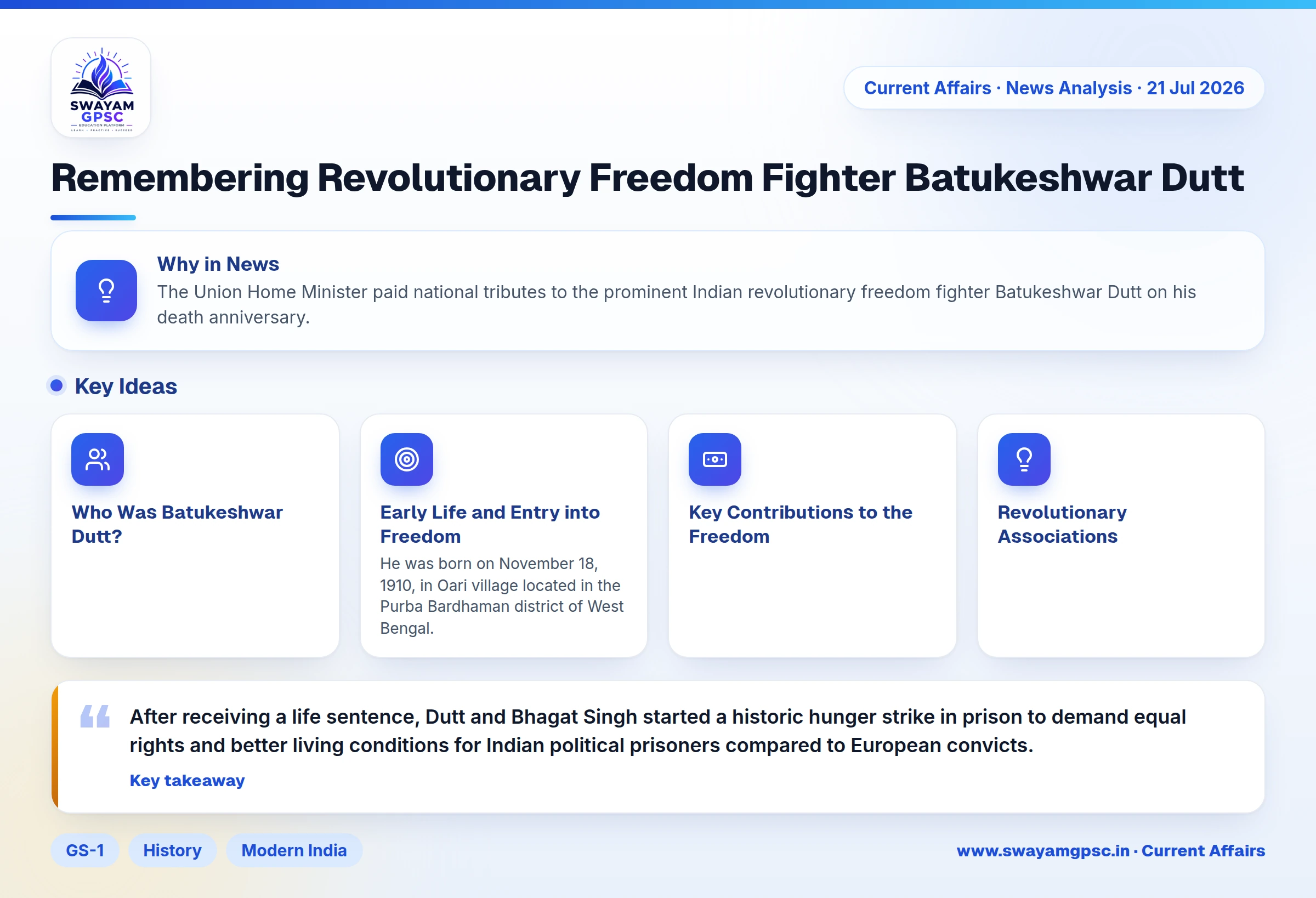
Remembering Revolutionary Freedom Fighter Batukeshwar Dutt
#GS-1 #History #Modern India #Freedom Struggle #GS-3 #Current Events #National #Batukeshwar Dutt #Revolutionary Movement
Why in News
- The Union Home Minister paid national tributes to the prominent Indian revolutionary freedom fighter Batukeshwar Dutt on his death anniversary.
Who Was Batukeshwar Dutt?
- Batukeshwar Dutt, also known as B.K. Dutt, Battu, or Mohan, was a leading Indian socialist revolutionary who executed the historic Central Legislative Assembly bombing in New Delhi alongside Bhagat Singh in 1929 to protest colonial oppression.
Early Life and Entry into Freedom Struggle
- He was born on November 18, 1910, in Oari village located in the Purba Bardhaman district of West Bengal.
- He spent most of his childhood in Kanpur, Uttar Pradesh, where he completed his basic schooling at P.P.N. High School.
- In 1924, Dutt met Bhagat Singh in Kanpur, and under the mentorship of Chandrashekhar Azad, he joined the underground revolutionary movement and learned bomb-making techniques.
Key Contributions to the Freedom Movement
- The British administration introduced two anti-Indian laws, namely the Public Safety Bill and the Trade Disputes Bill, to suppress labor movements and revolutionary activities.
- On April 8, 1929, Dutt and Bhagat Singh threw two low-intensity, non-lethal bombs into empty areas of the Central Assembly in Delhi, scattered anti-imperialist leaflets, and raised the slogan Inquilab Zindabad.
- Both revolutionaries chose not to run away and voluntarily offered themselves for arrest to use colonial courtrooms as a platform to spread their message.
- After receiving a life sentence, Dutt and Bhagat Singh started a historic hunger strike in prison to demand equal rights and better living conditions for Indian political prisoners compared to European convicts.
- Sentenced to life imprisonment in 1929, Dutt was deported to the Cellular Jail in the Andaman Islands, where he faced harsh forced labor and participated in major prison hunger strikes in 1933 and 1937.
- He was released in 1938 after contracting tuberculosis in jail, but he later joined Mahatma Gandhi's Quit India Movement in 1942 and spent four more years in Motihari Jail in Bihar.
Revolutionary Associations
- He was a key leader of the Hindustan Socialist Republican Association (HSRA), working closely with Bhagat Singh, Chandrashekhar Azad, and Sukhdev.
- He was also actively involved in the Naujawan Bharat Sabha, a youth organization established to mobilize workers and students against British colonial rule.
Later Years and Legacy
- After independence in 1947, Batukeshwar Dutt lived quietly with his family in Patna, Bihar, while facing severe financial struggles and official neglect.
- In the 1960s, he developed bone cancer and was admitted to AIIMS Delhi, where he passed away on July 20, 1965, at the age of 54.
- Following his final wish, his last rites were performed at Hussainiwala in Firozpur, Punjab, alongside the memorials of his revolutionary comrades Bhagat Singh, Rajguru, and Sukhdev.