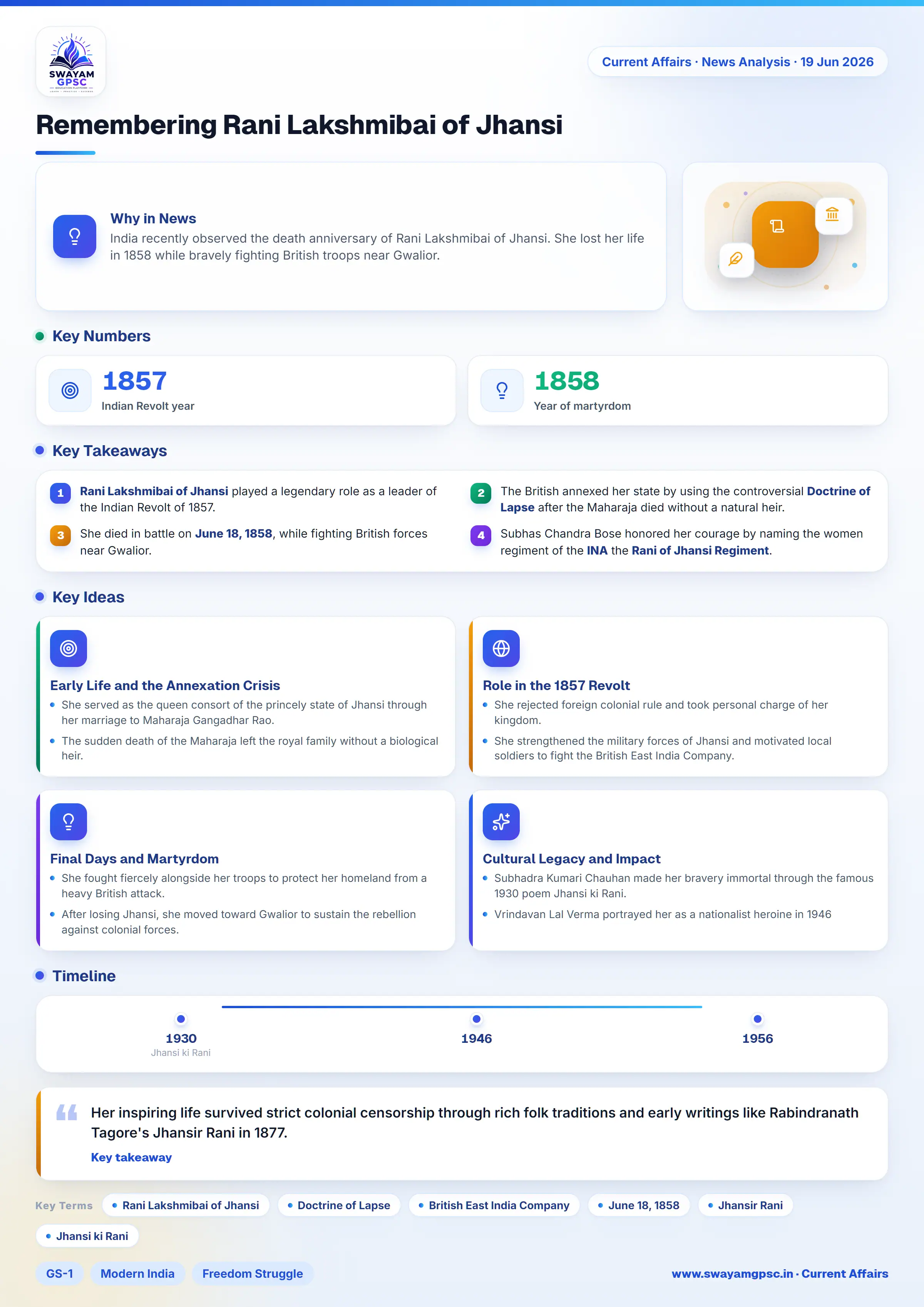
Remembering Rani Lakshmibai of Jhansi
#GS-1 #Modern India #Freedom Struggle #History #Current Events
Key takeaways
- Rani Lakshmibai of Jhansi played a legendary role as a leader of the Indian Revolt of 1857.
- The British annexed her state by using the controversial Doctrine of Lapse after the Maharaja died without a natural heir.
- She died in battle on June 18, 1858, while fighting British forces near Gwalior.
- Subhas Chandra Bose honored her courage by naming the women regiment of the INA the Rani of Jhansi Regiment.
Why in News
- India recently observed the death anniversary of Rani Lakshmibai of Jhansi.
- She lost her life in 1858 while bravely fighting British troops near Gwalior.
Early Life and the Annexation Crisis
- She served as the queen consort of the princely state of Jhansi through her marriage to Maharaja Gangadhar Rao.
- The sudden death of the Maharaja left the royal family without a biological heir.
- To protect their lineage, the royal couple adopted a young prince before the ruler passed away.
- The English East India Company rejected this adoption as part of their aggressive expansion plans.
- The British applied the controversial Doctrine of Lapse to annex Jhansi into British India because the ruler lacked a natural male heir.
Role in the 1857 Revolt
- She rejected foreign colonial rule and took personal charge of her kingdom.
- She strengthened the military forces of Jhansi and motivated local soldiers to fight the British East India Company.
- She stood apart from other rulers who submitted to the British and became a powerful symbol of complete sacrifice.
Final Days and Martyrdom
- She fought fiercely alongside her troops to protect her homeland from a heavy British attack.
- After losing Jhansi, she moved toward Gwalior to sustain the rebellion against colonial forces.
- She died in battle on June 18, 1858, while confronting British cavalry units near Gwalior.
- Historians remember her as a martyr whose sacrifice made her an immortal legend of Indian history.
Cultural Legacy and Impact
- Her inspiring life survived strict colonial censorship through rich folk traditions and early writings like Rabindranath Tagore's Jhansir Rani in 1877.
- Subhadra Kumari Chauhan made her bravery immortal through the famous 1930 poem Jhansi ki Rani.
- Vrindavan Lal Verma portrayed her as a nationalist heroine in 1946, while Mahasweta Devi explored folk accounts in 1956.
- Subhas Chandra Bose honored her memory during World War II by naming the all-women combat unit of the INA the Rani of Jhansi Regiment.