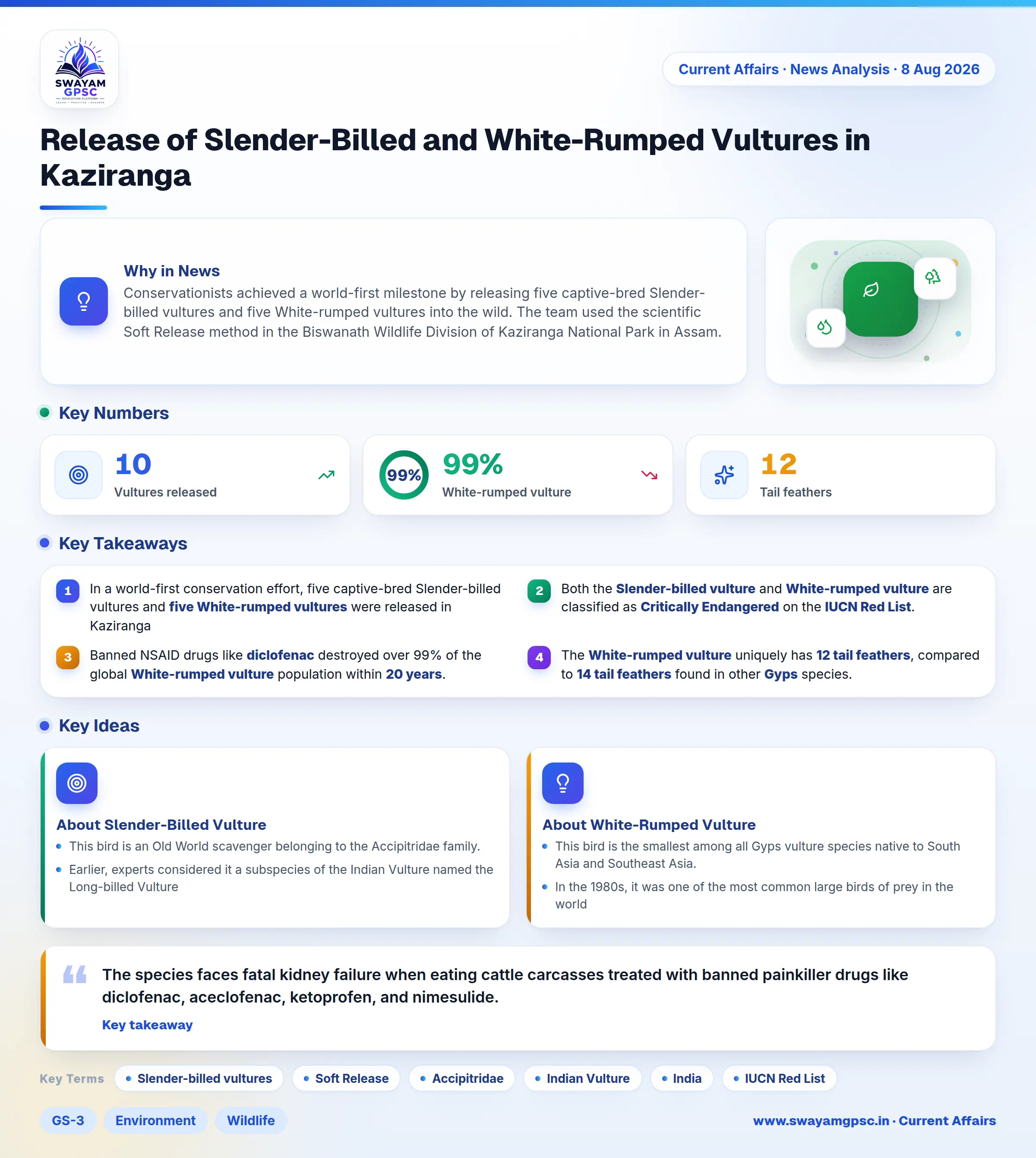
Release of Slender-Billed and White-Rumped Vultures in Kaziranga
#GS-3 #Environment #Wildlife #Biodiversity #Current Events #National #Vulture Conservation
Key takeaways
- In a world-first conservation effort, five captive-bred Slender-billed vultures and five White-rumped vultures were released in Kaziranga National Park, Assam.
- Both the Slender-billed vulture and White-rumped vulture are classified as Critically Endangered on the IUCN Red List.
- Banned NSAID drugs like diclofenac destroyed over 99% of the global White-rumped vulture population within 20 years.
- The White-rumped vulture uniquely has 12 tail feathers, compared to 14 tail feathers found in other Gyps species.
Why in News
- Conservationists achieved a world-first milestone by releasing five captive-bred Slender-billed vultures and five White-rumped vultures into the wild.
- The team used the scientific Soft Release method in the Biswanath Wildlife Division of Kaziranga National Park in Assam.
About Slender-Billed Vulture
- This bird is an Old World scavenger belonging to the Accipitridae family.
- Earlier, experts considered it a subspecies of the Indian Vulture named the Long-billed Vulture, but today it is classified as a distinct species across South Asia and Southeast Asia.
- It prefers savannas, dry open lands, dry deciduous forests, and river valleys at lower elevations.
- It avoids crowded human towns, but it occasionally visits slaughterhouses and garbage dumps to find food.
- Its natural population lives in sub-Himalayan regions across India (mainly Assam), Nepal, Bangladesh, Myanmar, and Cambodia.
- The IUCN Red List classifies the Slender-billed vulture as Critically Endangered.
- This medium-to-large scavenger measures 77-103 cm in length and has a wingspan of 196-258 cm.
- It features an unfeathered, narrow, long black head and a skinny black neck, which gives it a messy look.
- Its sharp, shiny, slender bill helps it feed deep inside animal carcasses.
- Dark brown, light brown, and beige feathers cover its body, while cream-colored feathers on its legs show clearly during flight.
About White-Rumped Vulture
- This bird is the smallest among all Gyps vulture species native to South Asia and Southeast Asia.
- In the 1980s, it was one of the most common large birds of prey in the world, but toxic veterinary drugs destroyed over 99% of its population in just 20 years.
- It adapts well to open grasslands, open forests, and farmlands, and it easily lives near towns and slaughterhouse grounds.
- Resident populations still survive in northern and central India, Pakistan, Nepal, Bangladesh, and small parts of Southeast Asia.
- The IUCN Red List classifies the White-rumped vulture as Critically Endangered.
- It measures 75-93 cm in length, weighs 3.5-6 kg, and has a wingspan of 1.92-2.13 meters.
- It has a bright white patch on its lower back and underwing coverts, which is easy to spot when flying or stretching.
- Adult birds have dark body feathers with a soft, white downy collar around the base of the neck.
- It has 12 tail feathers, whereas most other Gyps vulture species have 14 tail feathers.
- The species faces fatal kidney failure when eating cattle carcasses treated with banned painkiller drugs like diclofenac, aceclofenac, ketoprofen, and nimesulide.