Reimagining Caregiving in India: NITI Aayog Report
#GS-2 #Governance & Social Justice #Health #GS-3 #Economy #Employment #Current Events #National
Key takeaways
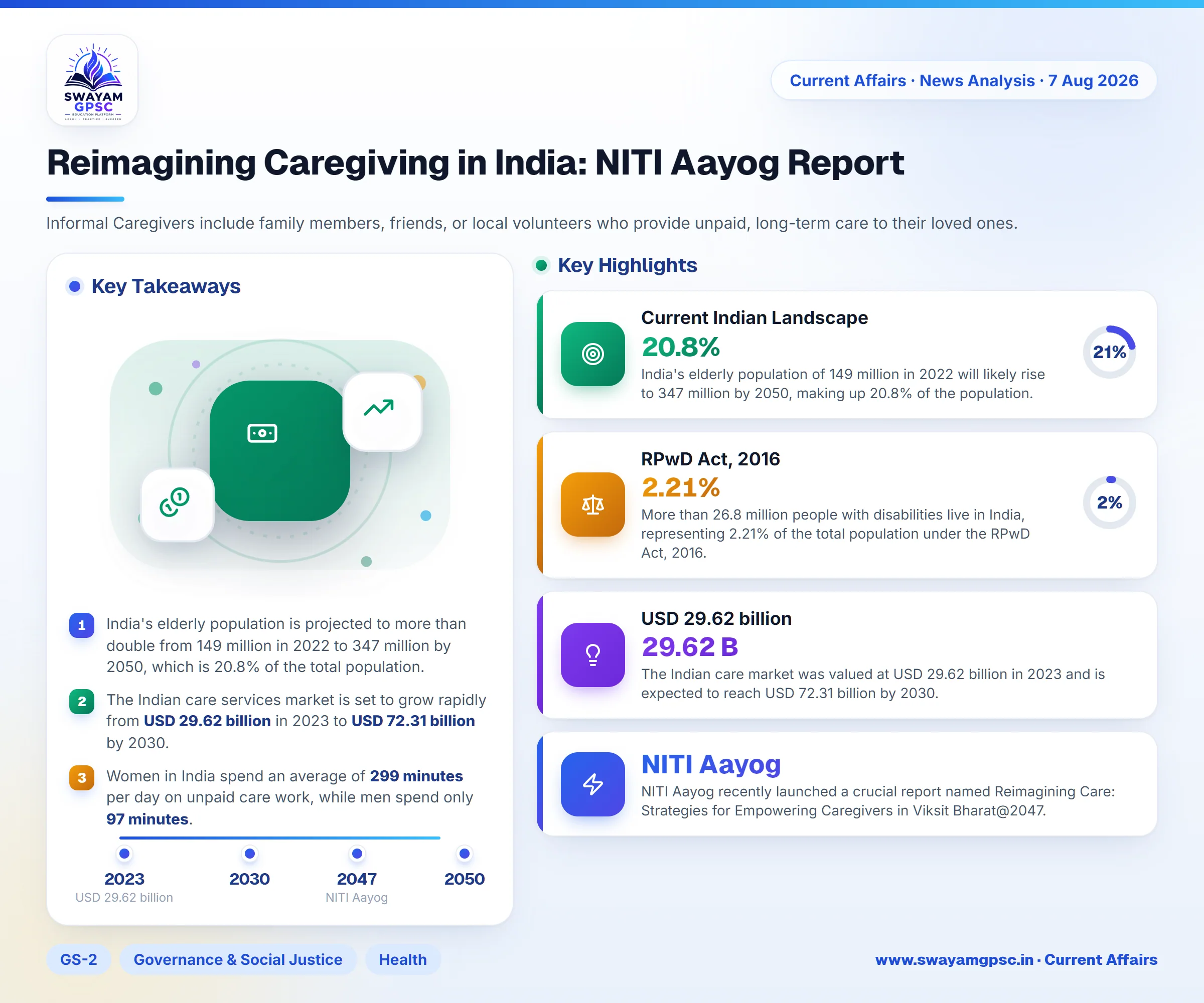
- India's elderly population is projected to more than double from 149 million in 2022 to 347 million by 2050, which is 20.8% of the total population.
- The Indian care services market is set to grow rapidly from USD 29.62 billion in 2023 to USD 72.31 billion by 2030.
- Women in India spend an average of 299 minutes per day on unpaid care work, while men spend only 97 minutes.
- NITI Aayog has recommended setting up a National Caregiver Council under the Ministry of Social Justice and Empowerment to regulate training and standards.
Why in News
- NITI Aayog recently launched a crucial report named Reimagining Care: Strategies for Empowering Caregivers in Viksit Bharat@2047.
- This report highlights the urgent need to support people who take care of the elderly, sick, and disabled.
Understanding Caregivers
- According to the World Health Organization (WHO), caregivers are people who assist those unable to perform daily activities due to age, illness, or disability.
- Formal Caregivers are trained professionals like home health aides and geriatric assistants who get paid for their services in homes or hospitals.
- Informal Caregivers include family members, friends, or local volunteers who provide unpaid, long-term care to their loved ones.
Current Indian Landscape
- India's elderly population of 149 million in 2022 will likely rise to 347 million by 2050, making up 20.8% of the population.
- More than 26.8 million people with disabilities live in India, representing 2.21% of the total population under the RPwD Act, 2016.
- The Time Use Survey reveals that Indian women spend 299 minutes daily on unpaid care, whereas men spend only 97 minutes.
- The Indian care market was valued at USD 29.62 billion in 2023 and is expected to reach USD 72.31 billion by 2030.
Types of Caregivers in India
- Family-Based Informal Caregivers are relatives who look after family members without any pay, forming the core of India's social structure.
- Community-Based Informal Caregivers are local volunteers and Self-Help Groups, such as Kerala's Neighbourhood Network in Palliative Care or Kudumbashree's K4 Care.
- Institutional Formal Caregivers are trained staff working full-time in old-age homes, rehab centers, and specialized hospital wards.
- Home-Based and Specialized Palliative Caregivers are paid professionals who offer bedside support, dementia care, and chronic illness management directly at home.
Best Global Practices
- Japan introduced mandatory Long-Term Care Insurance in 2000 and uses the Specified Skilled Worker Visa to bring in foreign caregivers.
- Germany uses a dual-financing model under its Familienpflegezeitgesetz law, which allows up to 24 months of protected leave for family carers.
- China created an eight-level national certification system, removed formal education barriers for rural workers, and set standards for eldercare robots.
Challenges
- India lacks a single apex body to coordinate caregiving efforts across various ministries like health, labor, and skill development.
- Training courses for caregiving are not standardized, which means they lack international recognition in major destination countries.
- Formal caregivers do not have proper social security under laws like the Unorganised Workers Social Security Act, leading to low wages and exploitation.
- Managing complex mental conditions like dementia causes severe emotional exhaustion and high turnover rates among caregivers.
- Young people moving from villages to cities leaves the elderly without traditional family support networks.
Way Forward
- India should set up a National Caregiver Council under the Ministry of Social Justice and Empowerment to regulate and standardize training.
- The government must create a National Policy on Caregiving to recognize this field as an allied health profession with fair minimum wages.
- All caregiving courses should align with the National Skills Qualification Framework (NSQF) and offer certification for informal family carers.
- The Ministry of External Affairs should expand government-to-government agreements, like the India-Germany Triple Win, to help trained caregivers work abroad.
- Employers should offer formal care leave, while communities should build respite centers and integrate care with Ayushman Arogya Mandirs.