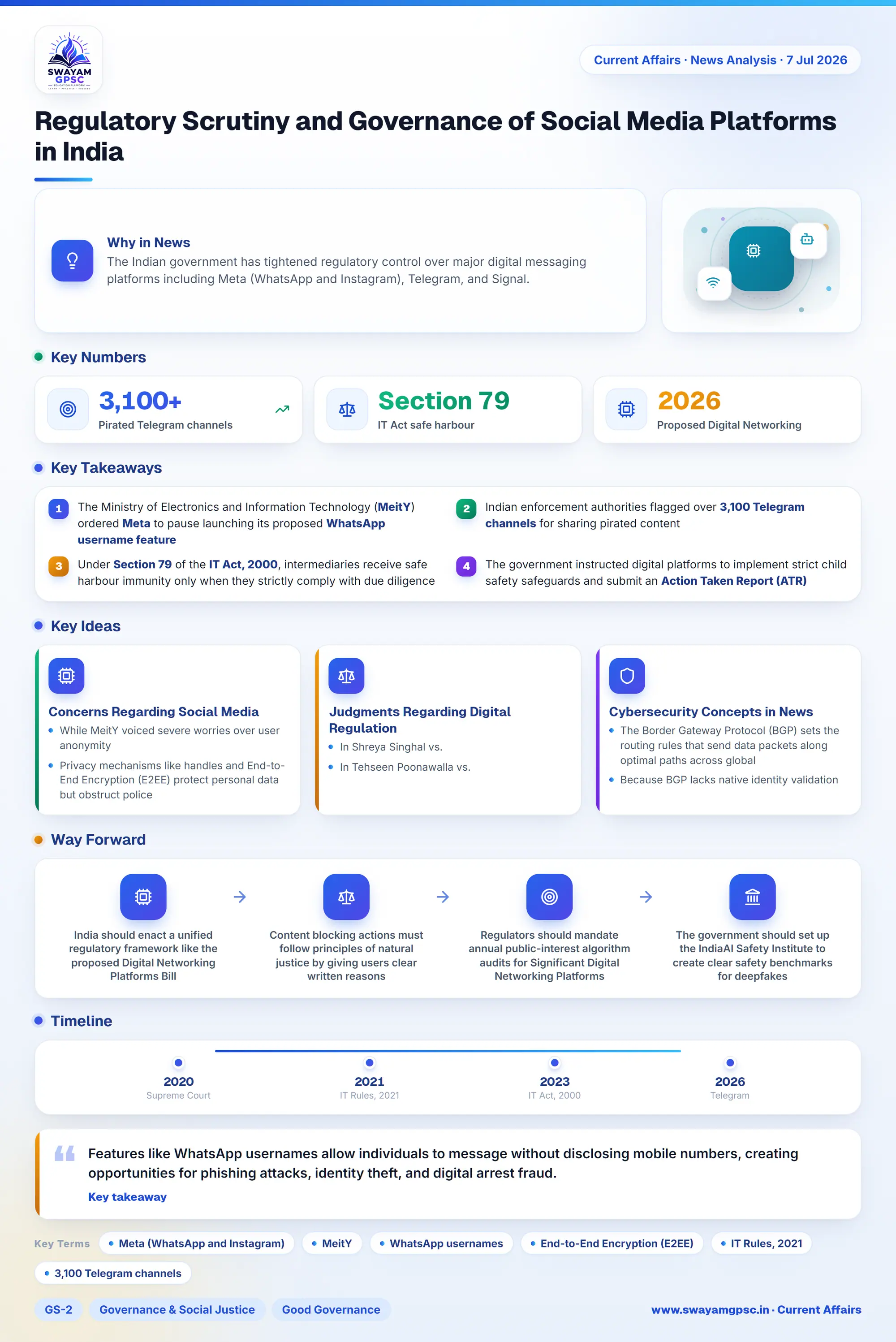
Regulatory Scrutiny and Governance of Social Media Platforms in India
#GS-2 #Governance & Social Justice #Good Governance #E-Governance #GS-3 #Science & Technology #Artificial Intelligence #ICT #Cyber Security #Current Events #National #Government Policies & Interventions #Social Media
Key takeaways
- The Ministry of Electronics and Information Technology (MeitY) ordered Meta to pause launching its proposed WhatsApp username feature over user traceability and cyber fraud risks.
- Indian enforcement authorities flagged over 3,100 Telegram channels for sharing pirated content, asking the app to deploy automated detection tools.
- Under Section 79 of the IT Act, 2000, intermediaries receive safe harbour immunity only when they strictly comply with due diligence obligations set in IT Rules, 2021.
- The government instructed digital platforms to implement strict child safety safeguards and submit an Action Taken Report (ATR) under the POCSO Act, 2012.
Why in News
- The Indian government has tightened regulatory control over major digital messaging platforms including Meta (WhatsApp and Instagram), Telegram, and Signal.
- The Ministry of Electronics and Information Technology (MeitY) issued an official directive to Meta demanding an immediate pause on rolling out the WhatsApp username feature in India.
- These governmental enforcement measures target urgent risks such as digital impersonation scams, online movie piracy, deepfake harms, and Child Sexual Exploitation and Abuse Material (CSEAM).
- These policy moves have renewed national debates regarding intermediary liability, algorithmic accountability, individual privacy, and mandatory user traceability.
Concerns Regarding Social Media Platforms
- Features like WhatsApp usernames allow individuals to message without disclosing mobile numbers, creating opportunities for phishing attacks, identity theft, and digital arrest fraud.
- While MeitY voiced severe worries over user anonymity, Meta claims phone numbers will stay linked behind the scenes and handle reservations will safeguard public figures.
- Privacy mechanisms like handles and End-to-End Encryption (E2EE) protect personal data but obstruct police investigations under Section 66C and Section 66D of the IT Act, 2000.
- The central government classified WhatsApp as a Significant Social Media Intermediary (SSMI), placing strict statutory compliance obligations on the platform under IT Rules, 2021.
- Law enforcement authorities uncovered more than 3,100 Telegram channels distributing copyrighted films, proving that traditional notice-and-takedown models fail to stop rapid re-uploads.
- Commercial movie piracy remains a punishable offense under provisions of the Copyright Act, 1957 and the Cinematograph Act, 1952.
- The government directed Telegram to install automated monitoring tools that proactively block copyrighted media instead of relying on delayed post-flagging takedowns.
- Authorities temporarily blocked Telegram using Section 69A of the IT Act, 2000 during the NEET-UG 2026 re-exam because bad actors used it for paper leaks.
- Under Section 79 of the IT Act, 2000, platforms lose safe harbour legal protection if they fail to perform mandatory due diligence against illegal content.
- Investigations revealed that paid Instagram advertisements promoted illegal access to child abuse material and redirected users toward private Telegram groups.
- Organized criminal groups manipulate social media recommendation algorithms to distribute illegal content, exposing huge flaws in automated moderation filters.
- Distributing explicit child exploitation material violates children's constitutional rights, provisions of the POCSO Act, 2012, the IT Act, 2000, and the UNCRC.
- The Union government ordered Meta to eliminate all child exploitation content immediately and file an Action Taken Report (ATR).
- Generative AI tools produce deepfakes, voice clones, and synthetic non-consensual images that threaten individual privacy, democratic elections, and public trust.
- Modern digital platforms use active recommendation algorithms that highlight misleading news, fraudulent offers, and inflammatory viral posts that have triggered communal riots.
- Cross-border operations of platforms like WhatsApp, Telegram, and Instagram make collecting electronic evidence and prosecuting international cybercriminals exceptionally difficult.
Judgments Regarding Digital Regulation
- In Shreya Singhal vs. Union of India (2015), the Supreme Court upheld Section 69A of the IT Act, 2000 because it contains procedural checks like written orders.
- In Tehseen Poonawalla vs. Union of India (2018), the Supreme Court directed state governments to curb fake news on messaging apps that incites mob violence.
- In Anuradha Bhasin vs. Union of India (2020), the Supreme Court declared online speech and internet-based trade as protected fundamental rights under Article 19.
- In Ajit Mohan vs. Delhi Legislative Assembly (2021), the Supreme Court observed that platforms like Meta act as powerful gatekeepers that actively shape public opinion.
Cybersecurity Concepts in News
- The Border Gateway Protocol (BGP) sets the routing rules that send data packets along optimal paths across global autonomous internet networks.
- Because BGP lacks native identity validation, hackers can execute BGP hijacking to intercept or reroute user web traffic.
- The Resource Public Key Infrastructure (RPKI) functions as a cryptographic identity system that seals and verifies BGP routing announcements.
- In DNS Hijacking, cybercriminals alter domain registry records to quietly redirect visitors from legitimate websites to fake phishing pages.
- A Zero Trust Architecture (ZTA) works on the principle 'Never Trust, Always Verify', demanding strict identity verification for every user and device.
- The term Splinternet describes how the global open internet is breaking apart into localized, government-controlled national networks.
Challenges in Regulating Social Media Platforms
- Algorithmic content recommendations make it difficult to decide whether a platform is a neutral intermediary under Section 79 or an active publisher.
- India lacks preventive risk-based regulations, relying instead on delayed reactive notices after harmful content or AI deepfakes spread widely.
- Fact-checking mechanisms like the PIB Fact Check Unit identify government misinformation only after viral posts have already reached millions.
- Recommendation engines and moderation bots run on opaque black-box algorithms that prevent independent technical audits and external accountability.
- Digital companies must navigate overlapping regulations across the IT Act, 2000, DPDP Act, 2023, Copyright Act, 1957, POCSO Act, 2012, and Competition Act, 2002.
- Regulators struggle to protect fundamental privacy rights under Article 21 and free speech under Article 19(1)(a) while tackling serious national security threats.
- Enforcement agencies face a shortage of trained experts in AI auditing, digital forensics, reverse engineering, and advanced cryptography.
- Unlike the EU's Digital Services Act (DSA) and Digital Markets Act (DMA), India lacks a unified statute dedicated specifically to digital platforms.
Way Forward
- India should enact a unified regulatory framework like the proposed Digital Networking Platforms Bill, 2026 instead of patching two-decade-old laws.
- Content blocking actions must follow principles of natural justice by giving users clear written reasons and access to formal appeal channels.
- Regulators should mandate annual public-interest algorithm audits for Significant Digital Networking Platforms to evaluate their societal impact.
- The government should set up the IndiaAI Safety Institute to create clear safety benchmarks for deepfakes and generative AI under the IndiaAI Mission.
- Authorities should establish court-monitored message origin mechanisms for terror and child abuse cases without compromising End-to-End Encryption (E2EE) for normal users.
- Platforms must implement Safety-by-Design principles, automated abuse filters, and fast takedown response times under the POCSO Act, 2012 and IT Rules, 2021.
Prelims in Focus: WhatsApp Username Feature
- The proposed WhatsApp username feature is an optional privacy control that lets people start chats using text handles instead of disclosing personal phone numbers.
- To prevent misuse, WhatsApp will not host any public searchable handle directory, meaning users must know the exact handle to send a message.
- Users can secure their handle with a custom PIN that blocks unsolicited chats even if an unknown person correctly guesses their username.
- To prevent brand fraud and fake accounts, Meta reserved handles matching verified public figures, government bodies, and celebrities.
- Messages sent from unknown handles will show the sender's country of origin and confirm that the person is not saved in contacts.
- Misusing handles for online identity theft or digital impersonation attracts criminal penalties under Section 66C and Section 66D of the IT Act, 2000.
- Under Rule 3(1)(b), Rule 3(2), and Rule 4 of the IT Rules, 2021, messaging platforms must curb deceptive profiles and trace first originators when legally ordered.
- The government claims that tools reducing account traceability increase cyber fraud risks and could forfeit safe harbour immunities under Section 79 of the IT Act, 2000.
- Digital rights advocates argue that Section 79 only limits legal liability for user posts and does not give MeitY legal power to block new app features before launch.