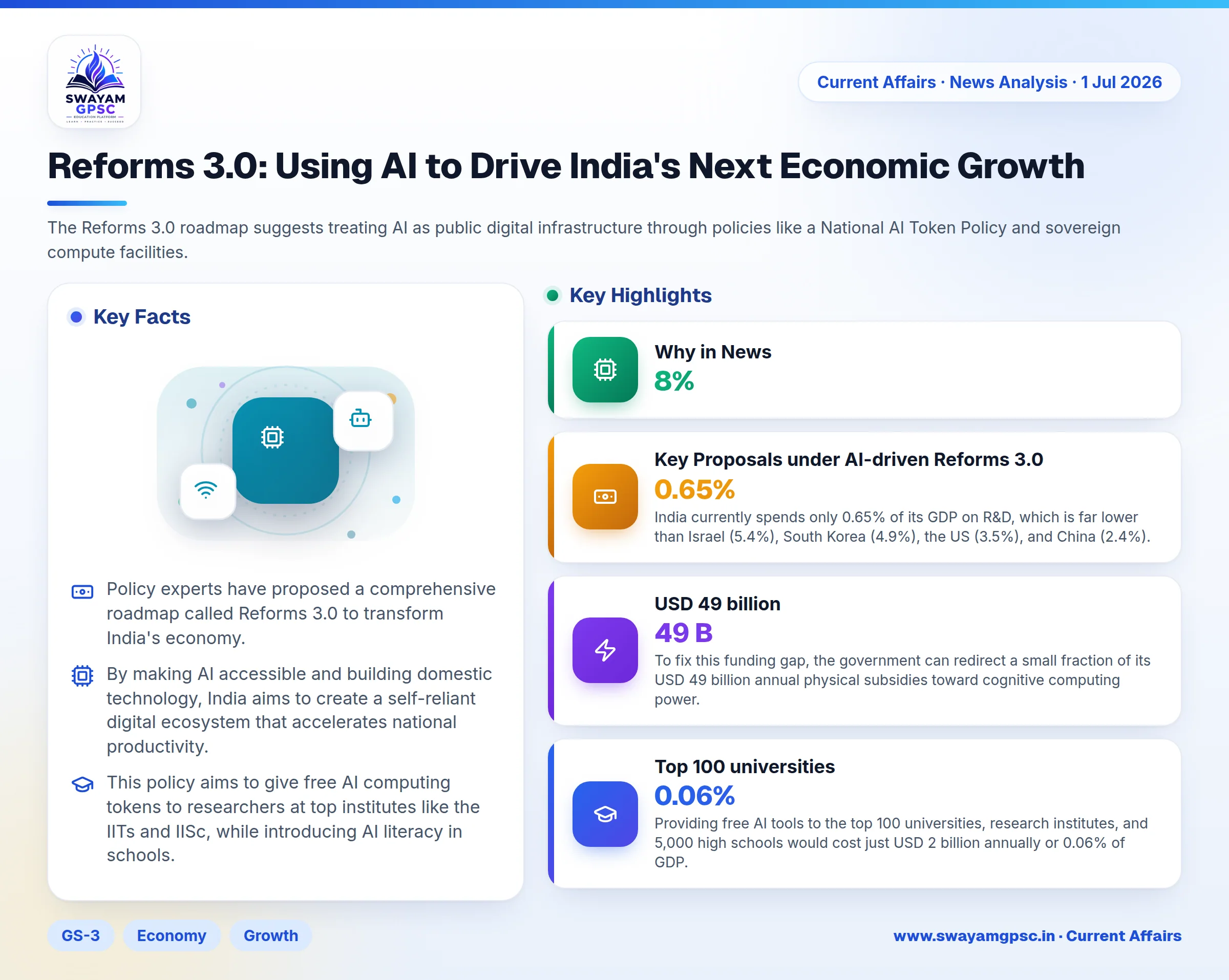
Reforms 3.0: Using AI to Drive India's Next Economic Growth
#GS-3 #Economy #Growth #Science & Technology #Artificial Intelligence #Infrastructure #Current Events #National
Why in News
- Policy experts have proposed a comprehensive roadmap called Reforms 3.0 to transform India's economy.
- This proposal positions Artificial Intelligence as a core public digital infrastructure to help India achieve a sustained Bharat Rate of Growth of over 8% over the next decade.
Executive Summary
- The Reforms 3.0 roadmap suggests treating AI as public digital infrastructure through policies like a National AI Token Policy and sovereign compute facilities.
- By making AI accessible and building domestic technology, India aims to create a self-reliant digital ecosystem that accelerates national productivity.
Key Proposals under AI-driven Reforms 3.0
- India should establish a National AI Token Policy over the next 24 months by creating public-private partnerships with global technology companies like AWS, Google, and Microsoft.
- This policy aims to give free AI computing tokens to researchers at top institutes like the IITs and IISc, while introducing AI literacy in schools.
- India currently spends only 0.65% of its GDP on R&D, which is far lower than Israel (5.4%), South Korea (4.9%), the US (3.5%), and China (2.4%).
- To fix this funding gap, the government can redirect a small fraction of its USD 49 billion annual physical subsidies toward cognitive computing power.
- Providing free AI tools to the top 100 universities, research institutes, and 5,000 high schools would cost just USD 2 billion annually or 0.06% of GDP.
- India must host open-source AI models like Llama and domestic models like Sarvam on local servers to prevent total reliance on foreign platforms.
- The country needs to treat domestic AI infrastructure as a critical strategic asset, similar to its national space and nuclear programs.
- National scale AI hosting requires building servers with 99.99% uptime, extremely low latency for smaller cities, and strong data security.
- Relying on a single hardware supplier creates high costs, so India should diversify its hardware suppliers.
- Experts recommend a 40:30:30 hardware matrix using 40% AWS Trainium, 30% Google Tensor Processing Units (TPUs), and 30% NVIDIA Graphics Processing Units (GPUs).
- India can use its vast 1.4-billion-user market as leverage when negotiating terms with global technology firms.
- The state can negotiate lower cloud costs for public institutions in exchange for offering land, power, and simple regulatory pathways to tech firms.
- Paid plans for enterprise clients can help cover the operational costs of offering free AI access to students and researchers.
- Developing specialized AI models in all 22 Scheduled Languages will ensure technology benefits local courts, clinics, and farming communities.
Bharat Rate of Growth
- For nearly 45 years after independence, India recorded a slow economic expansion known as the Hindu rate of growth (averaging 3.5% to 4%).
- The Reforms 1.0 (1991) initiative opened up the economy through market liberalization and structural economic changes.
- The Reforms 2.0 era built strong digital systems, highlighted by the Unified Payments Interface (UPI) and cheap mobile data.
- The proposed Reforms 3.0 focuses on cognitive digital infrastructure to help India cross a continuous economic growth rate of 8% or more.
Challenges to AI-driven Reforms 3.0
- Large AI data centers require up to 10 times more electricity than standard servers, putting pressure on power grids and Panchamrit commitments (Net Zero by 2070).
- India lacks domestic factories for advanced computer chips, leaving the country dependent on global suppliers like TSMC and vulnerable to export controls.
- Shifting public funds away from conventional welfare subsidies to computing power can trigger political friction and public disagreement.
- Current AI models require more processing power to read Indian languages compared to English, creating an added cost barrier for non-English speakers.
- India lacks a complete regulatory safety system to govern complex AI models, resolve copyright issues, and enforce the Digital Personal Data Protection (DPDP) Act, 2023.
- Providing fast AI tools to smaller towns requires strong digital connections, but rural areas still face uneven coverage from BharatNet and 5G networks.
Foundational Initiatives by India
- The government established the IndiaAI Mission to support national computing capacity and AI startup development.
- The India Semiconductor Mission (ISM) promotes local microchip manufacturing and electronics design.
- The National Supercomputing Mission (NSM) connects high-performance research computers across educational institutions.
- The BHASHINI project builds digital language translation systems across Indian languages.
- India continues to expand its Digital Public Infrastructure (DPI) to deliver essential civic and financial services.
Way Forward and Conclusion
- The government should focus on creating smart regulations rather than just funding projects directly, similar to how telecom reforms encouraged private growth.
- Combining stable economic policies with strong domestic tech talent will help launch thousands of new AI startups and secure long-term economic growth.
Frequently Asked Questions
- A National AI Token Policy is a plan to provide free or subsidized computing credits to researchers and educational institutions.
- Sovereign AI infrastructure allows a country to store data locally and run AI systems independently without relying on foreign technology providers.
- Diversifying hardware options prevents supplier dependence, controls operational expenses, and ensures a stable technology supply chain.
- The main obstacles to national AI adoption include high energy consumption, semiconductor chip shortages, regulatory gaps, and infrastructure limits.
- Public-private partnerships combine government resources with private technical skills to build accessible computing systems for public benefit.