Reforming India's Insurance Sector
#GS-3 #Economy #Mobilization of Resources #GS-2 #Government Policies & Interventions #Welfare Schemes #Issues Related to Elderly #Infrastructure
Key takeaways
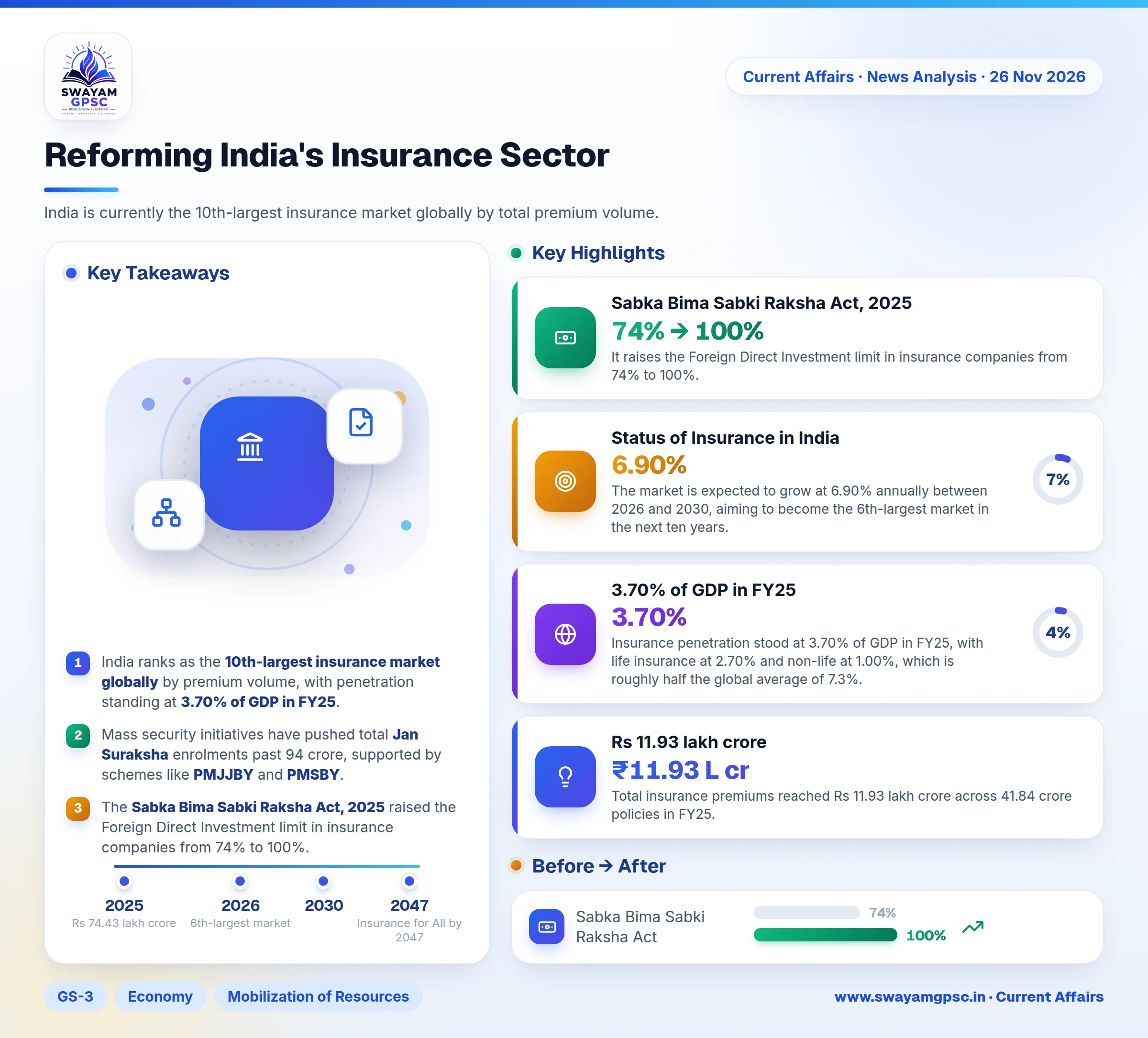
- India ranks as the 10th-largest insurance market globally by premium volume, with penetration standing at 3.70% of GDP in FY25.
- Mass security initiatives have pushed total Jan Suraksha enrolments past 94 crore, supported by schemes like PMJJBY and PMSBY.
- The Sabka Bima Sabki Raksha Act, 2025 raised the Foreign Direct Investment limit in insurance companies from 74% to 100%.
- Out-of-pocket health expenditure dropped significantly from 64.2% in FY14 to 42.7% in FY24 due to government-backed health reforms.
Why in News
- Experts have requested a policy reset for the Pradhan Mantri Jeevan Jyoti Bima Yojana (PMJJBY) and the Pradhan Mantri Suraksha Bima Yojana (PMSBY).
- They pointed out serious problems in India's mass insurance coverage like rising policy cancellations, outdated sum assured values due to inflation, and weak renewal systems.
Summary
- Government schemes like PMJJBY, PMSBY, and Atal Pension Yojana (APY) have improved financial inclusion and social security for low-income families, women, and informal sector workers.
- Low insurance spread, increasing policy lapses, outdated coverage values, and slow claim settlements show the urgent need for better rules, affordable plans, and smoother renewal systems to reach Insurance for All by 2047.
Status of Insurance in India
- India is currently the 10th-largest insurance market globally by total premium volume.
- The market is expected to grow at 6.90% annually between 2026 and 2030, aiming to become the 6th-largest market in the next ten years.
- Insurance penetration stood at 3.70% of GDP in FY25, with life insurance at 2.70% and non-life at 1.00%, which is roughly half the global average of 7.3%.
- Insurance density went up slightly from USD 95 in FY24 to USD 97 per capita in FY25, divided into USD 72 for life and USD 25 for non-life.
- Total insurance premiums reached Rs 11.93 lakh crore across 41.84 crore policies in FY25.
- Total Assets Under Management (AUM) reached Rs 74.43 lakh crore by March 2025, with life insurers holding 91% of that total.
- India had 74 registered insurers as of March 2025.
- According to the Economic Survey 2025-26, insurance and pension funds increased their share in household financial assets from 28.6% in FY19 to 29.6% in FY25.
India's Mass Insurance Schemes
- Schemes like PMJJBY, PMSBY, and Atal Pension Yojana (APY), which crossed 9.04 crore subscribers by April 2026, have pushed total Jan Suraksha enrolments past 94 crore.
- This links social security directly to the JAM (Jan Dhan-Aadhaar-Mobile) system instead of restricting it only to formal workers.
- The Employees' State Insurance Corporation (ESIC) covered 3.24 crore employees and 14.91 crore beneficiaries by March 2025.
- Women account for 12.72 crore enrolments under PMJJBY and 27.45 crore under PMSBY, along with nearly 49% under APY, helping female informal workers build financial safety.
- Jan Suraksha schemes put the Directive Principles of State Policy (DPSP) into practice, specifically Articles 38, 39, and 41, by protecting citizens against poverty, disability, and sudden death.
- Health reforms like Ayushman Bharat PM-JAY crossed 44.14 crore Ayushman Cards, 12.03 crore hospitalisations, and 1.20 crore senior citizen enrolments under the Vay Vandana expansion by June 2026.
- These government efforts helped bring down out-of-pocket health expenditure from 64.2% in FY14 to 42.7% in FY24.
- Individual life and health insurance policies, including family floaters and reinsurance, are now exempt from GST, making coverage more affordable.
PMJJBY and PMSBY Overview
- PMJJBY offers a one-year renewable life insurance cover for death from any cause, while PMSBY provides personal accident insurance that excludes natural death and suicide.
- PMJJBY provides a sum assured of Rs 2 lakh on death.
- PMSBY provides Rs 2 lakh for accidental death or permanent total disability, and Rs 1 lakh for permanent partial disability.
- Entry age for PMJJBY is 18 to 50 years with renewal up to 55 years, while PMSBY covers ages 18 to 70 years.
- Both policies run from 1st June to 31st May with auto-debit facilities from a designated bank or post office account.
- PMJJBY has a 30-day waiting period for non-for-first-time subscribers for non-accidental death, whereas PMSBY requires police or medical proof like an FIR or panchnama for claims.
- As of April 2026, cumulative enrolments reached over 27.43 crore for PMJJBY and over 58.09 crore for PMSBY.
Sabka Bima Sabki Raksha Act, 2025
- The Sabka Bima Sabki Raksha (Amendment of Insurance Laws) Act, 2025 aims to achieve Insurance for All by 2047 by updating the Insurance Act, 1938, LIC Act, 1956, and IRDAI Act, 1999.
- It raises the Foreign Direct Investment limit in insurance companies from 74% to 100%.
- It sets up a Policyholders' Education and Protection Fund to safeguard consumer interests.
- It gives the IRDAI stronger supervisory, investigative, and corrective powers.
- It gives the Life Insurance Corporation (LIC) more freedom in daily operations, such as opening zonal offices without government permission.
Challenges in Government Schemes
- By February 2026, PMJJBY had 26.88 crore total sign-ups but only 12.64 crore active policies.
- Policies lapsing due to low bank balances during auto-debits grew from 0.75 crore in 2021-22 to 2.32 crore in 2025-26.
- The Rs 2 lakh cover amount has stayed frozen since 2015 and lost value due to inflation.
- According to the Ministry of Statistics and Programme Implementation (MoSPI), Rs 2 lakh in 2015 is worth about Rs 3.3 lakh in 2026.
- Banks report that even small premium amounts feel heavy for low-income families.
- The entry age cap of 50 years for PMJJBY leaves older informal workers unprotected, and a lapsed policy restarting requires a 30-day waiting period for natural death.
- Offering voluntary higher insurance slabs might attract people with high health risks, increasing insurer liabilities and requiring careful actuarial planning.
Broader Sectoral Bottlenecks
- According to the IRDAI Annual Report 2024-25, India's total insurance penetration remained flat at 3.7% of GDP.
- Life insurance penetration dropped from 2.8% in FY24 to 2.7% in FY25, showing that the sector is growing slower than the overall economy.
- Insurance purchases focus heavily on savings returns rather than pure protection, driven by agent incentives that reward first-year sales over long-term retention.
- Complicated policy language and difficult claim processes discourage retail buyers from purchasing policies voluntarily.
- Over 40 crore Indians, including gig workers and MSME staff, remain outside government schemes and cannot afford private plans.
- More reliance on digital platforms exposes insurance companies to cyberattacks, data breaches, and misuse of personal financial and health records.
Way Forward
- Raise the PMSBY default cover to Rs 3 lakh to protect families against accidental death while keeping PMJJBY at Rs 2 lakh to ensure low-income affordability.
- Offer higher optional slabs up to Rs 5 lakh with matching premiums for young and higher-earning workers.
- Replace rigid annual auto-debits with automated vernacular SMS alerts, a mandatory 30-to-60-day grace period, and UPI AutoPay to reduce policy lapses.
- Link the Civil Registration System (CRS) death registry with the Jansuraksha Portal, Aadhaar, and Bima Sugam.
- Insurers and banks should automatically send SMS alerts to nominees once a death certificate is issued instead of making grieving families complete paperwork.
- Fix technology hurdles to launch Bima Sugam quickly and expand Bima Vistaar through Bima Vahak women agents to solve rural digital connectivity issues.
- Change agent pay structures from front-loaded sales commissions to persistency-linked trail commissions to reward long-term customer retention.
- Strengthen the Jan Suraksha Delivery system through regular renewal plans, automated reminders, and assisted digital access.
Conclusion
- Over the past ten years, PMJJBY and PMSBY have brought micro-insurance to millions through banks and post offices.
- Updating these schemes and aligning them with the IRDAI 2026 regulatory overhaul will make them strong foundations for achieving Insurance for All by 2047.