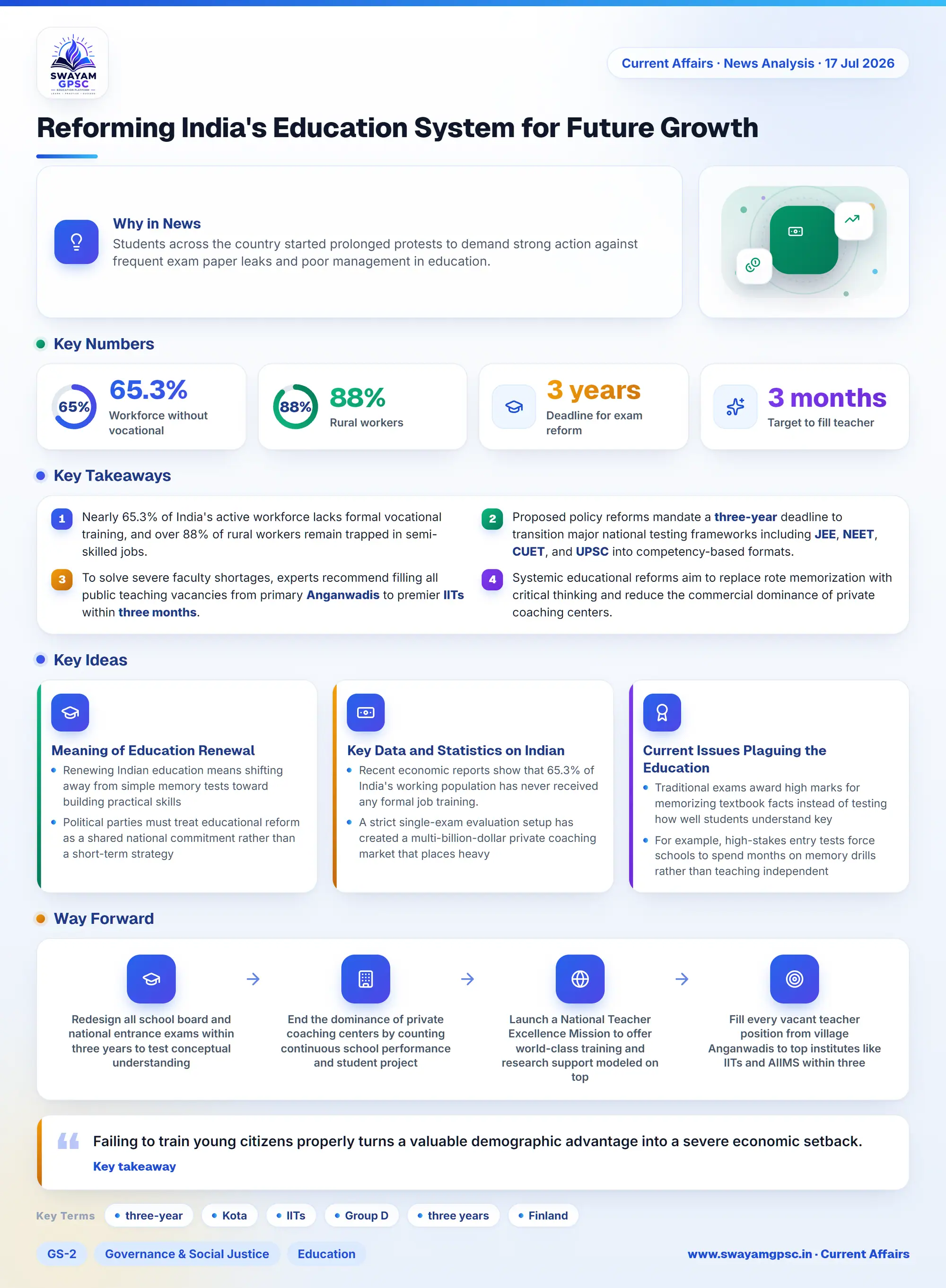
Reforming India's Education System for Future Growth
#GS-2 #Governance & Social Justice #Education #Good Governance #Current Events #National #GS-3 #Economy #Employment
Key takeaways
- Nearly 65.3% of India's active workforce lacks formal vocational training, and over 88% of rural workers remain trapped in semi-skilled jobs.
- Proposed policy reforms mandate a three-year deadline to transition major national testing frameworks including JEE, NEET, CUET, and UPSC into competency-based formats.
- To solve severe faculty shortages, experts recommend filling all public teaching vacancies from primary Anganwadis to premier IITs within three months.
- Systemic educational reforms aim to replace rote memorization with critical thinking and reduce the commercial dominance of private coaching centers.
Why in News
- Students across the country started prolonged protests to demand strong action against frequent exam paper leaks and poor management in education.
Meaning of Education Renewal
- Renewing Indian education means shifting away from simple memory tests toward building practical skills, critical thinking, and real subject mastery.
- Political parties must treat educational reform as a shared national commitment rather than a short-term strategy to win elections.
Key Data and Statistics on Indian Education
- Recent economic reports show that 65.3% of India's working population has never received any formal job training.
- A strict single-exam evaluation setup has created a multi-billion-dollar private coaching market that places heavy financial stress on ordinary families.
- More than 88% of workers in rural areas stay trapped in basic or low-skilled jobs because college degrees do not match market demands.
- New policy proposals set a hard three-year limit to convert major competitive tests like JEE, NEET, CUET, and UPSC into skill-based assessments.
Current Issues Plaguing the Education System
- Traditional exams award high marks for memorizing textbook facts instead of testing how well students understand key concepts.
- For example, high-stakes entry tests force schools to spend months on memory drills rather than teaching independent thinking.
- Extreme pressure to pass entrance exams has forced families to depend heavily on private coaching hubs.
- For example, thousands of students flocking to coaching cities like Kota shows a system that prefers repetitive practice over real learning.
- Delays in recruiting staff leave teacher posts vacant from primary schools all the way to top engineering colleges.
- For example, empty professor seats at central universities and IITs leave students without proper academic mentorship.
- State regulators often enforce rigid rules on local public colleges, which prevents teachers from trying innovative methods.
- For example, bureaucratic control over university courses keeps local departments from updating lessons to fit nearby industry needs.
Implications of Educational Failures
- Failing to train young citizens properly turns a valuable demographic advantage into a severe economic setback.
- For example, millions of young adults remain unemployed or underemployed because they lack practical technical skills.
- Expensive commercial coaching creates unfair barriers that favor wealthy students over poor ones.
- For example, low-income students from rural areas miss out on professional seats because their parents cannot pay coaching fees.
- Offering millions of degrees without creating real jobs causes deep disappointment and anger among educated youth.
- For example, postgraduates regularly apply for basic Group D government jobs because the private sector lacks suitable positions.
- Unequal funding between modern private institutions and basic public schools destroys public faith in government education.
- For example, poor parents struggle to afford private school fees because local government schools lack basic toilets, computer labs, and libraries.
Way Forward
- Redesign all school board and national entrance exams within three years to test conceptual understanding and problem-solving skills.
- End the dominance of private coaching centers by counting continuous school performance and student project portfolios alongside exam scores.
- Launch a National Teacher Excellence Mission to offer world-class training and research support modeled on top global systems like Finland and Japan.
- Fill every vacant teacher position from village Anganwadis to top institutes like IITs and AIIMS within three months.
- Establish an independent National Education Reform Commission and an online public tracking dashboard to monitor actual student learning outcomes.
Conclusion
- Fixing education in India requires political leaders to come together and treat system reform as a national priority.
- Focusing on real innovation instead of rote memorization will turn youth ambition into long-term national success.