Recognising Women Farmers in India: Legal Status, Challenges, and Solutions
#GS-2 #GS-3 #Governance & Social Justice #Economy #Indian Society #Issues Related to Women #Welfare Schemes #Agriculture #Social Justice #Vulnerable Sections #Government Policies & Interventions
Key takeaways
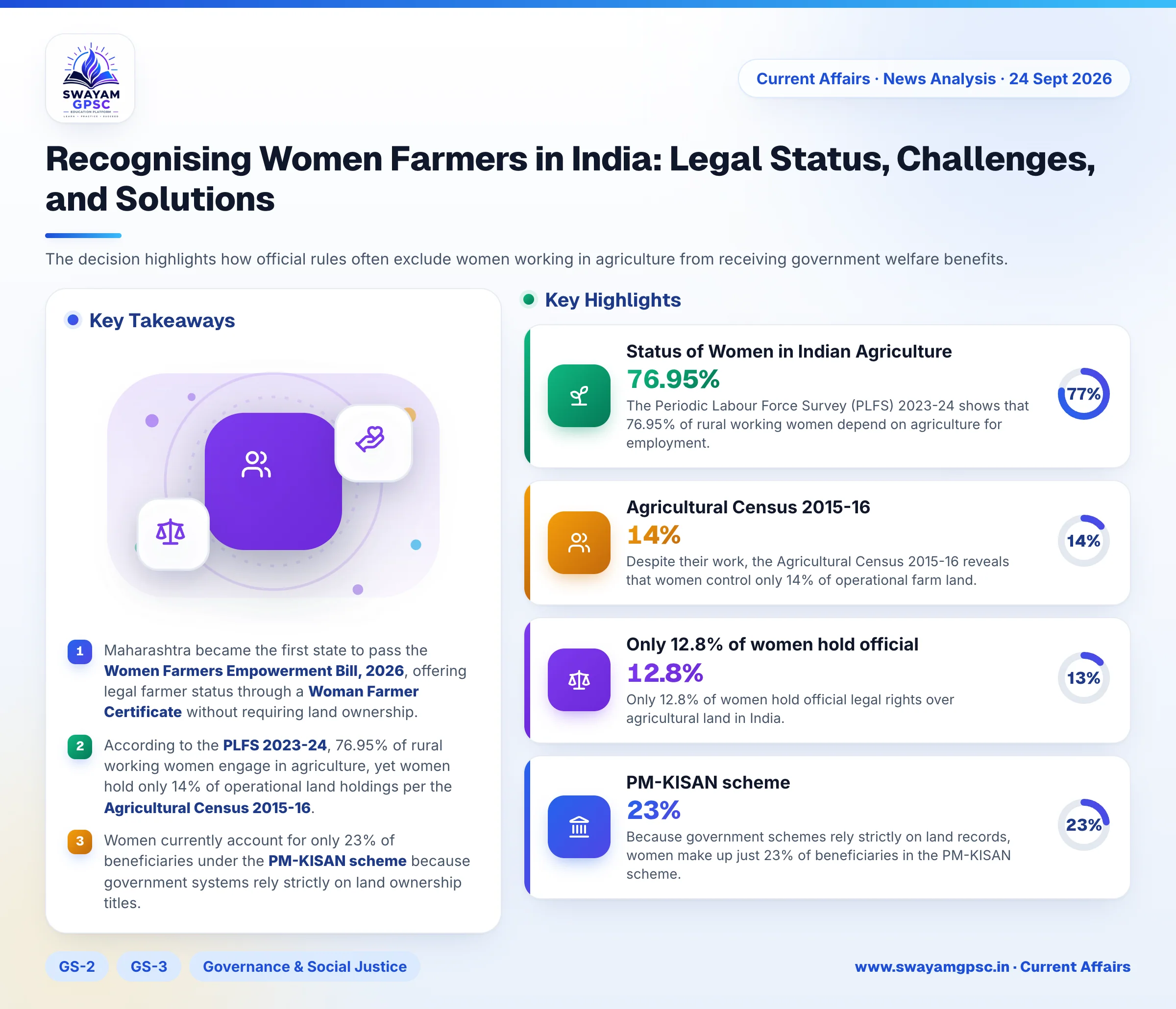
- Maharashtra became the first state to pass the Women Farmers Empowerment Bill, 2026, offering legal farmer status through a Woman Farmer Certificate without requiring land ownership.
- According to the PLFS 2023-24, 76.95% of rural working women engage in agriculture, yet women hold only 14% of operational land holdings per the Agricultural Census 2015-16.
- Women currently account for only 23% of beneficiaries under the PM-KISAN scheme because government systems rely strictly on land ownership titles.
- The Food and Agriculture Organization (FAO) estimates that equal resource access for women farmers could increase farm yields by 20% to 30% and reduce global hunger for 100-150 million people.
- To solve this issue, states must de-link farmer identity from land ownership, integrate data into Agri Stack, and enforce the mandatory 30% budget allocation for women.
Why in News
- Maharashtra recently became the first state in India to pass the Women Farmers Empowerment Bill, 2026.
- This law grants women legal recognition as farmers through a Woman Farmer Certificate, even if they do not own land.
- This step aligns with the United Nations declaring 2026 as the International Year of the Woman Farmer.
- The decision highlights how official rules often exclude women working in agriculture from receiving government welfare benefits.
Summary
- The Women Farmers Empowerment Bill, 2026 helps women overcome historical gaps in land ownership and official farmer databases.
- Governments can advance gender equality and food security by recognizing activity-based farming, expanding credit, and integrating data into Agri Stack.
Status of Women in Indian Agriculture
- Indian agriculture is experiencing a rapid demographic shift known as the feminisation of agriculture.
- The Periodic Labour Force Survey (PLFS) 2023-24 shows that 76.95% of rural working women depend on agriculture for employment.
- Despite their work, the Agricultural Census 2015-16 reveals that women control only 14% of operational farm land.
- Only 12.8% of women hold official legal rights over agricultural land in India.
- Because government schemes rely strictly on land records, women make up just 23% of beneficiaries in the PM-KISAN scheme.
- In 2025, over 41% of female farm workers worked as unpaid family helpers, compared to 20% of male workers.
- While 63% of male farm workers operate as independent account workers, only 39% of women hold this position.
- This sharp difference creates a massive gap between the actual work women perform and their legal recognition as farmers.
Economic Factors Driving Feminisation of Agriculture
- Rural men frequently move to cities for better construction or factory wages, leaving farm operations entirely to women.
- When men returned during Covid-19 lockdowns, they reclaimed key farming decisions and pushed women back into unpaid labor.
- Landowners frequently hire women as casual laborers because patriarchal norms allow paying them 20-30% less than men.
- Distressed small farm families often swap hired workers with unpaid female family members to protect small profits.
- A lack of local factories and formal job training options prevents rural women from moving into non-farm employment.
Socio-Cultural Factors Driving Feminisation of Agriculture
- Social expectations assign domestic care duties to women, keeping them tied to the village while men migrate.
- Societies view physically demanding tasks like weeding and harvesting as domestic chores, making farm work acceptable for women.
- Safety worries and traditional social taboos restrict women from moving to cities for independent job opportunities.
- Traditional inheritance customs pass property down to sons, leaving women without the land needed to secure business loans.
Why Recognising Women Farmers is Crucial
- The Food and Agriculture Organization (FAO) notes that equal resource access for women could raise farm yields by 20% to 30%.
- This potential yield growth could help lift 100-150 million people out of global hunger.
- When women gain direct control over agricultural income, they reinvest it into household health, food, and child education.
- Women hold rich traditional knowledge regarding seed conservation, biodiversity, and healthy soil management.
- Supporting female farmers remains essential for spreading climate-resilient practices across rural communities.
Major Challenges Faced by Women Farmers
- Traditional inheritance customs hand land titles to men, rendering female farmers invisible in official data.
- Without land titles to offer as collateral, women cannot easily get bank loans or Kisan Credit Cards (KCC).
- State programs distributing subsidized seed, fertilizer, and PMFBY crop insurance reach only land title holders.
- Most farm machines fit male physical strength, causing physical fatigue for female workers due to a lack of lighter tools.
- Limited transportation and male-dominated APMC mandis force women to rely on middlemen who pay low prices.
India's Initiatives Related to Women Farmers
- The Mahila Kisan Sashaktikaran Pariyojana (MKSP) under DAY-NRLM builds farming skills and boosts productivity among rural women.
- The Krishi Sakhi Convergence Program, linked with the Lakhpati Didi drive, trains women to deliver local farming advice.
- The Ministry of Agriculture reserves at least 30% of its central scheme funds specifically for female farmers.
- The government actively supports women-only Farmer Producer Organizations (FPOs) to improve their market bargaining power.
- The Uttar Pradesh government offers a 1% stamp duty discount when property or farm land is registered under a woman's name.
Measures to Empower Women Farmers in India
- States must follow Maharashtra by adopting activity-based definitions and issuing Woman Farmer Certificates through Gram Sabhas.
- Linking official woman farmer data with Agri Stack will create unified records for direct benefit transfers.
- Banks and NABARD should accept activity-based certificates to provide collateral-free loans and Kisan Credit Cards.
- Empowering Gram Panchayats helps integrate women's farming needs directly into Gram Panchayat Development Plans (GPDPs).
- State governments must conduct strict annual gender audits to verify that the 30% subsidy budget reaches women.
Conclusion
- Recognizing women as farmers without requiring land titles improves their access to credit, tools, and social welfare.
- This reform directly supports global targets under SDG 1 (No Poverty), SDG 2 (Zero Hunger), and SDG 5 (Gender Equality).
- As 2026 marks the International Year of the Woman Farmer, expanding activity-based recognition across India will build an inclusive rural economy.
Frequently Asked Questions (FAQs)
- What is the Women Farmers Empowerment Bill, 2026? It is a law in Maharashtra granting legal farmer status to women through a Woman Farmer Certificate regardless of land ownership.
- Why are women farmers left out of government schemes? Most welfare schemes identify farmers using land records, excluding women who work on family farms without land titles.
- What is Mahila Kisan Sashaktikaran Pariyojana (MKSP)? MKSP is a program under DAY-NRLM that enhances the skills and farm output of rural women.
- What is the Krishi Sakhi Convergence Program? This program trains rural women as local advisory providers to share agricultural knowledge across villages.
- How does recognizing women farmers boost rural development? Connecting Woman Farmer Certificates with Agri Stack, loans, and subsidies gives women direct access to essential farm resources.