Rebalancing India's Rice Economy
#GS-3 #Economy #Agriculture #Infrastructure #Environment #Climate Change #Pollution #Cropping Patterns #Irrigation #Direct & Indirect Farm Subsidies #Environmental Pollution & Degradation
Key takeaways
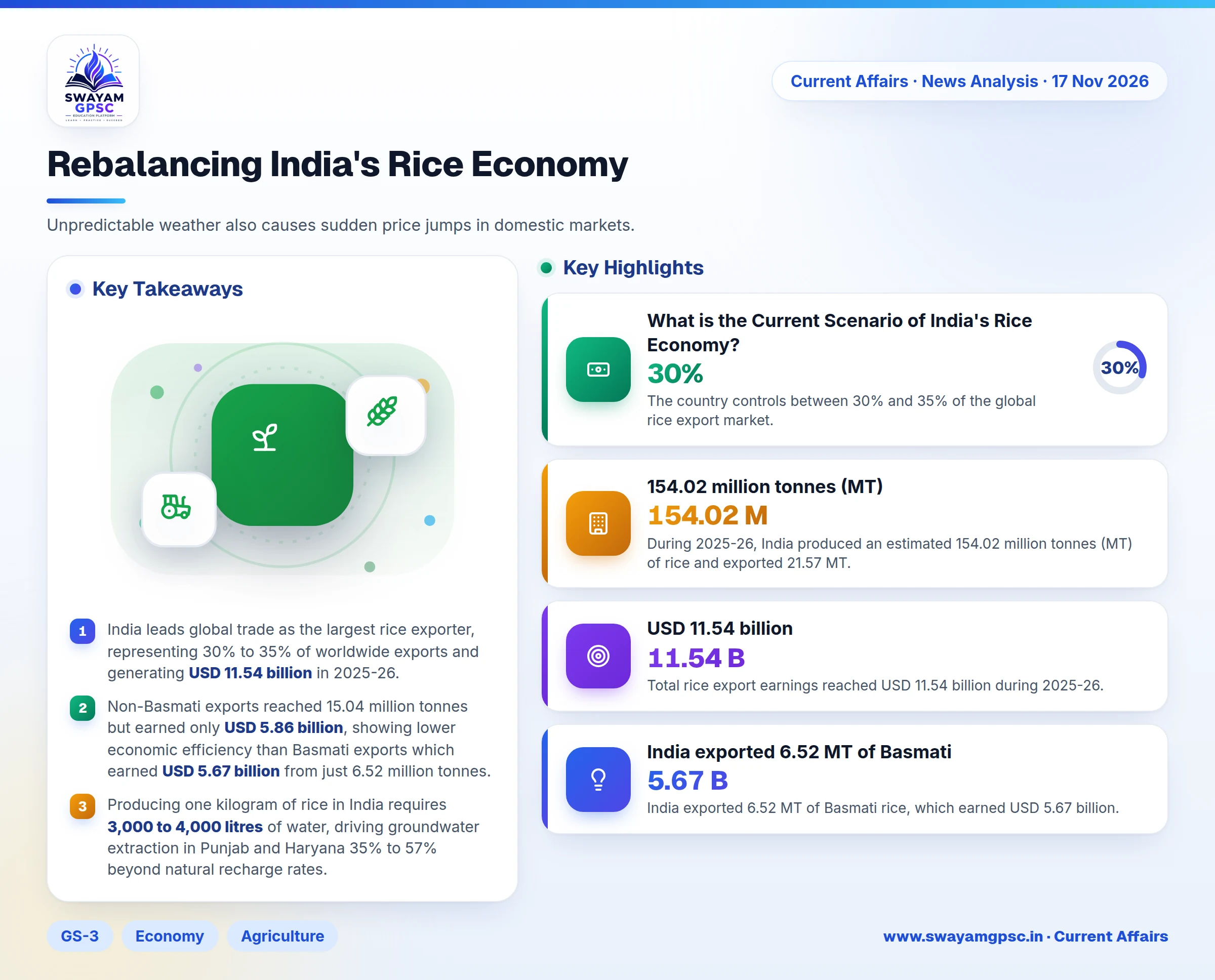
- India leads global trade as the largest rice exporter, representing 30% to 35% of worldwide exports and generating USD 11.54 billion in 2025-26.
- Non-Basmati exports reached 15.04 million tonnes but earned only USD 5.86 billion, showing lower economic efficiency than Basmati exports which earned USD 5.67 billion from just 6.52 million tonnes.
- Producing one kilogram of rice in India requires 3,000 to 4,000 litres of water, driving groundwater extraction in Punjab and Haryana 35% to 57% beyond natural recharge rates.
- Irrigated paddy fields in India emit roughly 3.9 million tonnes of methane each year, making rice farming a major source of agricultural greenhouse gas emissions.
- The government needs to adopt a Water-Carbon-Value matrix while promoting sustainable practices like Direct-Seeded Rice (DSR) and Alternate Wetting and Drying (AWD).
Why in News?
- India leads the global market as the largest rice exporter.
- However, this export success creates serious environmental challenges inside the country.
- Rice farming drains underground aquifers and releases large amounts of harmful greenhouse gas emissions.
- Unpredictable weather also causes sudden price jumps in domestic markets.
- To protect the environment and secure local food supplies, India must change its focus from selling high physical volumes to selling high-value premium rice.
Summary
- India relies heavily on exporting rice, but this strategy speeds up groundwater loss and increases methane emissions.
- Erratic weather patterns make rice crops vulnerable to failure.
- The country needs to balance its international trade success with local environmental protection.
- India can improve farmer incomes and protect natural resources by shifting toward high-value rice varieties.
- Promoting alternative crops, climate-smart farming, water-saving irrigation, and smart subsidies will secure long-term water and food supplies.
What is the Current Scenario of India's Rice Economy?
- India has remained the world's top rice exporter since 2012.
- The country controls between 30% and 35% of the global rice export market.
- During 2025-26, India produced an estimated 154.02 million tonnes (MT) of rice and exported 21.57 MT.
- Total rice export earnings reached USD 11.54 billion during 2025-26.
- India exported 6.52 MT of Basmati rice, which earned USD 5.67 billion.
- In contrast, India exported 15.04 MT of non-Basmati rice, which earned USD 5.86 billion.
What are the Concerns Regarding India's Rice Economy?
- Irregular monsoon rains leave Indian rice fields highly vulnerable to extreme weather.
- An El Niño event in 2026 caused a 3.46% drop in the Kharif rice planting area, reducing it to 433.62 lakh hectares.
- This crop shortfall raised domestic retail prices quickly and made basic food less affordable for local citizens.
- Selling low-margin non-Basmati rice generates poor financial returns compared to the huge volumes shipped.
- India can earn far more money by marketing higher quality rice with strong branding instead of sending bulk shipments abroad.
- Free or cheap electricity policies encourage farmers to pump out groundwater without any limit.
- Regular increases in the Minimum Support Price (MSP) for paddy promise guaranteed government buying, which stops farmers from switching to safer, low-water crops.
- Producing one kilogram of rice in India requires 3,000 to 4,000 litres of water, which is 20% to 60% higher than the global average.
- Exporting millions of tonnes of rice effectively transfers billions of litres of local water to foreign buyers through virtual water trade.
- Rain-fed green water supports sustainable farming, but Indian exporters rely heavily on blue water pumped from underground reserves.
- Groundwater pumping in farming heartlands like Punjab and Haryana exceeds natural rainfall recharge by 35% to 57%.
- Local borewell water tables collapsed from 30 feet deep down to 80 to 200 feet over the past decade.
- Flooded rice fields lack oxygen, which creates perfect conditions for microbes to produce methane gas.
- Indian irrigated fields release roughly 3.9 million tonnes of methane every year, exceeding total industrial emissions from countries like Germany.
- Flooding fields continuously and overusing synthetic nitrogen fertilizers depletes Soil Organic Carbon (SOC) and turns carbon-absorbing soils into net greenhouse gas sources.
What Measures are Needed for Rebalancing India's Rice Economy?
- Government officials should evaluate agricultural trade using a broad Water-Carbon-Value framework instead of checking total export weight.
- This new assessment method must measure export income earned per cubic metre of groundwater spent.
- The system should also monitor greenhouse gas releases per kilogram of harvested grain.
- It must measure net farm income generated against the total water and carbon resources used.
- Trade rules should favor high-value premium rice over cheap non-Basmati bulk shipments.
- The government should support this shift by investing in global marketing campaigns, product tracking, organic certifications, and expanding Geographical Indications (GI) tags.
- Farmers should adopt Direct-Seeded Rice (DSR) to sow seeds straight into fields without preparing flooded seedling nurseries.
- Growers can use Alternate Wetting and Drying (AWD) to drain fields periodically, which stops methane-producing microbes from thriving.
- Agricultural workers can apply the System of Rice Intensification (SRI) to space out seedlings, improve harvest yields, and save water.
- Regional farm offices must introduce soil management techniques that rebuild Soil Organic Carbon (SOC) levels.
- For example, trials under the International Rice Research Institute's KERA-AWD project show that replacing standard lime with phosphogypsum in acidic soils reduces subsoil gas emissions.
- State governments should promote low-water crops like millets (Shree Anna), pulses, and oilseeds in dry regions by guaranteeing purchases at standard support prices.
- States can copy the Odisha Millet Mission to reduce farmer reliance on water-heavy paddy crops.
- Policymakers must replace open-ended power and fertilizer subsidies with targeted Direct Benefit Transfers (DBT) that reward water conservation.
- Programs can follow Haryana's Mera Pani Meri Virasat model to encourage sustainable resource use.
- Officials should empower Krishi Vigyan Kendras (KVKs) to teach small farmers practical techniques like Direct-Seeded Rice (DSR) and Alternate Wetting and Drying (AWD).
Conclusion
- India must shift its national rice strategy toward a sustainable Water-Carbon-Value framework.
- Updating farm policies to encourage eco-friendly techniques and alternative crops is essential to save groundwater, cut emissions, and protect long-term food security.