RBI Revives Proposal for Plastic Polymer Currency Notes
#GS-3 #Economy #Monetary Policy #Fiscal Policy #Current Events #National
Why in News
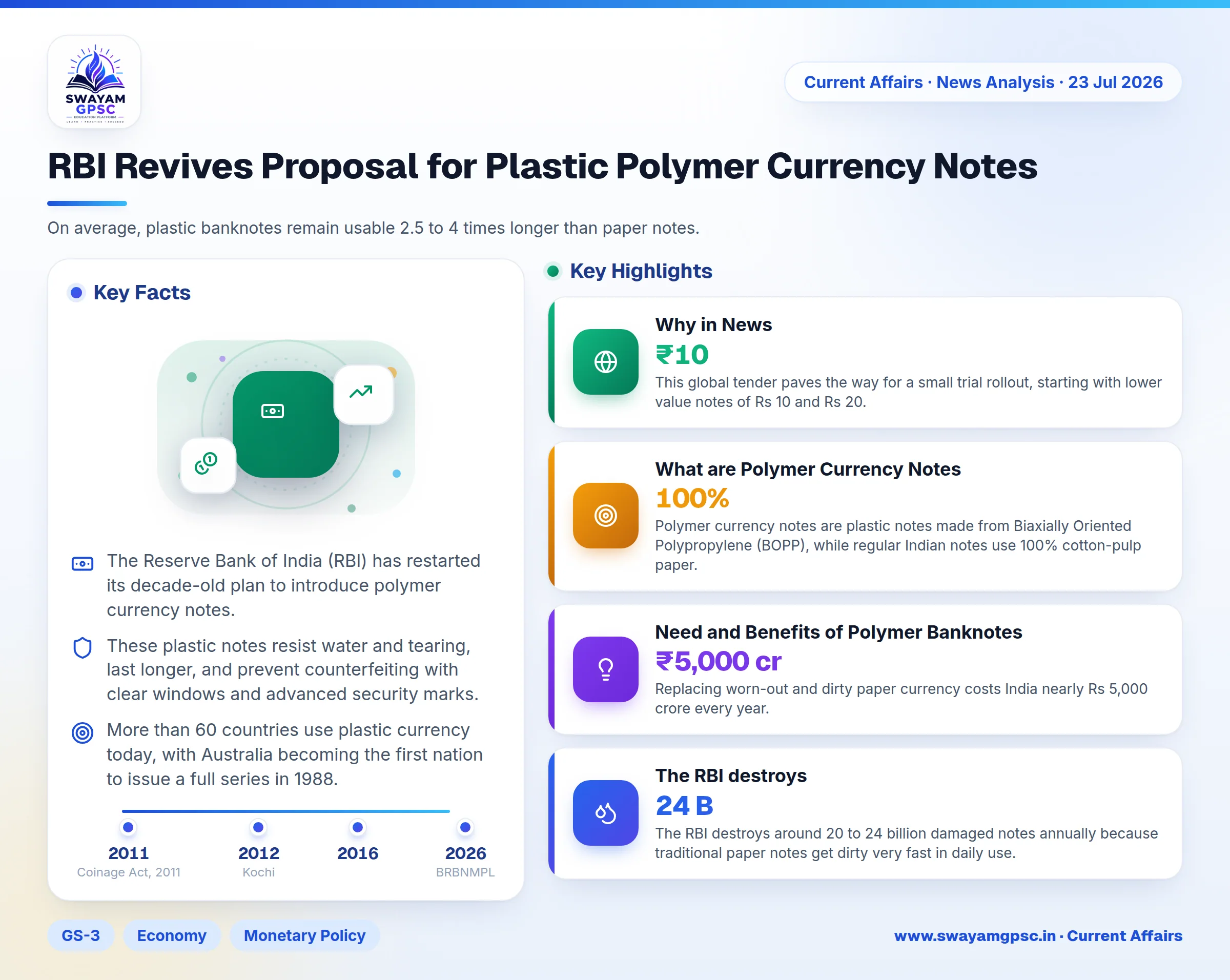
- The Reserve Bank of India (RBI) has restarted its decade-old plan to introduce polymer currency notes.
- The Bharatiya Reserve Bank Note Mudran Private Limited (BRBNMPL), owned completely by the RBI, issued a global call for supplying Biaxially Oriented Polypropylene (BOPP) polymer material.
- This global tender paves the way for a small trial rollout, starting with lower value notes of Rs 10 and Rs 20.
What are Polymer Currency Notes
- Polymer currency notes are plastic notes made from Biaxially Oriented Polypropylene (BOPP), while regular Indian notes use 100% cotton-pulp paper.
- These plastic notes resist water and tearing, last longer, and prevent counterfeiting with clear windows and advanced security marks.
- More than 60 countries use plastic currency today, with Australia becoming the first nation to issue a full series in 1988.
- On average, plastic banknotes remain usable 2.5 to 4 times longer than paper notes.
Need and Benefits of Polymer Banknotes
- Replacing worn-out and dirty paper currency costs India nearly Rs 5,000 crore every year.
- The RBI destroys around 20 to 24 billion damaged notes annually because traditional paper notes get dirty very fast in daily use.
- Low-value notes like Rs 10 and Rs 20 pass through many hands quickly and spoil rapidly.
- Using polymer notes reduces how often notes must be replaced, saving long-term printing costs and providing stronger safety against fake currency.
- A study by The Energy and Resources Institute (TERI) showed that polymer notes need more energy to make initially, but their longer lifespan reduces total environmental damage over time.
Timeline of Polymer Currency in India
- In 2009, the RBI first suggested issuing 100 crore plastic notes of Rs 10.
- In 2012, the central government approved a trial run across five cities with different climates: Kochi, Mysuru, Jaipur, Bhubaneswar, and Shimla.
- Technical difficulties stopped the project, and the topic was put aside after the 2016 demonetisation.
- In 2026, BRBNMPL invited global tenders for polymer materials, bringing the plan back to life.
Challenges
- Making polymer banknotes costs 30% to 60% more than making paper notes, and printing lower value notes costs 20% to 24% of their actual face value.
- Polymer notes need polypropylene made from crude oil, and India imports about one-fifth of its needs, leaving costs open to global oil price shifts.
- Banks and businesses must change and upgrade cash machines, ATMs, and sorting machinery, adding heavy setup costs.
- Plastic notes create environmental concerns because managing plastic waste needs special recycling facilities.
Digital Payments vs Physical Currency Paradox
- Digital payments have expanded rapidly, with the Unified Payments Interface (UPI) processing over 24,000 crore transactions a year and handling 85% of small digital transactions.
- Even with high digital growth, cash in circulation rose to over Rs 41 lakh crore in 2025-26, up from Rs 16-17 lakh crore ten years ago.
- Physical cash remains vital for local markets, small street vendors, rural areas with poor internet, and during power or network outages.
- India needs a balanced mix where both cash and digital payments function together smoothly.
RBI's Clean Note Policy
- The RBI introduced the Clean Note Policy in 1999 to ensure citizens receive high quality currency notes while removing damaged notes from market circulation.
- The policy aims to improve currency quality, increase note life, and keep public confidence strong in the cash system.
- Commercial banks must issue only crisp, clean notes and must not hand out dirty or damaged cash back to customers.
- Anyone can exchange dirty or torn notes at any bank currency chest branch for free, even without an account at that bank.
- The RBI stopped using metal staples on note bundles and switched to paper or polythene bands to prevent paper damage.
- The RBI uses automated Currency Verification and Processing Systems (CVPS) to verify, sort, shred, and compress bad notes into small blocks.
- Banks are encouraged to supply enough coins and set up cash exchange points, especially in rural and semi-urban areas.
Currency Management in India
- Under the Indian Constitution, matters of currency, coins, legal money, and foreign exchange rest solely with the central government under the Union List.
- The Reserve Bank of India Act, 1934 lays down the main rules for printing and managing currency notes.
- The Coinage Act, 2011 controls how coins are designed, made, and issued by the central government.
- The RBI has exclusive power to issue banknotes, estimate total cash needs, maintain supply, and keep circulating notes clean.
- The central bank also distributes coins that are made by the central government.
- The central government keeps the sole right to issue Rs 1 notes, design coins, approve RBI note designs and materials, and offer full financial backing for all banknotes.