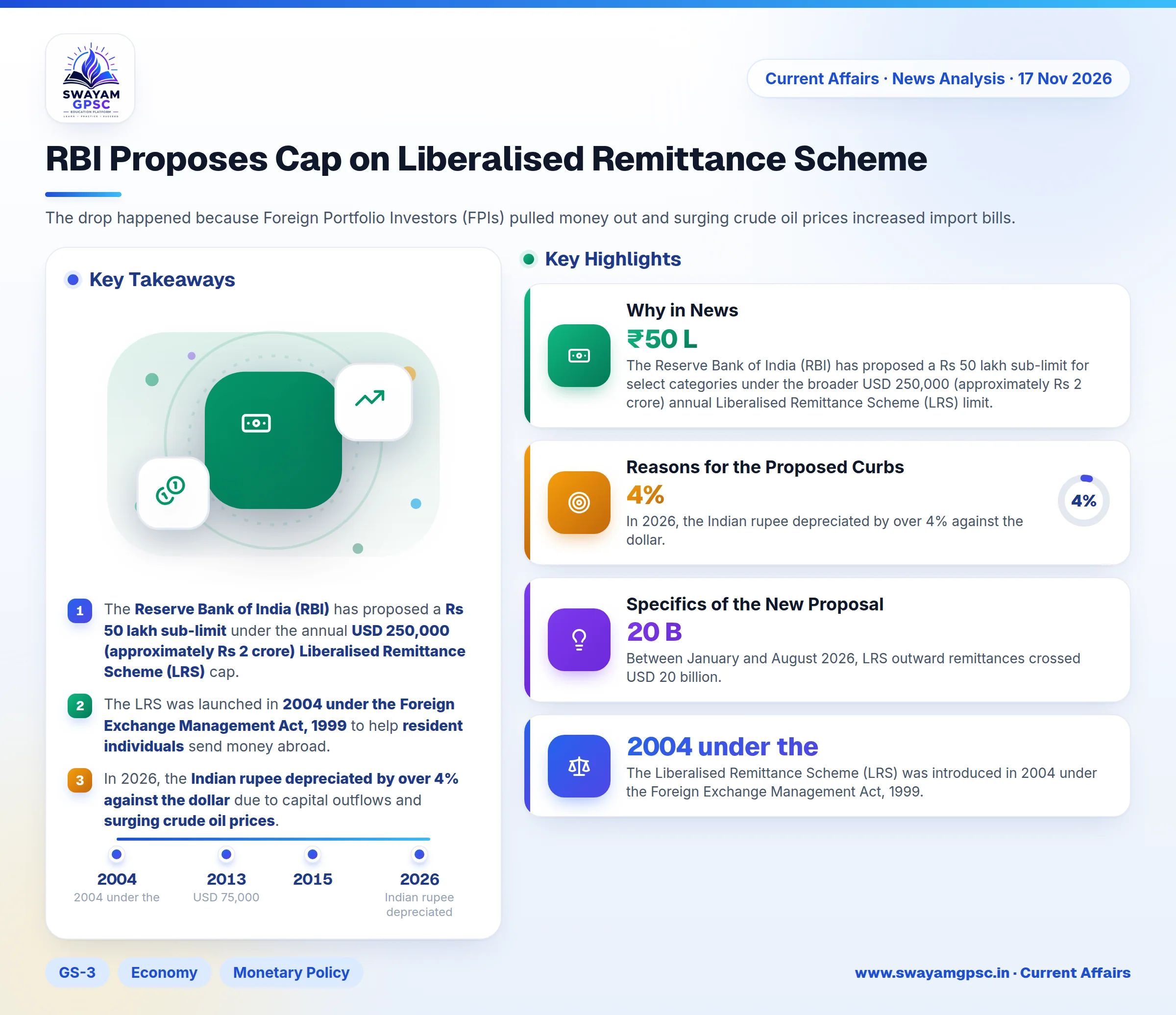
RBI Proposes Cap on Liberalised Remittance Scheme
#GS-3 #Economy #Monetary Policy #Fiscal Policy #Banking #Rapid Fire CA #Quick Facts For Prelims
Key takeaways
- The Reserve Bank of India (RBI) has proposed a Rs 50 lakh sub-limit under the annual USD 250,000 (approximately Rs 2 crore) Liberalised Remittance Scheme (LRS) cap.
- The LRS was launched in 2004 under the Foreign Exchange Management Act, 1999 to help resident individuals send money abroad.
- In 2026, the Indian rupee depreciated by over 4% against the dollar due to capital outflows and surging crude oil prices.
- Outward remittances under the scheme crossed USD 20 billion between January and August 2026.
Why in News
- The Reserve Bank of India (RBI) has proposed a Rs 50 lakh sub-limit for select categories under the broader USD 250,000 (approximately Rs 2 crore) annual Liberalised Remittance Scheme (LRS) limit.
- This proposal aims to stop massive dollar outflows and protect the falling Indian rupee.
About the Liberalised Remittance Scheme
- The Liberalised Remittance Scheme (LRS) was introduced in 2004 under the Foreign Exchange Management Act, 1999.
- It allows resident individuals to freely send up to USD 250,000 per financial year abroad.
- The scheme covers both capital account transactions like buying overseas property and current account transactions like overseas travel and education.
Reasons for the Proposed Curbs
- In 2026, the Indian rupee depreciated by over 4% against the dollar.
- The drop happened because Foreign Portfolio Investors (FPIs) pulled money out and surging crude oil prices increased import bills.
Specifics of the New Proposal
- The new Rs 50 lakh sub-limit focuses on non-essential spending like business trips and pilgrimages.
- Important remittances for education and medical purposes are expected to be exempted from this sub-limit.
- Between January and August 2026, LRS outward remittances crossed USD 20 billion.
Impact on Businesses and Past Precedents
- The LRS applies only to resident individuals, so tighter limits will not directly impact businesses, MSMEs, or corporate trade payments/receivables.
- During the 2013 'Taper Tantrum' currency crisis, the RBI slashed the LRS limit to USD 75,000 before restoring it in 2015.