The Ravidassia Community and Religious Identity Demand
#GS-1 #History #Medieval India #Culture #Heritage #GS-2 #Indian Society #Vulnerable Sections #GS-3 #Current Events #National #Ravidassia Community #Guru Ravidas #Bhakti Movement
Why in News
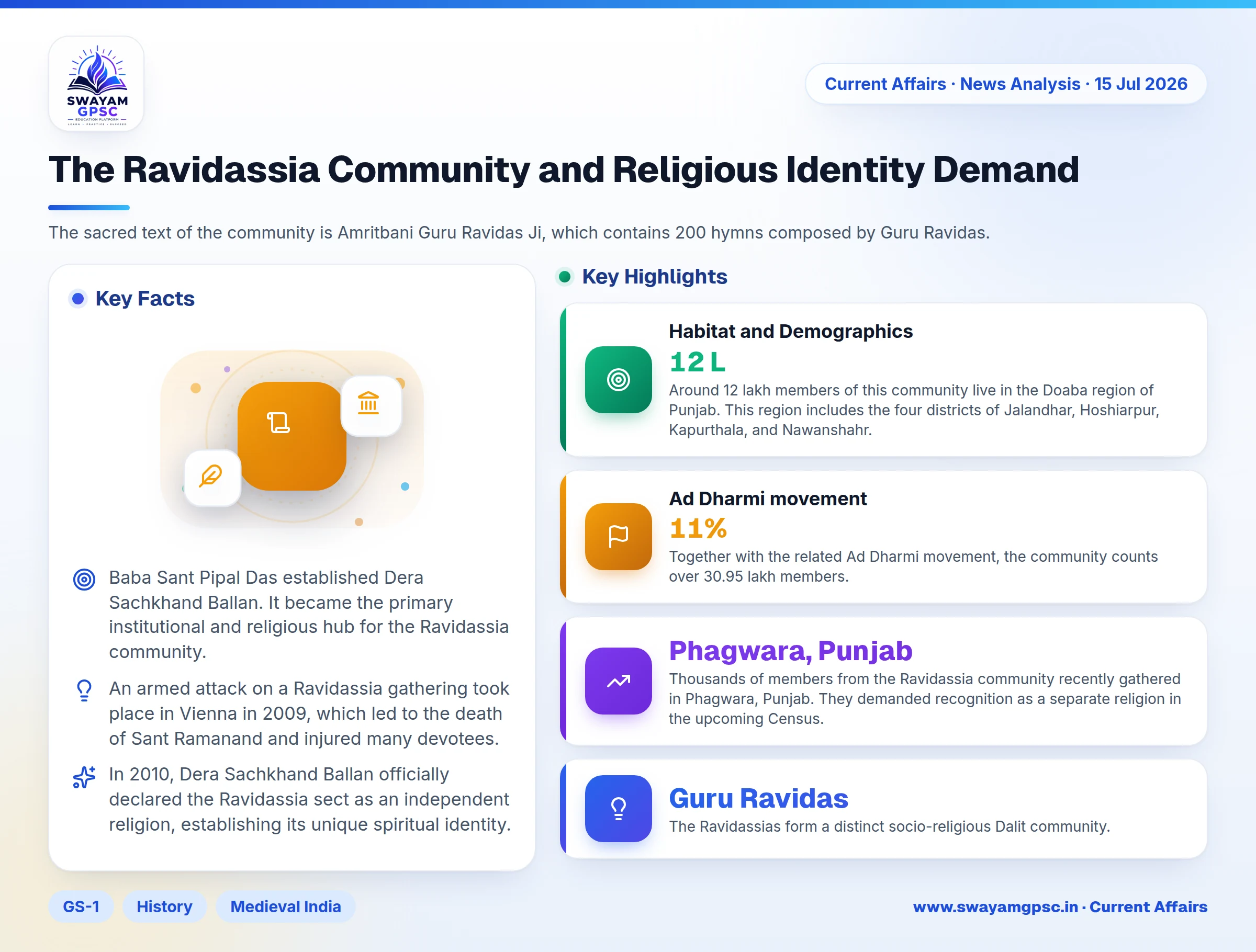
- Thousands of members from the Ravidassia community recently gathered in Phagwara, Punjab. They demanded recognition as a separate religion in the upcoming Census.
Who Are the Ravidassias?
- The Ravidassias form a distinct socio-religious Dalit community. They follow the spiritual teachings, egalitarian philosophy, and mystic poetry of Guru Ravidas, a celebrated saint of the Bhakti Movement from the 15th and 16th centuries.
Habitat and Demographics
- Around 12 lakh members of this community live in the Doaba region of Punjab. This region includes the four districts of Jalandhar, Hoshiarpur, Kapurthala, and Nawanshahr.
- Together with the related Ad Dharmi movement, the community counts over 30.95 lakh members. They make up more than 11% of Punjab's total population and form a major part of the state's 32% Dalit population.
History and Key Turning Points
- Baba Sant Pipal Das established Dera Sachkhand Ballan. It became the primary institutional and religious hub for the Ravidassia community.
- An armed attack on a Ravidassia gathering took place in Vienna in 2009, which led to the death of Sant Ramanand and injured many devotees. This incident triggered huge protests across Punjab.
- In 2010, Dera Sachkhand Ballan officially declared the Ravidassia sect as an independent religion, establishing its unique spiritual identity.
Key Features of the Ravidassia Faith
- The sacred text of the community is Amritbani Guru Ravidas Ji, which contains 200 hymns composed by Guru Ravidas.
- Guru Ravidas conceptualized Begampura, meaning a city without sorrow. He envisioned it as an equal, caste-free society without fear, discrimination, or exploitation.
- The community has its own worship places, religious greetings, and holy symbols such as the Har emblem.
- The birthplace of Guru Ravidas at Seer Goverdhanpur in Varanasi serves as the main pilgrimage site for the community, drawing lakhs of followers every year.
Significance of the Demand
- A separate category in the Census would ensure accurate population counting, prevent official misclassification, and give formal recognition to their distinct identity.
- The community holds strong voting power in the Doaba region, giving it a significant role in Punjab politics and in discussions regarding Dalit representation.