The Ras Laffan Gas Facility
#GS-3 #Economy #Infrastructure #Energy #Current Events #International
Key takeaways
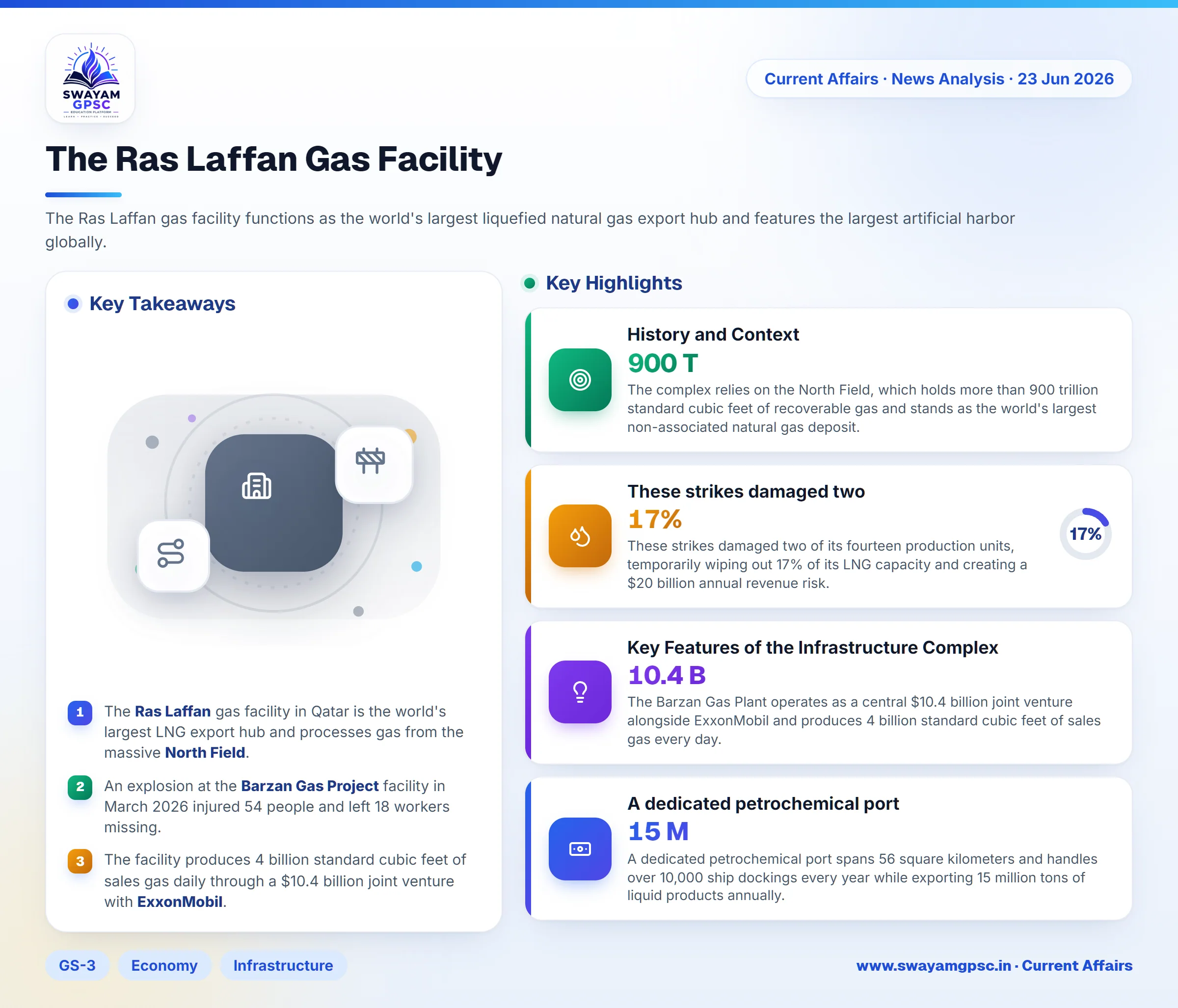
- The Ras Laffan gas facility in Qatar is the world's largest LNG export hub and processes gas from the massive North Field.
- An explosion at the Barzan Gas Project facility in March 2026 injured 54 people and left 18 workers missing.
- The facility produces 4 billion standard cubic feet of sales gas daily through a $10.4 billion joint venture with ExxonMobil.
- Missile strikes in March 2026 damaged two production units, temporarily destroying 17% of its LNG capacity and risking $20 billion in annual revenue.
Why in News
- A massive explosion and fire recently struck the Barzan Gas Project facility located inside Qatar's Ras Laffan industrial zone.
- This dangerous incident resulted in injuries to 54 people while leaving 18 workers missing.
- This event brings major global attention to the safety and security of critical energy infrastructure in the Middle East.
About The Ras Laffan Gas Facility
- The Ras Laffan gas facility functions as the world's largest liquefied natural gas export hub and features the largest artificial harbor globally.
- It operates as a heavily secured industrial center built to process, refine, and ship natural gas across the world.
Location
- This critical facility stands in the Al Khor municipality of Qatar.
- It is located roughly 80 kilometers north of Doha, which is the capital city of Qatar.
History and Context
- QatarEnergy launched this industrial city in 1996 to handle petrochemical operations for gas extracted from the North Field.
- The complex relies on the North Field, which holds more than 900 trillion standard cubic feet of recoverable gas and stands as the world's largest non-associated natural gas deposit.
- During regional conflicts in March 2026, missile attacks struck the asset on March 18, 2026, bypassing defense shields.
- These strikes damaged two of its fourteen production units, temporarily wiping out 17% of its LNG capacity and creating a $20 billion annual revenue risk.
Key Features of the Infrastructure Complex
- The Barzan Gas Plant operates as a central $10.4 billion joint venture alongside ExxonMobil and produces 4 billion standard cubic feet of sales gas every day.
- The zone includes major downstream processing plants like the Pearl GTL, ORYX GTL, the Dolphin gas processing hub, and the Laffan Refinery.
- Three massive power and desalination facilities named Ras Laffan A, Ras Laffan B, and Ras Girtas supply electricity and fresh water to the area.
- A dedicated petrochemical port spans 56 square kilometers and handles over 10,000 ship dockings every year while exporting 15 million tons of liquid products annually.
- A specialized emergency pipeline connected to the Ras Laffan Emergency & Safety College along with a repair zone provides dedicated crisis support.