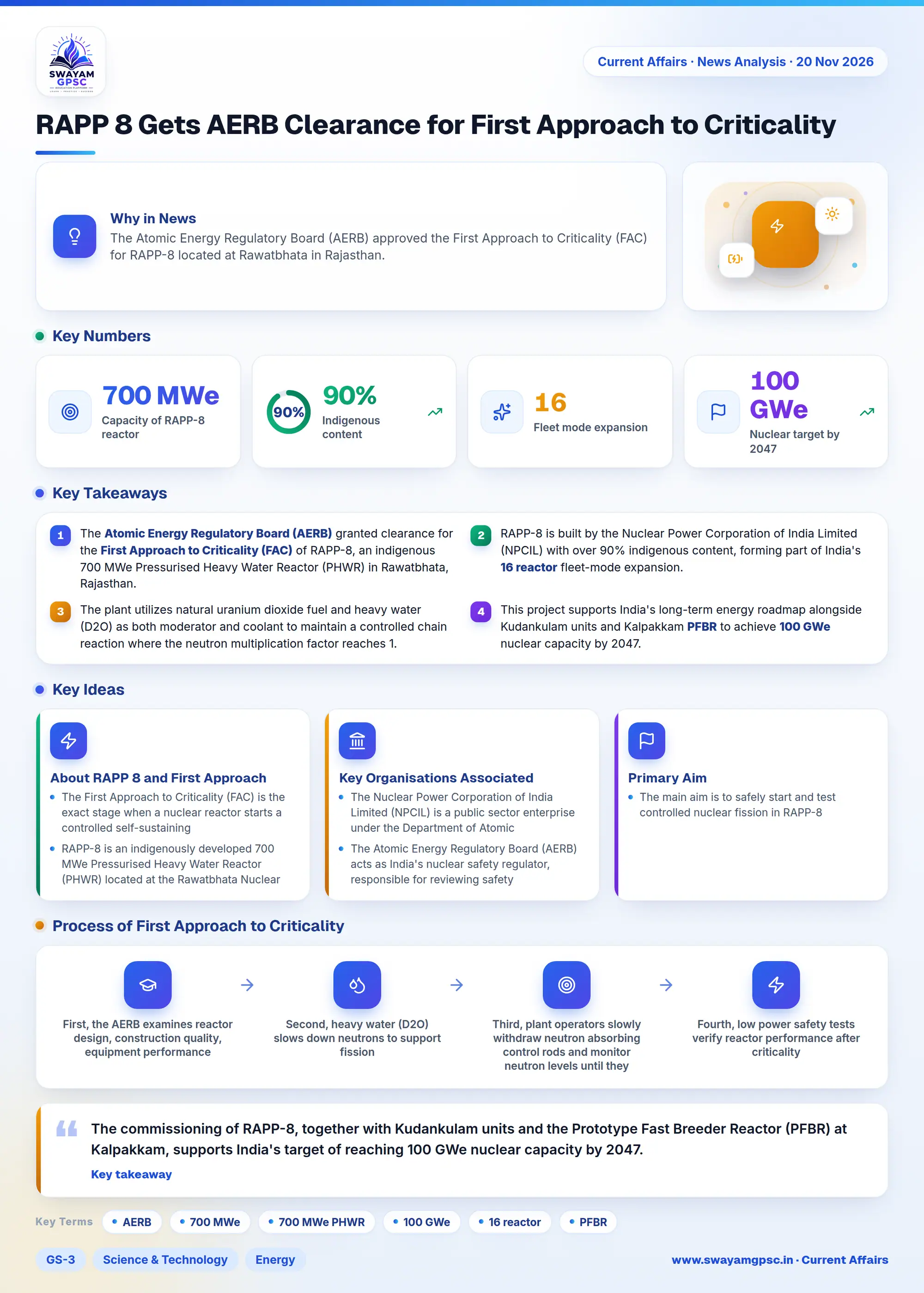
RAPP 8 Gets AERB Clearance for First Approach to Criticality
#GS-3 #Science & Technology #Energy #RAPP-8 #AERB #Nuclear Energy #PHWR
Key takeaways
- The Atomic Energy Regulatory Board (AERB) granted clearance for the First Approach to Criticality (FAC) of RAPP-8, an indigenous 700 MWe Pressurised Heavy Water Reactor (PHWR) in Rawatbhata, Rajasthan.
- RAPP-8 is built by the Nuclear Power Corporation of India Limited (NPCIL) with over 90% indigenous content, forming part of India's 16 reactor fleet-mode expansion.
- The plant utilizes natural uranium dioxide fuel and heavy water (D2O) as both moderator and coolant to maintain a controlled chain reaction where the neutron multiplication factor reaches 1.
- This project supports India's long-term energy roadmap alongside Kudankulam units and Kalpakkam PFBR to achieve 100 GWe nuclear capacity by 2047.
Why in News
- The Atomic Energy Regulatory Board (AERB) approved the First Approach to Criticality (FAC) for RAPP-8 located at Rawatbhata in Rajasthan.
About RAPP 8 and First Approach to Criticality
- The First Approach to Criticality (FAC) is the exact stage when a nuclear reactor starts a controlled self-sustaining chain reaction for the first time at low power, which marks a major step toward generating electricity.
- RAPP-8 is an indigenously developed 700 MWe Pressurised Heavy Water Reactor (PHWR) located at the Rawatbhata Nuclear Power Plant in Chittorgarh district of Rajasthan.
Key Organisations Associated
- The Nuclear Power Corporation of India Limited (NPCIL) is a public sector enterprise under the Department of Atomic Energy (DAE) that handles designing, constructing, commissioning, and operating RAPP-8.
- The Atomic Energy Regulatory Board (AERB) acts as India's nuclear safety regulator, responsible for reviewing safety, inspecting facilities, and granting approvals before operations start.
Primary Aim
- The main aim is to safely start and test controlled nuclear fission in RAPP-8, preparing the reactor for gradual power scaling, grid connection, and eventual commercial operations.
Process of First Approach to Criticality
- First, the AERB examines reactor design, construction quality, equipment performance, and fuel loading tests before granting permission to achieve criticality.
- Second, heavy water (D2O) slows down neutrons to support fission, while operators gradually reduce neutron absorbing chemicals under continuous safety monitoring.
- Third, plant operators slowly withdraw neutron absorbing control rods and monitor neutron levels until they achieve a self-sustaining chain reaction where effective neutron multiplication factor equals 1.
- Fourth, low power safety tests verify reactor performance after criticality, leading to gradual power increases, grid connection, and commercial electricity generation.
Key Features of RAPP 8 and 700 MWe PHWR Series
- This reactor is the fourth 700 MWe unit, following Kakrapar Atomic Power Station Units 3 and 4 (KAPS-3 and 4) in Gujarat and twin unit RAPP-7 at Rawatbhata, forming part of India's 16 reactor fleet mode expansion.
- The plant uses natural uranium dioxide as fuel along with heavy water (D2O) as both coolant and moderator to sustain controlled nuclear fission.
- The design features advanced safety systems including double containment structures and passive decay heat removal to prevent radiation leaks and cool the core during emergencies.
- Manufacturing achieves over 90% indigenous content for major components, which strengthens domestic industry, reduces reliance on imports, and standardizes reactor construction.
- The AERB resident observer team performs continuous safety monitoring during commissioning and power increases, backed by regular safety inspections.
Current Status of Nuclear Power in India
- With KAPS-3, KAPS-4, and RAPP-7 already operational, RAPP-8 strengthens India's 700 MWe PHWR programme alongside 12 additional sanctioned reactors.
- The commissioning of RAPP-8, together with Kudankulam units and the Prototype Fast Breeder Reactor (PFBR) at Kalpakkam, supports India's target of reaching 100 GWe nuclear capacity by 2047.