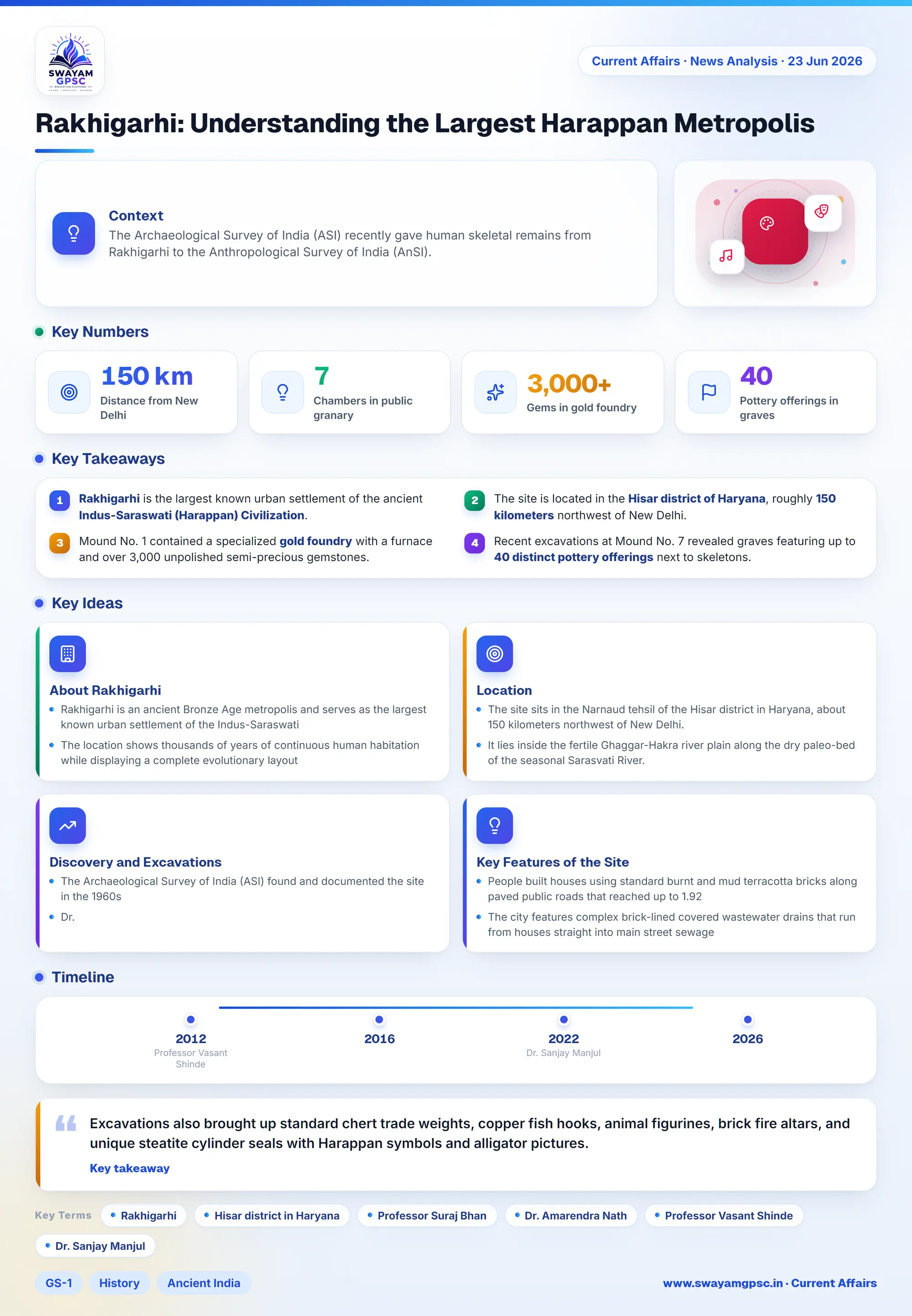
Rakhigarhi: Understanding the Largest Harappan Metropolis
#GS-1 #History #Ancient India #Culture #Art & Architecture #Heritage #Archaeology #Harappan Civilization
Key takeaways
- Rakhigarhi is the largest known urban settlement of the ancient Indus-Saraswati (Harappan) Civilization.
- The site is located in the Hisar district of Haryana, roughly 150 kilometers northwest of New Delhi.
- Mound No. 1 contained a specialized gold foundry with a furnace and over 3,000 unpolished semi-precious gemstones.
- Recent excavations at Mound No. 7 revealed graves featuring up to 40 distinct pottery offerings next to skeletons.
Context
- The Archaeological Survey of India (ASI) recently gave human skeletal remains from Rakhigarhi to the Anthropological Survey of India (AnSI).
About Rakhigarhi
- Rakhigarhi is an ancient Bronze Age metropolis and serves as the largest known urban settlement of the Indus-Saraswati (Harappan) Civilization.
- The location shows thousands of years of continuous human habitation while displaying a complete evolutionary layout from early to mature periods.
Location
- The site sits in the Narnaud tehsil of the Hisar district in Haryana, about 150 kilometers northwest of New Delhi.
- It lies inside the fertile Ghaggar-Hakra river plain along the dry paleo-bed of the seasonal Sarasvati River.
Discovery and Excavations
- The Archaeological Survey of India (ASI) found and documented the site in the 1960s, with early work done by Professor Suraj Bhan in 1969.
- Dr. Amarendra Nath from the ASI led major digs between 1997 and 2000, proving the giant scale of the city and finding old graves.
- Professor Vasant Shinde from Deccan College managed large structural and skeletal digs from 2012 to 2016, increasing the known mound count and extracting ancient DNA.
- Dr. Sanjay Manjul from the Institute of Archaeology directed modern field work from 2022 through 2026, finding unique cemetery items at Mound No. 7.
Key Features of the Site
- People built houses using standard burnt and mud terracotta bricks along paved public roads that reached up to 1.92 meters in width.
- The city features complex brick-lined covered wastewater drains that run from houses straight into main street sewage channels.
- A large public granary was found in mature layers, featuring mud-brick walls and seven large rectangular chambers.
- Mound No. 1 acted as an old manufacturing zone with cloth-dyeing setups, terracotta kilns, and a special gold foundry containing a furnace and over 3,000 unpolished semi-precious gemstones.
- Mound No. 7 acts as the main burial ground where recent 2025-26 digs showed graves containing up to 40 distinct pottery offerings next to skeletons laid in a north-south direction.
- Excavations also brought up standard chert trade weights, copper fish hooks, animal figurines, brick fire altars, and unique steatite cylinder seals with Harappan symbols and alligator pictures.