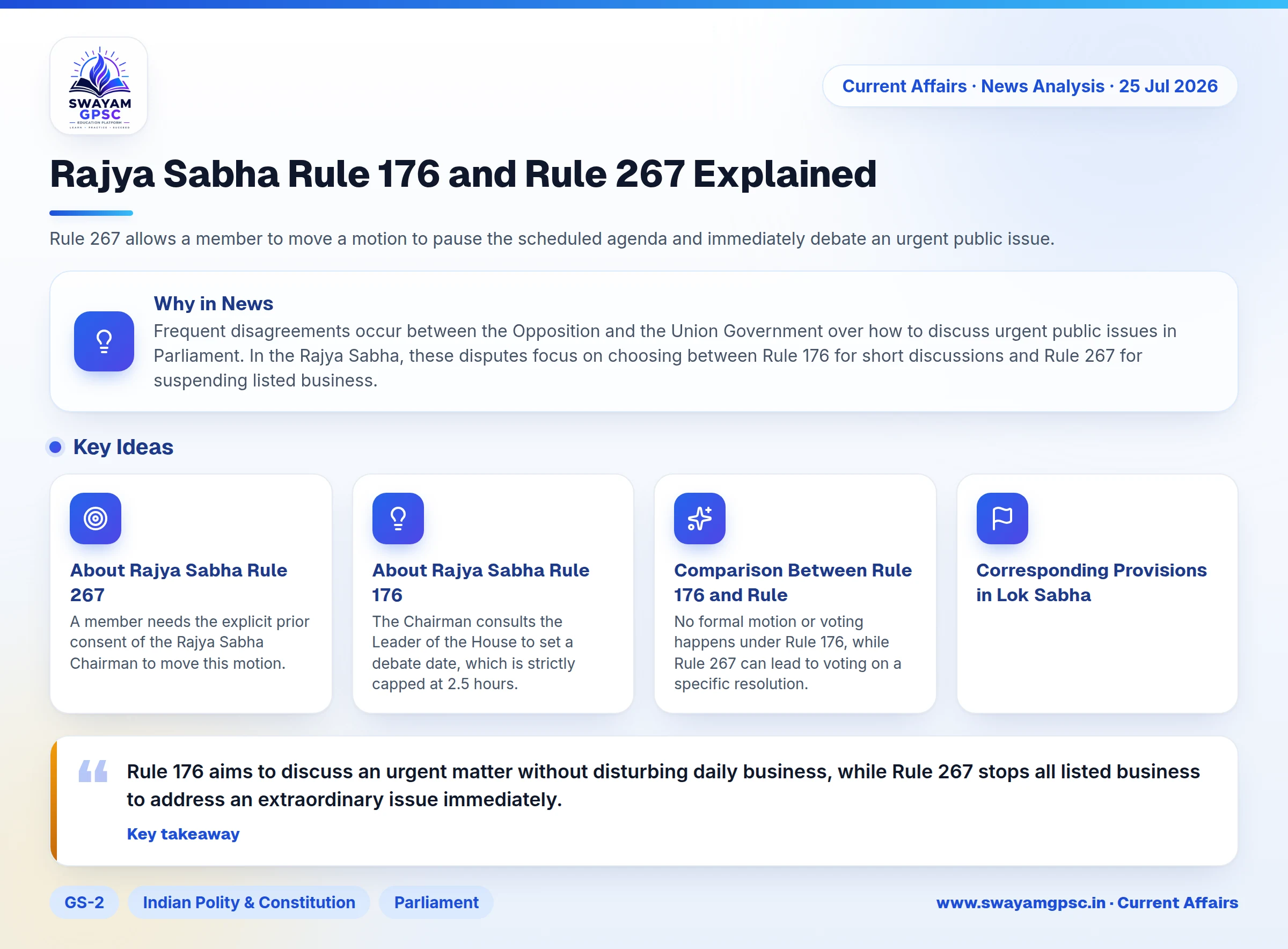
Rajya Sabha Rule 176 and Rule 267 Explained
#GS-2 #Indian Polity & Constitution #Parliament #Executive #Current Events #National #Rajya Sabha Rules
Why in News
- Frequent disagreements occur between the Opposition and the Union Government over how to discuss urgent public issues in Parliament.
- In the Rajya Sabha, these disputes focus on choosing between Rule 176 for short discussions and Rule 267 for suspending listed business.
About Rajya Sabha Rule 267
- Rule 267 allows a member to move a motion to pause the scheduled agenda and immediately debate an urgent public issue.
- A member needs the explicit prior consent of the Rajya Sabha Chairman to move this motion.
- If the Chairman admits the motion, all regular legislative business scheduled for that day is put aside.
- The debate can lead to a formal motion and voting, which carries significant political consequences for the government.
About Rajya Sabha Rule 176
- Rule 176 allows members to hold a short discussion on an urgent public issue without stopping the scheduled agenda.
- A member must submit a written notice to the Secretary-General along with an explanatory note signed by at least two other members.
- The Chairman consults the Leader of the House to set a debate date, which is strictly capped at 2.5 hours.
- This discussion does not end with a formal motion or vote, but the concerned Minister gives an official reply at the end.
Comparison Between Rule 176 and Rule 267
- Rule 176 aims to discuss an urgent matter without disturbing daily business, while Rule 267 stops all listed business to address an extraordinary issue immediately.
- Under Rule 176, regular parliamentary work continues as planned, whereas under Rule 267, scheduled business is completely suspended.
- Debates under Rule 176 have a strict time limit of 2.5 hours, but Rule 267 has no time cap and can take up the whole day.
- No formal motion or voting happens under Rule 176, while Rule 267 can lead to voting on a specific resolution.
- The government usually prefers Rule 176 for controlled debate, whereas opposition members invoke Rule 267 to demand direct accountability.
Corresponding Provisions in Lok Sabha
- Rule 193 in the Lok Sabha works like Rule 176, letting members raise urgent issues through written notice without voting.
- Adjournment Motion under Rule 56 works like Rule 267 by stopping regular business to discuss urgent matters, which implies censure of the government.