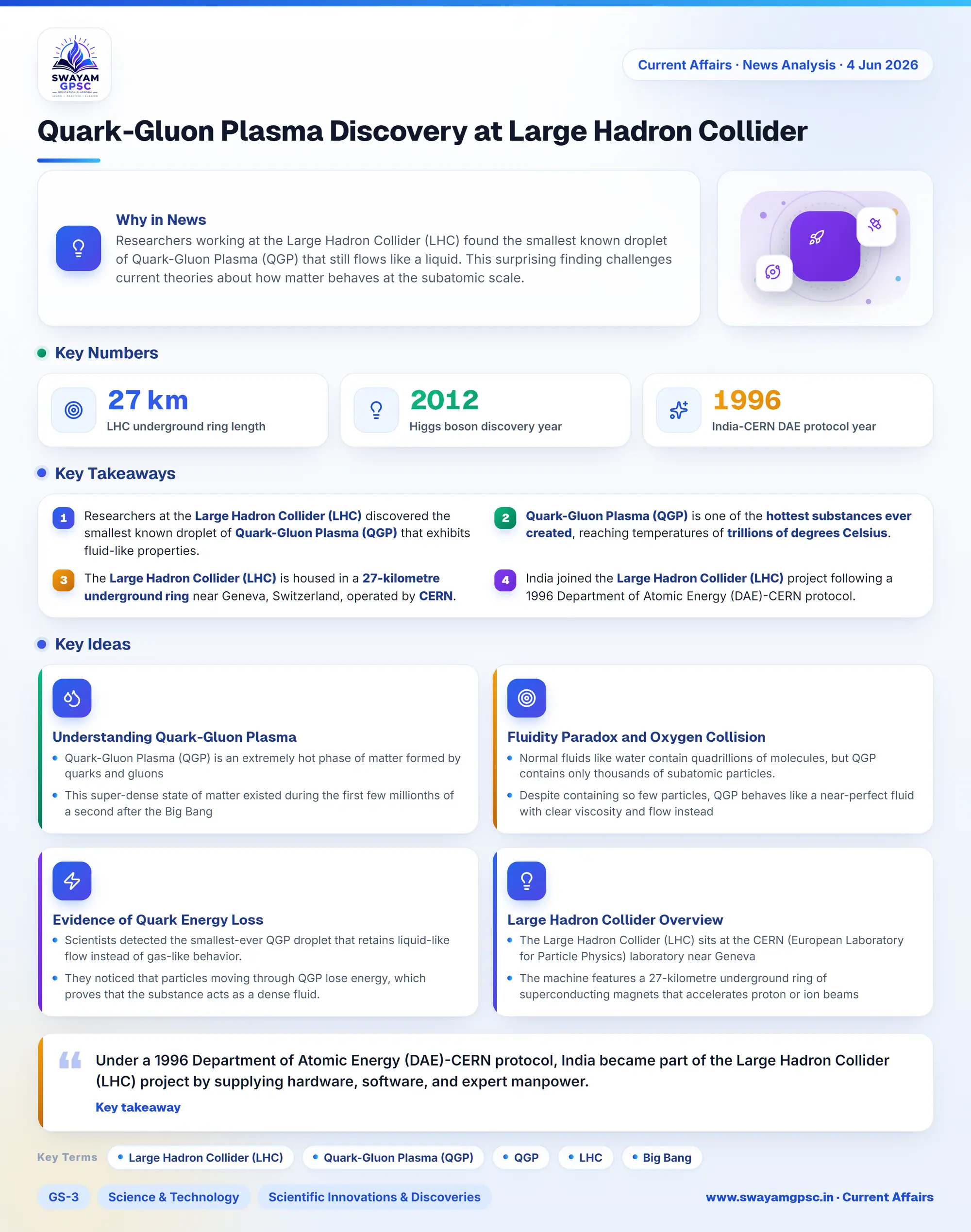
Quark-Gluon Plasma Discovery at Large Hadron Collider
#GS-3 #Science & Technology #Scientific Innovations & Discoveries #Space #Rapid Fire CA #Quick Facts For Prelims
Key takeaways
- Researchers at the Large Hadron Collider (LHC) discovered the smallest known droplet of Quark-Gluon Plasma (QGP) that exhibits fluid-like properties.
- Quark-Gluon Plasma (QGP) is one of the hottest substances ever created, reaching temperatures of trillions of degrees Celsius.
- The Large Hadron Collider (LHC) is housed in a 27-kilometre underground ring near Geneva, Switzerland, operated by CERN.
- India joined the Large Hadron Collider (LHC) project following a 1996 Department of Atomic Energy (DAE)-CERN protocol.
Why in News
- Researchers working at the Large Hadron Collider (LHC) found the smallest known droplet of Quark-Gluon Plasma (QGP) that still flows like a liquid.
- This surprising finding challenges current theories about how matter behaves at the subatomic scale.
Understanding Quark-Gluon Plasma
- Quark-Gluon Plasma (QGP) is an extremely hot phase of matter formed by quarks and gluons, which are the fundamental building blocks of matter.
- This super-dense state of matter existed during the first few millionths of a second after the Big Bang, long before protons and neutrons formed.
- QGP ranks among the hottest substances ever created, with temperatures reaching trillions of degrees Celsius.
- Scientists create this plasma by smashing atomic nuclei together at very high speeds inside the LHC.
- Researchers previously observed QGP mostly in collisions involving heavy elements like lead.
Fluidity Paradox and Oxygen Collision Breakthrough
- Normal fluids like water contain quadrillions of molecules, but QGP contains only thousands of subatomic particles.
- Despite containing so few particles, QGP behaves like a near-perfect fluid with clear viscosity and flow instead of acting like a gas.
- Scientists recently collided oxygen nuclei inside the LHC and proved that this much smaller system could create QGP.
- Oxygen acts as an important middle ground between light protons and heavy lead nuclei.
- This oxygen experiment helps researchers find the exact tipping point where independent particles turn into a collective fluid.
Evidence of Quark Energy Loss
- Scientists detected the smallest-ever QGP droplet that retains liquid-like flow instead of gas-like behavior.
- They noticed that particles moving through QGP lose energy, which proves that the substance acts as a dense fluid.
- This major discovery shows scientists how matter shifts from a gas-like state to a liquid-like state at the smallest scales.
Large Hadron Collider Overview
- The Large Hadron Collider (LHC) sits at the CERN (European Laboratory for Particle Physics) laboratory near Geneva, Switzerland, making it the world's largest and most powerful particle accelerator.
- The machine features a 27-kilometre underground ring of superconducting magnets that accelerates proton or ion beams to near-light speed before crashing them together.
- These high-energy crashes recreate the physical environment that existed right after the Big Bang, letting physicists study subatomic interactions.
- The LHC is most famous for helping confirm the 2012 discovery of the Higgs boson, the particle that gives mass to other particles.
- It continues exploring cosmic mysteries like dark matter, antimatter, and exotic states of matter like quark-gluon plasma.
- Under a 1996 Department of Atomic Energy (DAE)-CERN protocol, India became part of the Large Hadron Collider (LHC) project by supplying hardware, software, and expert manpower.