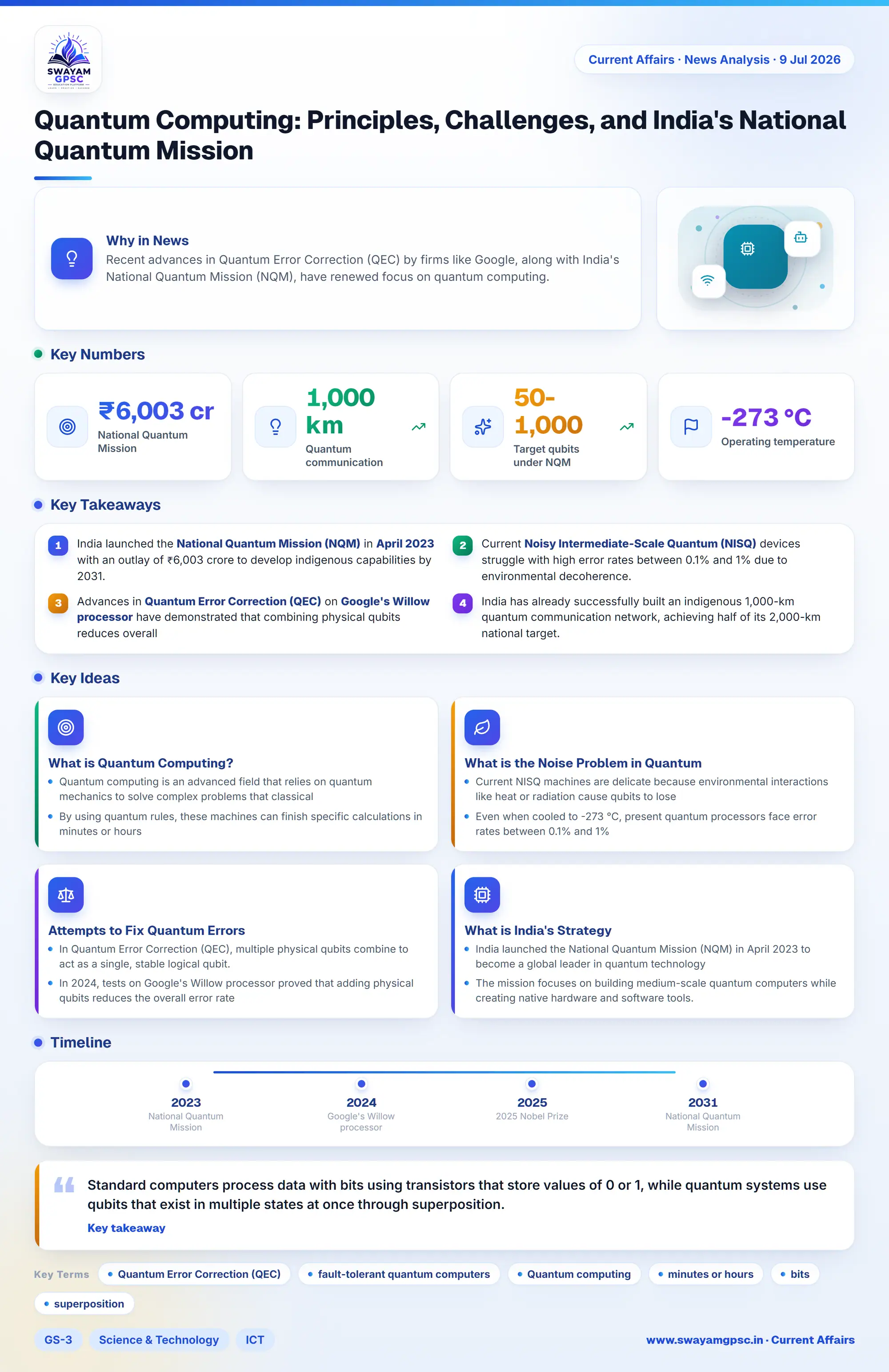
Quantum Computing: Principles, Challenges, and India's National Quantum Mission
#GS-3 #Science & Technology #ICT #National #Quantum Computing
Key takeaways
- India launched the National Quantum Mission (NQM) in April 2023 with an outlay of ₹6,003 crore to develop indigenous capabilities by 2031.
- Current Noisy Intermediate-Scale Quantum (NISQ) devices struggle with high error rates between 0.1% and 1% due to environmental decoherence.
- Advances in Quantum Error Correction (QEC) on Google's Willow processor have demonstrated that combining physical qubits reduces overall system errors.
- India has already successfully built an indigenous 1,000-km quantum communication network, achieving half of its 2,000-km national target.
Why in News
- Recent advances in Quantum Error Correction (QEC) by firms like Google, along with India's National Quantum Mission (NQM), have renewed focus on quantum computing.
- These technical breakthroughs could speed up the move from today's error-prone Noisy Intermediate-Scale Quantum (NISQ) machines to reliable, fault-tolerant quantum computers.
What is Quantum Computing?
- Quantum computing is an advanced field that relies on quantum mechanics to solve complex problems that classical computers cannot handle.
- By using quantum rules, these machines can finish specific calculations in minutes or hours, whereas standard supercomputers would take thousands of years.
- Standard computers process data with bits using transistors that store values of 0 or 1, while quantum systems use qubits that exist in multiple states at once through superposition.
- Under superposition, a qubit does not lock into one value. Instead, it exists in a combination of states, much like a spinning coin before it lands.
- Through entanglement, qubits connect so that changing one immediately alters another, allowing computers to process vast amounts of data at incredible speed.
- Quantum processors use interference to cancel out wrong answers while boosting the signal of correct solutions.
- Through massive parallelism, superposition and entanglement allow quantum machines to test countless possibilities simultaneously, greatly speeding up sorting and search algorithms.
- Engineers build superconducting qubits with a Josephson junction cooled close to absolute zero, which powers Google's Willow processor.
- The 2025 Nobel Prize in Physics was awarded to John Clarke, Michel H. Devoret, and John M. Martinis for discovering quantum tunneling and energy levels in electrical circuits.
- Their work enabled the development of superconducting circuits, forming the foundation for future quantum computers and sensitive sensors.
- Researchers build quantum dot qubits using microscopic semiconductor particles made of silicon or germanium.
- Scientists create trapped ion qubits by holding and guiding individual charged atoms with electromagnetic fields.
- Engineers use photonic qubits by guiding light particles, known as photons, to carry quantum signals.
- Researchers built the earliest quantum demonstration in 1998 using NMR qubits, which rely on the spinning magnetic cores of molecules.
- A Quantum Key Distribution (QKD) network uses light particles to share secret encryption keys securely without risk of hacking.
- If an eavesdropper tries to read the key, the quantum particles change state immediately, exposing the intrusion attempt.
What is the Noise Problem in Quantum Computing?
- Current NISQ machines are delicate because environmental interactions like heat or radiation cause qubits to lose their state, a problem known as decoherence.
- Even when cooled to -273 °C, present quantum processors face error rates between 0.1% and 1%, which is far higher than standard computers.
- Imperfect control systems, such as lasers and microwave pulses used to adjust qubits, introduce extra noise and calculation errors.
Attempts to Fix Quantum Errors
- In Quantum Error Correction (QEC), multiple physical qubits combine to act as a single, stable logical qubit.
- In 2024, tests on Google's Willow processor proved that adding physical qubits reduces the overall error rate, bringing us closer to stable quantum computers.
What is India's Strategy in the Quantum Race?
- India launched the National Quantum Mission (NQM) in April 2023 to become a global leader in quantum technology by 2031.
- The mission focuses on building medium-scale quantum computers while creating native hardware and software tools.
- India aims to build systems with 50 to 1,000 qubits, set up a 2,000-km quantum network, build precise sensors, and establish four Thematic Hubs.
- India has built a 1,000-km quantum communication link through the Department of Science and Technology (DST) and QNu Labs, reaching half its overall target.
Frequently Asked Questions (FAQs)
- Approved in April 2023 with ₹6,003 crore, the National Quantum Mission aims to develop native quantum tech by 2030-31.
- Quantum Error Correction (QEC) groups multiple physical qubits into stable logical qubits to lower error rates as systems grow.
- NISQ devices are current quantum processors that suffer from noise, low qubit counts, and high error rates.
- Quantum Key Distribution (QKD) secures data by using quantum physics, where any spying attempt disturbs the key and alerts users.
- India has built a 1,000-km quantum communication network, covering half of its 2,000-km goal under the national mission.