Punjab-Haryana-Rajasthan Water Dispute: History, Challenges, and Solutions
#GS-2 #Indian Polity & Constitution #Federalism #Current Events #National #GS-3 #Economy #Infrastructure #Agriculture #Environment #Water Resources #Co-operative Federalism
Key takeaways
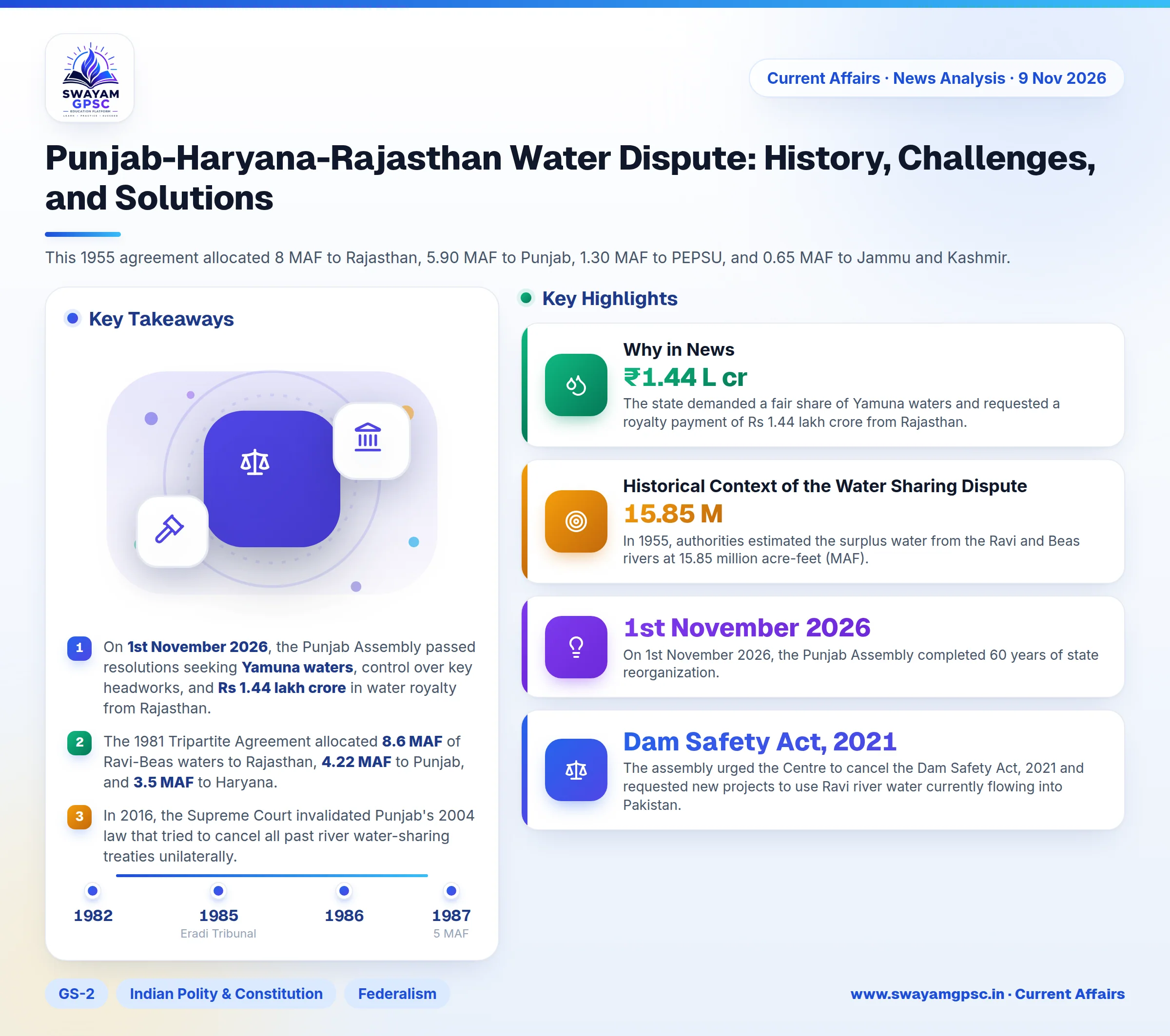
- On 1st November 2026, the Punjab Assembly passed resolutions seeking Yamuna waters, control over key headworks, and Rs 1.44 lakh crore in water royalty from Rajasthan.
- The 1981 Tripartite Agreement allocated 8.6 MAF of Ravi-Beas waters to Rajasthan, 4.22 MAF to Punjab, and 3.5 MAF to Haryana.
- In 2016, the Supreme Court invalidated Punjab's 2004 law that tried to cancel all past river water-sharing treaties unilaterally.
- Inter-state water disputes are governed under Article 262 of the Indian Constitution and the Inter-State River Water Disputes Act, 1956.
Why in News
- On 1st November 2026, the Punjab Assembly completed 60 years of state reorganization.
- To mark this occasion, the assembly passed five resolutions to restart long-standing river water conflicts with neighboring states.
- The state demanded a fair share of Yamuna waters and requested a royalty payment of Rs 1.44 lakh crore from Rajasthan.
- Punjab also demanded total control over the Ropar, Harike, and Ferozepur headworks.
- The assembly urged the Centre to cancel the Dam Safety Act, 2021 and requested new projects to use Ravi river water currently flowing into Pakistan.
Historical Context of the Water Sharing Dispute
- Under a 1920 arrangement, the former princely state of Bikaner received Sutlej river water using the Gang Canal from the Ferozepur headworks by paying usage fees.
- In 1955, authorities estimated the surplus water from the Ravi and Beas rivers at 15.85 million acre-feet (MAF).
- This 1955 agreement allocated 8 MAF to Rajasthan, 5.90 MAF to Punjab, 1.30 MAF to PEPSU, and 0.65 MAF to Jammu and Kashmir.
- When PEPSU merged with Punjab in 1956, the total share for Punjab rose to 7.20 MAF.
- India used these early water allocations to show planned river usage while negotiating the Indus Waters Treaty, 1960.
- The Indus Waters Treaty, 1960 gave India full control over the eastern rivers, which include the Sutlej, Beas, and Ravi.
- After 1960, India treated water sharing as an internal national distribution, leading Rajasthan to stop paying water royalties to Punjab.
- The Punjab Reorganisation Act, 1966 created Haryana and established rules to divide water rights for the Bhakra-Nangal and Beas projects.
- This 1966 law gave the central government authority to set final water shares if the states could not agree within two years.
- Sections 79 and 80 of the 1966 Act specifically governed the management of the Bhakra Management Board and the Beas Project.
- In 1976, the central government assigned 3.5 MAF of water each to Punjab and Haryana, while giving 0.08 MAF to Delhi.
- The Bhakra Beas Management Board (BBMB) continues to control key dams and canals that supply water, electricity, and irrigation across the region.
- A central agreement in 1981 revised the total surplus water pool to 17.17 MAF.
- Under the 1981 pact, Rajasthan received 8.6 MAF, Punjab got 4.22 MAF, Haryana received 3.5 MAF, Jammu & Kashmir got 0.65 MAF, and Delhi received 0.2 MAF.
- The 1981 allocation supported the buildout of the Indira Gandhi Canal in Rajasthan.
- The 1981 pact made it mandatory to build the Sutlej-Yamuna Link (SYL) canal to move water to Haryana.
- Protests named the Nehar Roko Morcha started in 1982, causing political violence in Punjab that left the canal unfinished.
- The central government set up the Eradi Tribunal in 1986 following the 1985 Rajiv-Longowal Accord to recheck water availability.
- In 1987, the tribunal suggested giving 5 MAF to Punjab and 3.83 MAF to Haryana while keeping Rajasthan's share at 8.6 MAF.
- Punjab passed the Punjab Termination of Agreements Act in 2004 to cancel all previous water-sharing deals unilaterally.
- The Supreme Court declared the 2004 state law unconstitutional in 2016, ruling that a single state cannot cancel binding inter-state water deals.
- Because the Punjab Reorganisation Act of 1966 is a central law, state assembly resolutions cannot override it without parliamentary action.
Arguments of the States
- Punjab uses the strict Riparian Principle to argue that rivers like the Ravi, Beas, and Sutlej do not flow through Haryana or Rajasthan.
- Punjab points to its dropping underground water levels and states it has no extra water to share.
- Punjab claims rights to Yamuna water because the river ran through undivided Punjab before 1966.
- Punjab bases its Rs 1.44 lakh crore royalty claim on pre-1960 commercial deals with the former Bikaner state.
- Punjab opposes the Dam Safety Act, 2021, claiming it takes away state control over water resources and damages federal structure.
- Haryana demands the immediate completion of the SYL canal based on the 1981 agreement and Supreme Court judgments.
- Haryana notes that its southern districts face severe dry conditions and require drinking water urgently.
- Rajasthan relies on its 8.6 MAF water share from 1981 to run the Indira Gandhi Canal, which feeds its desert regions.
- Rajasthan rejects royalty demands, stating that post-1960 water allocations are national decisions rather than commercial sales.
Constitutional and Statutory Provisions
- Entry 17 in the State List gives states control over water supply, irrigation, canals, drainage, and hydropower, subject to central laws.
- Entry 56 in the Union List allows Parliament to manage and develop inter-state rivers when it benefits the public interest.
- Entry 32 in the Concurrent List gives joint control over shipping and navigation on inland waterways using motor vessels.
- Article 262 of the Constitution lets Parliament create legal methods to resolve inter-state river disputes while restricting regular courts.
- The Inter-State River Water Disputes Act, 1956 allows the central government to set up a tribunal within one year of a state request.
- A tribunal decision published under the 1956 Act carries the same legal weight as an order from the Supreme Court.
Way Forward
- The central government should order a fresh hydrological study of the Ravi-Beas river basin to measure actual current water flows.
- States must encourage farmers to grow crops like millets, maize, and cotton instead of water-heavy paddy.
- The central government should offer guaranteed Minimum Support Prices to make low-water crops financially attractive to farmers.
- Parliament should set up a single permanent tribunal with set timelines to resolve inter-state water conflicts quickly.
- States should create a joint River Basin Organisation to manage water distribution, environmental needs, and drought planning together.
- Governments must expand subsidies for drip and sprinkler irrigation while repairing canal walls to prevent water leaks.
- Political leaders should resolve the Sutlej-Yamuna Link canal stalemate through neutral central mediation rather than election politics.