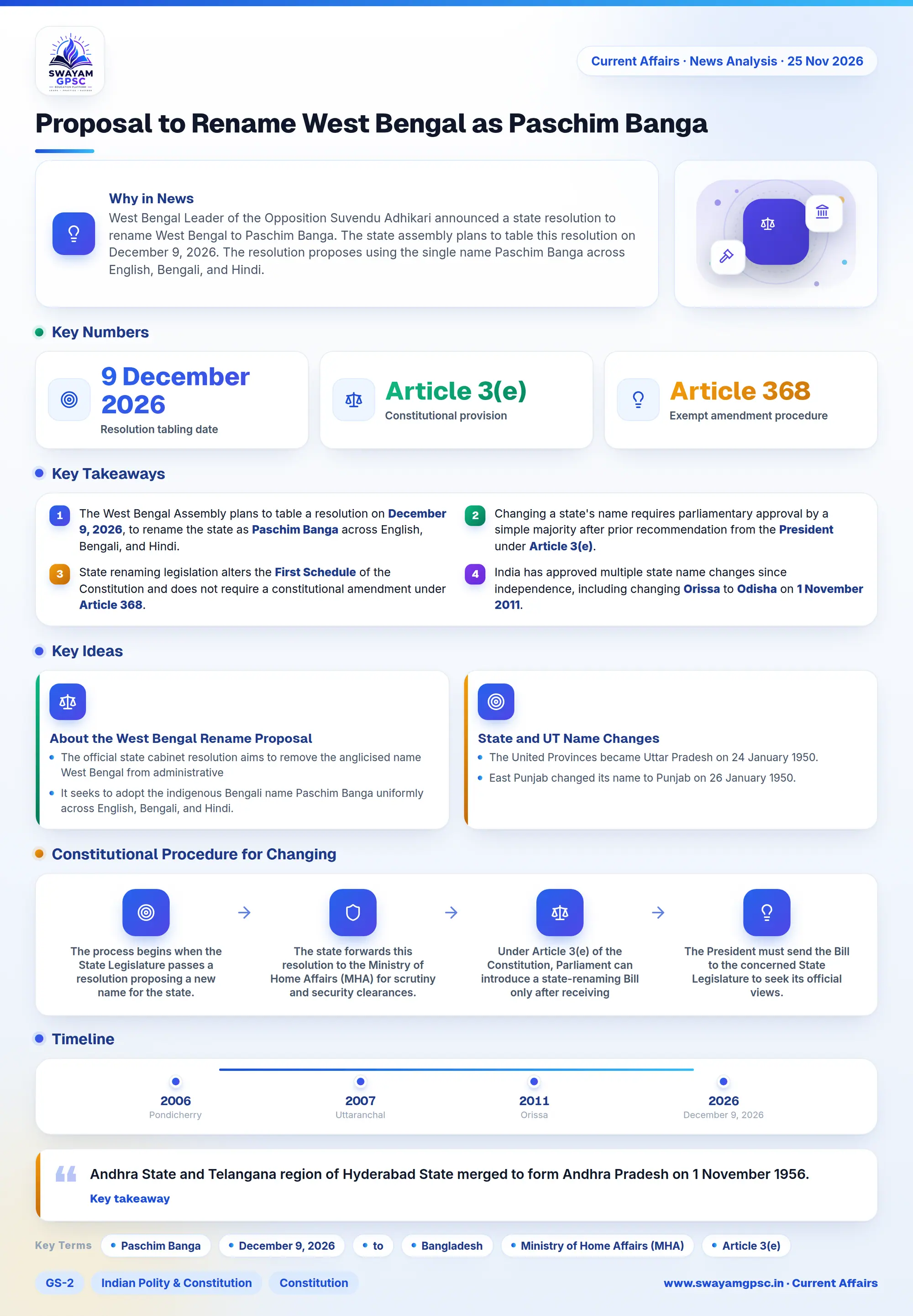
Proposal to Rename West Bengal as Paschim Banga
#GS-2 #Indian Polity & Constitution #Constitution #Current Events #National #State Renaming
Key takeaways
- The West Bengal Assembly plans to table a resolution on December 9, 2026, to rename the state as Paschim Banga across English, Bengali, and Hindi.
- Changing a state's name requires parliamentary approval by a simple majority after prior recommendation from the President under Article 3(e).
- State renaming legislation alters the First Schedule of the Constitution and does not require a constitutional amendment under Article 368.
- India has approved multiple state name changes since independence, including changing Orissa to Odisha on 1 November 2011.
Why in News
- West Bengal Leader of the Opposition Suvendu Adhikari announced a state resolution to rename West Bengal to Paschim Banga.
- The state assembly plans to table this resolution on December 9, 2026.
- The resolution proposes using the single name Paschim Banga across English, Bengali, and Hindi.
About the West Bengal Rename Proposal
- The official state cabinet resolution aims to remove the anglicised name West Bengal from administrative and constitutional records.
- It seeks to adopt the indigenous Bengali name Paschim Banga uniformly across English, Bengali, and Hindi.
- This change moves the state from W to P in national alphabetical order.
- The single-name approach also avoids international confusion with neighbouring Bangladesh.
Constitutional Procedure for Changing a State Name
- The process begins when the State Legislature passes a resolution proposing a new name for the state.
- The state forwards this resolution to the Ministry of Home Affairs (MHA) for scrutiny and security clearances.
- Under Article 3(e) of the Constitution, Parliament can introduce a state-renaming Bill only after receiving the prior recommendation of the President.
- The President must send the Bill to the concerned State Legislature to seek its official views.
- The views expressed by the State Legislature are advisory and do not bind Parliament.
- Both Houses of Parliament must pass the renaming Bill using a simple majority.
- Under Article 4, state renaming laws do not count as formal constitutional amendments under Article 368.
- The President gives final assent to the Bill to grant legal effect to the new state name.
- This final assent updates the name entry in the First Schedule and, if needed, the Fourth Schedule of the Constitution.
State and UT Name Changes Since Independence
- The United Provinces became Uttar Pradesh on 24 January 1950.
- East Punjab changed its name to Punjab on 26 January 1950.
- Central Provinces and Berar was renamed Madhya Pradesh on 26 January 1950.
- Madras Presidency transitioned to Madras State on 26 January 1950.
- Travancore-Cochin became Kerala on 1 November 1956.
- Andhra State and Telangana region of Hyderabad State merged to form Andhra Pradesh on 1 November 1956.
- Madras State officially changed its name to Tamil Nadu on 14 January 1969.
- Mysore State adopted the name Karnataka on 1 November 1973.
- Laccadive, Minicoy and Amindivi Islands was renamed Lakshadweep on 1 November 1973.
- Delhi became the National Capital Territory of Delhi on 1 February 1992.
- Pondicherry updated its official name to Puducherry on 1 October 2006.
- Uttaranchal changed its name to Uttarakhand on 1 January 2007.
- Orissa officially became Odisha on 1 November 2011.
- Kerala proposed changing its official name to Keralam in 2026.