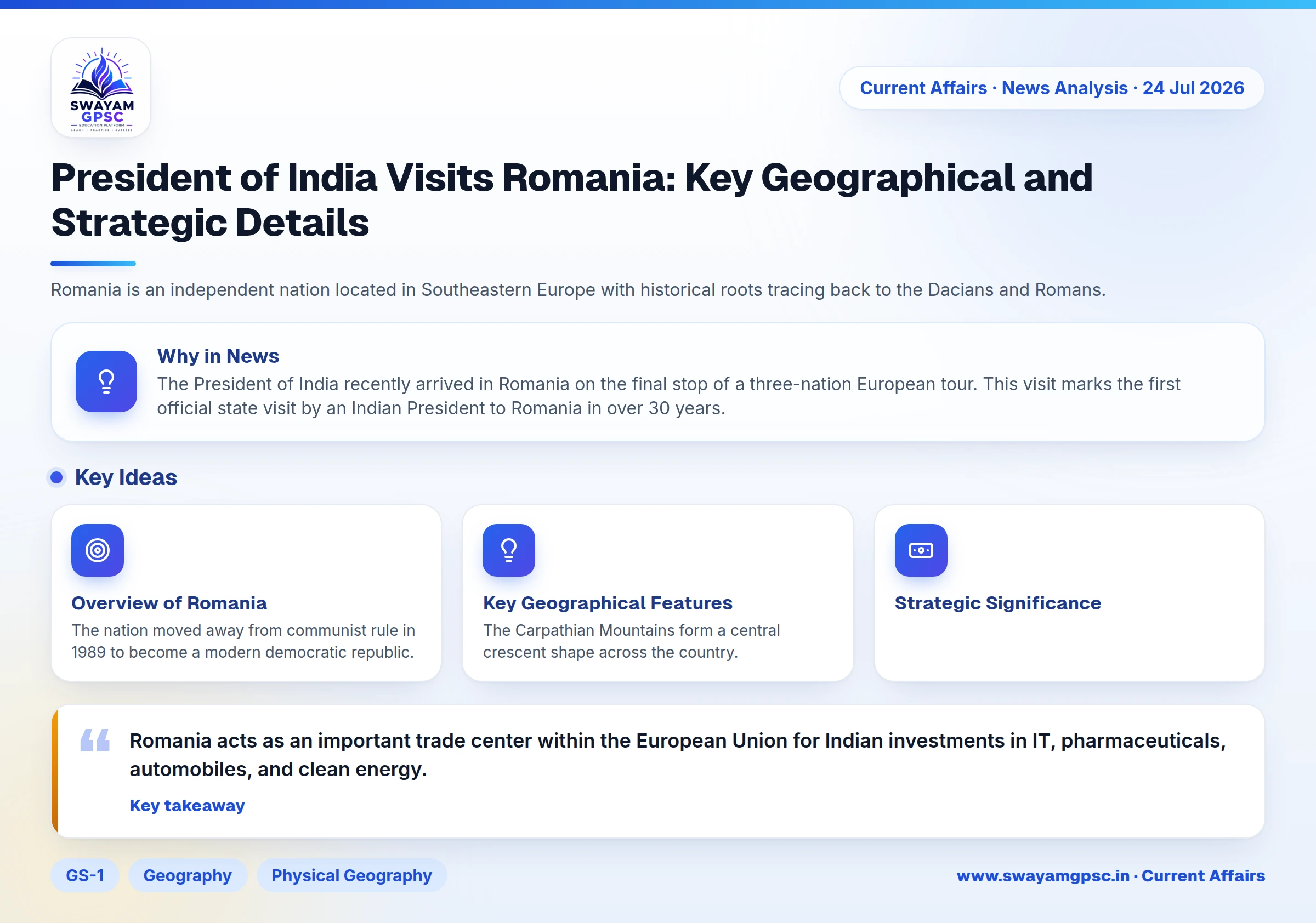
President of India Visits Romania: Key Geographical and Strategic Details
#GS-1 #Geography #Physical Geography #GS-3 #Current Events #International #Mapping #Romania
Why in News
- The President of India recently arrived in Romania on the final stop of a three-nation European tour.
- This visit marks the first official state visit by an Indian President to Romania in over 30 years.
Overview of Romania
- Romania is an independent nation located in Southeastern Europe with historical roots tracing back to the Dacians and Romans.
- The nation moved away from communist rule in 1989 to become a modern democratic republic.
- It gained full membership in NATO in 2004 and joined the European Union in 2007.
- Bucharest serves as the capital city and represents the primary economic and cultural hub of Romania.
- Located near the Transylvanian Basin and the Danube River delta, Romania shares land borders with five nations including Ukraine, Moldova, Bulgaria, Serbia, and Hungary, while bordering The Black Sea to the east.
Key Geographical Features
- The physical terrain of Romania is balanced equally into three main parts: one-third mountain ranges, one-third hills and plateaus, and one-third fertile lowland plains.
- The Carpathian Mountains form a central crescent shape across the country.
- The Eastern Carpathians feature volcanic formations, natural mineral springs, and deposits of copper and lead.
- The Southern Carpathians, also known as the Transylvanian Alps, contain the highest peak in Romania, Mount Moldoveanu (2,544 m), alongside the scenic Iron Gate gorge on the Danube River.
- The Western Carpathians store rich reserves of iron ore, marble, and metallic minerals.
- The Transylvanian Basin forms an elevated heartland bordered by rolling plateaus and Subcarpathian hills.
- Fertile black soils called chernozem cover the southern Walachian Plain and western plains, making Romania a major producer of grain crops.
- The Danube Delta is a recognized UNESCO World Heritage site located where the Danube River flows into the Black Sea, forming Europe's second-largest river delta and a vital wetland biosphere.
Strategic Significance
- Romania acts as an important trade center within the European Union for Indian investments in IT, pharmaceuticals, automobiles, and clean energy.
- Its strategic location on the Black Sea with the Port of Constanța strengthens regional stability, supply networks, and economic trade links between Europe and Asia.