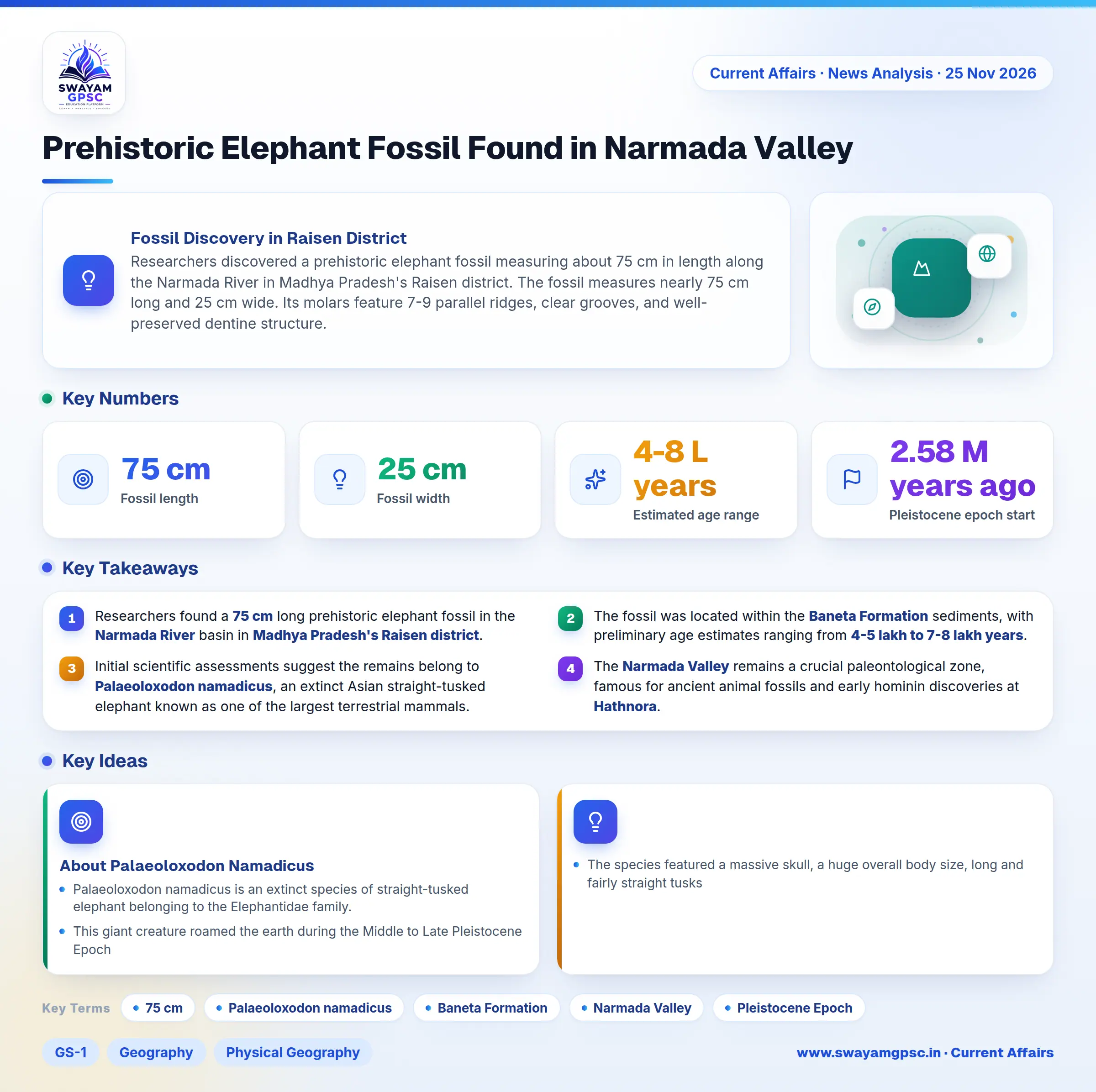
Prehistoric Elephant Fossil Found in Narmada Valley
#GS-1 #Geography #Physical Geography #GS-3 #Science & Technology #Current Events #National #Paleontology #Prehistoric India #Archaeology
Key takeaways
- Researchers found a 75 cm long prehistoric elephant fossil in the Narmada River basin in Madhya Pradesh's Raisen district.
- The fossil was located within the Baneta Formation sediments, with preliminary age estimates ranging from 4-5 lakh to 7-8 lakh years.
- Initial scientific assessments suggest the remains belong to Palaeoloxodon namadicus, an extinct Asian straight-tusked elephant known as one of the largest terrestrial mammals.
- The Narmada Valley remains a crucial paleontological zone, famous for ancient animal fossils and early hominin discoveries at Hathnora.
Fossil Discovery in Raisen District
- Researchers discovered a prehistoric elephant fossil measuring about 75 cm in length along the Narmada River in Madhya Pradesh's Raisen district.
- The fossil measures nearly 75 cm long and 25 cm wide. Its molars feature 7-9 parallel ridges, clear grooves, and well-preserved dentine structure.
- Initial examination of the teeth suggests that the animal was not fully grown when it died.
- Scientists preliminarily identified the specimen as Palaeoloxodon namadicus. However, they have not ruled out the possibility that it belongs to Stegodon, another extinct elephant relative.
- The fossil was found embedded in yellowish sediments of the Baneta Formation, which belongs to the Pleistocene Epoch. Early estimates place its age between 4-5 lakh to 7-8 lakh years, pending formal laboratory dating.
- The Narmada Valley contains abundant fossil remains of ancient animals like elephants, rhinoceroses, hippopotamuses, and horses. Previous hominin fossil finds at Hathnora in Madhya Pradesh confirm the valley's critical role in studying prehistoric biodiversity and human evolution in India.
About Palaeoloxodon Namadicus
- Palaeoloxodon namadicus is an extinct species of straight-tusked elephant belonging to the Elephantidae family. It is commonly referred to as the Asian straight-tusked elephant.
- This giant creature roamed the earth during the Middle to Late Pleistocene Epoch, which lasted from roughly 2.58 million to 11,700 years ago.
- The species featured a massive skull, a huge overall body size, long and fairly straight tusks, and specialized molars. Scientists consider it one of the largest land mammals to have ever lived.