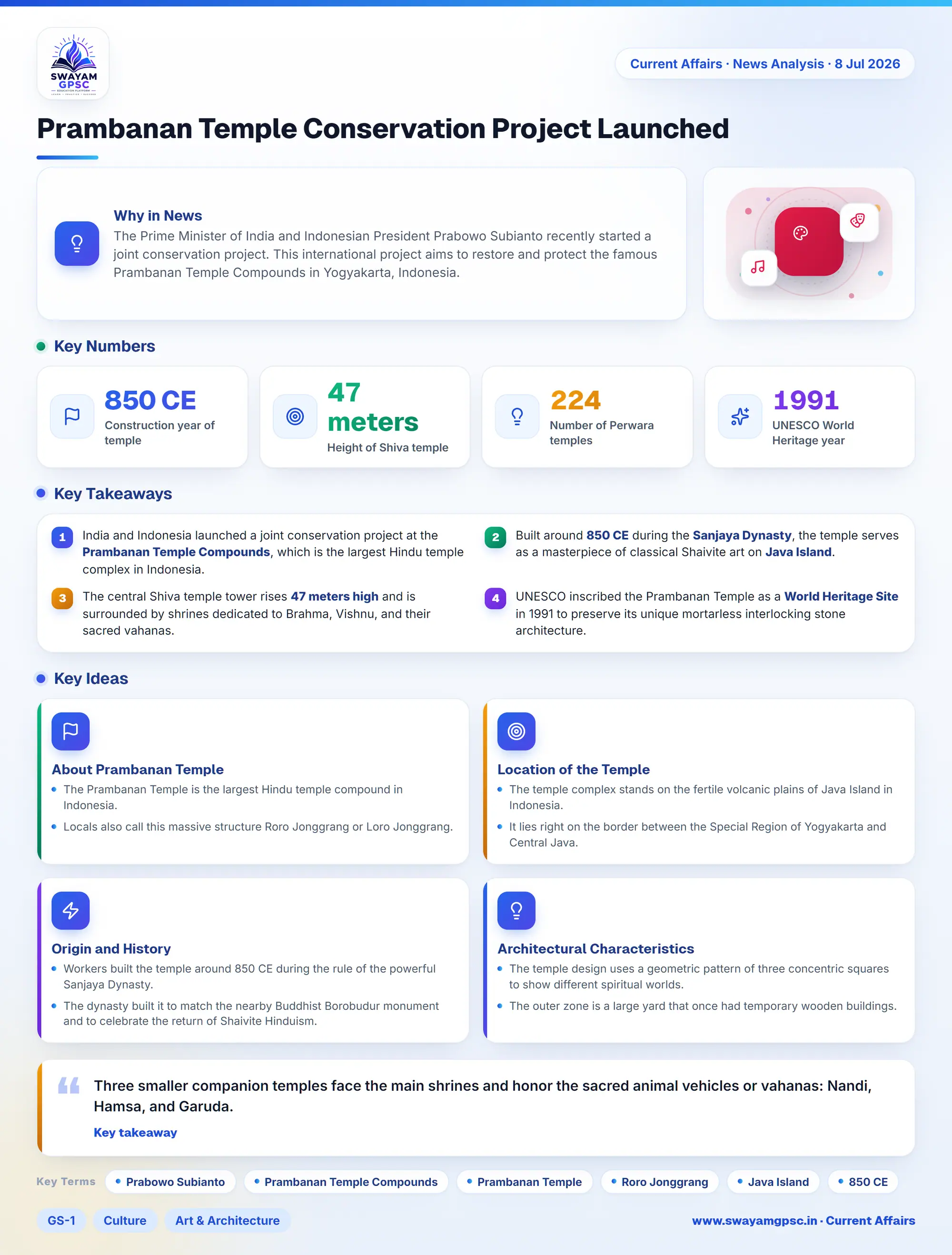
Prambanan Temple Conservation Project Launched
#GS-1 #Culture #Art & Architecture #Heritage #GS-2 #Current Events #International
Key takeaways
- India and Indonesia launched a joint conservation project at the Prambanan Temple Compounds, which is the largest Hindu temple complex in Indonesia.
- Built around 850 CE during the Sanjaya Dynasty, the temple serves as a masterpiece of classical Shaivite art on Java Island.
- The central Shiva temple tower rises 47 meters high and is surrounded by shrines dedicated to Brahma, Vishnu, and their sacred vahanas.
- UNESCO inscribed the Prambanan Temple as a World Heritage Site in 1991 to preserve its unique mortarless interlocking stone architecture.
Why in News
- The Prime Minister of India and Indonesian President Prabowo Subianto recently started a joint conservation project.
- This international project aims to restore and protect the famous Prambanan Temple Compounds in Yogyakarta, Indonesia.
About Prambanan Temple
- The Prambanan Temple is the largest Hindu temple compound in Indonesia.
- Locals also call this massive structure Roro Jonggrang or Loro Jonggrang.
- It is one of the biggest Hindu temples in Southeast Asia and represents the peak of classical Shaivite art.
Location of the Temple
- The temple complex stands on the fertile volcanic plains of Java Island in Indonesia.
- It lies right on the border between the Special Region of Yogyakarta and Central Java.
Origin and History
- Workers built the temple around 850 CE during the rule of the powerful Sanjaya Dynasty.
- The dynasty built it to match the nearby Buddhist Borobudur monument and to celebrate the return of Shaivite Hinduism.
- The temple was abandoned in the 11th century after power shifted to East Java and the Mount Merapi volcano erupted.
- British surveyors rediscovered the forgotten ruins in the early 19th century during their brief rule over Java.
- Scientific restoration of the site started in 1918 to rebuild the broken stone structures.
- UNESCO declared the temple complex a World Heritage Site in 1991 to protect its historical value.
- The Indonesian government named it a National Cultural Property in 1998.
Architectural Characteristics
- The temple design uses a geometric pattern of three concentric squares to show different spiritual worlds.
- The outer zone is a large yard that once had temporary wooden buildings.
- The middle zone contains 224 small, identical guardian shrines called Perwara temples arranged in four neat rows.
- The inner zone is a raised sacred platform that holds the 16 main temples.
- Three tall spires called shikharas dominate the inner square and represent the Hindu Trinity or Trimurti.
- The central Shiva temple rises 47 meters high and holds a large statue of Shiva Mahadeva.
- The Brahma temple stands to the north of the Shiva tower, while the Vishnu temple stands to the south.
- Three smaller companion temples face the main shrines and honor the sacred animal vehicles or vahanas: Nandi, Hamsa, and Garuda.
- The inner walls feature detailed stone carvings that tell the Indonesian version of the Ramayana and Bhagavata Purana.
- Builders used interlocking stone joints without any mortar, which helps the heavy towers survive earthquakes.