Pradhan Mantri Samajik Sahayata Yojana: Expanded Disability Coverage and Social Security Framework
#GS-2 #Governance & Social Justice #Social Justice #Vulnerable Sections #Poverty #Government Policies & Interventions #Important Schemes #Welfare Schemes
Key takeaways
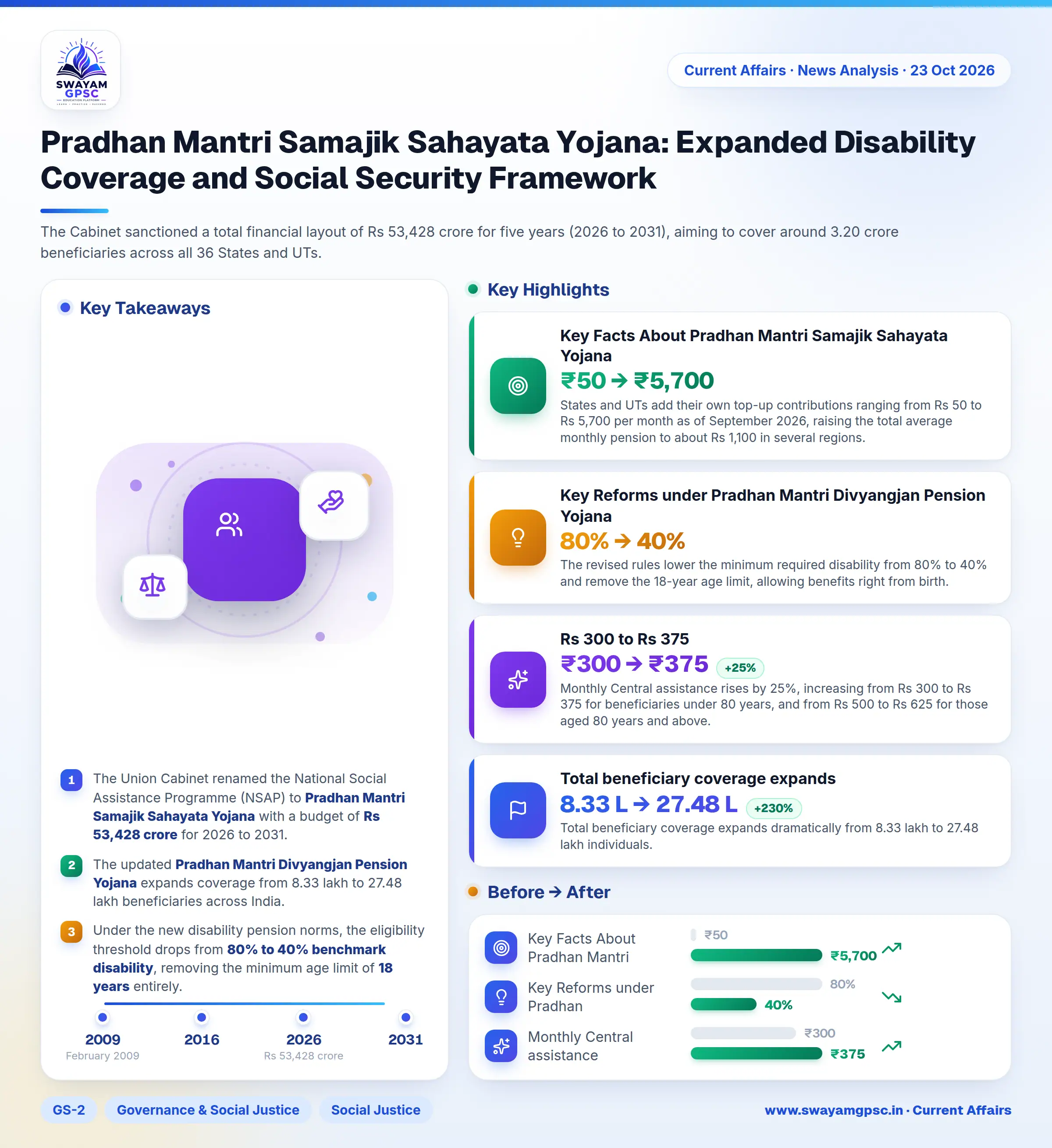
- The Union Cabinet renamed the National Social Assistance Programme (NSAP) to Pradhan Mantri Samajik Sahayata Yojana with a budget of Rs 53,428 crore for 2026 to 2031.
- The updated Pradhan Mantri Divyangjan Pension Yojana expands coverage from 8.33 lakh to 27.48 lakh beneficiaries across India.
- Under the new disability pension norms, the eligibility threshold drops from 80% to 40% benchmark disability, removing the minimum age limit of 18 years entirely.
- Monthly central pension rates for disabled beneficiaries have increased by 25%, raising payouts to Rs 375 for those aged 0 to 79 years and Rs 625 for those aged 80 years and above.
Why in News
- The Union Cabinet approved the continuation and renaming of the National Social Assistance Programme (NSAP) as the Pradhan Mantri Samajik Sahayata Yojana.
- The Cabinet also approved significant revisions to the disability pension framework under this newly renamed scheme.
Key Facts About Pradhan Mantri Samajik Sahayata Yojana
- The scheme originally began as the National Social Assistance Programme (NSAP) on 15th August 1995 to offer monetary help to Below Poverty Line (BPL) families dealing with old age, widowhood, disability, or the death of a primary earner.
- The programme gives effect to Article 41 under the Directive Principles of State Policy (DPSP), which directs the State to provide public aid in cases of unemployment, old age, sickness, and disablement within its economic limits.
- The Ministry of Rural Development oversees this 100% central-funded Centrally Sponsored Scheme to ensure minimum cash support reaches eligible people in both rural and urban areas.
- States and Union Territories implement the scheme on the ground, while Gram Panchayats and municipalities identify beneficiaries and process payments through Direct Benefit Transfer (DBT).
- The Cabinet sanctioned a total financial layout of Rs 53,428 crore for five years (2026 to 2031), aiming to cover around 3.20 crore beneficiaries across all 36 States and UTs.
- States and UTs add their own top-up contributions ranging from Rs 50 to Rs 5,700 per month as of September 2026, raising the total average monthly pension to about Rs 1,100 in several regions.
- The old-age pension, widow pension, and family benefit components continue without change, while the disability pension underwent updates regarding coverage, assistance rates, and basic eligibility.
Revised Components of the Framework
- Under the Pradhan Mantri Vay Vandana Pension Yojana (formerly IGNOAPS), eligible BPL individuals aged 60 to 79 years receive Rs 200 monthly, while those aged 80 years and above receive Rs 500 monthly.
- Under the Pradhan Mantri Widow Pension Yojana (formerly IGNWPS), eligible BPL widows aged 40 to 79 years receive a monthly assistance of Rs 300.
- Under the Pradhan Mantri Divyangjan Pension Yojana (formerly IGNDPS), eligible BPL individuals with 40% or more benchmark disability aged 0 to 79 years receive Rs 375 monthly, while those aged 80 years and above receive Rs 625 monthly.
- Under the Pradhan Mantri Parivar Sahayata Yojana (formerly NFBS), a one-time lump-sum payment of Rs 20,000 is provided to a BPL family upon the death of a primary breadwinner aged 18 to 59 years.
Significance of the Framework
- Lowering the disability threshold to 40 to 79% removes earlier exclusion barriers that required an 80% disability limit.
- Scrapping the minimum age barrier allows children with benchmark disabilities from BPL households to receive financial aid early in life.
- Increasing the monthly financial payout provides stronger basic income security to economically weak individuals living with disabilities.
- Combining Central funding with State top-ups reinforces cooperative federalism while keeping a uniform minimum social safety net across the nation.
Key Reforms under Pradhan Mantri Divyangjan Pension Yojana
- The scheme began in February 2009 as the Indira Gandhi National Disability Pension Scheme to support BPL individuals aged 18 years and above with at least 80% disability.
- The updated guidelines align with the Rights of Persons with Disabilities Act, 2016, which gives legal backing to the UN Convention on the Rights of Persons with Disabilities (UNCRPD).
- Section 2(r) of the 2016 Act defines a person with a benchmark disability as anyone holding a certificate for at least 40% specified disability from a competent medical authority.
- The revised rules lower the minimum required disability from 80% to 40% and remove the 18-year age limit, allowing benefits right from birth.
- Monthly Central assistance rises by 25%, increasing from Rs 300 to Rs 375 for beneficiaries under 80 years, and from Rs 500 to Rs 625 for those aged 80 years and above.
- Total beneficiary coverage expands dramatically from 8.33 lakh to 27.48 lakh individuals.
- Government authorities must issue and execute the updated guidelines detailing eligibility criteria, targeted coverage numbers, and payout rates within 3 months of Cabinet approval.
Conclusion
- The Pradhan Mantri Samajik Sahayata Yojana strengthens India's social safety system by expanding coverage for disabled citizens, boosting direct transfers, and keeping core support intact for poor families.
- Aligning pension rules with the Rights of Persons with Disabilities Act, 2016 moves the nation closer to an inclusive, rights-focused, and accessible welfare network.