Fair International Law: Navigating the Authoritarian Challenge
#GS-2 #Current Events #International #Governance & Social Justice #Regulatory Bodies #International Treaties & Agreements #Groupings & Agreements Involving India and/or Affecting India's Interests #Important International Institutions
Key takeaways
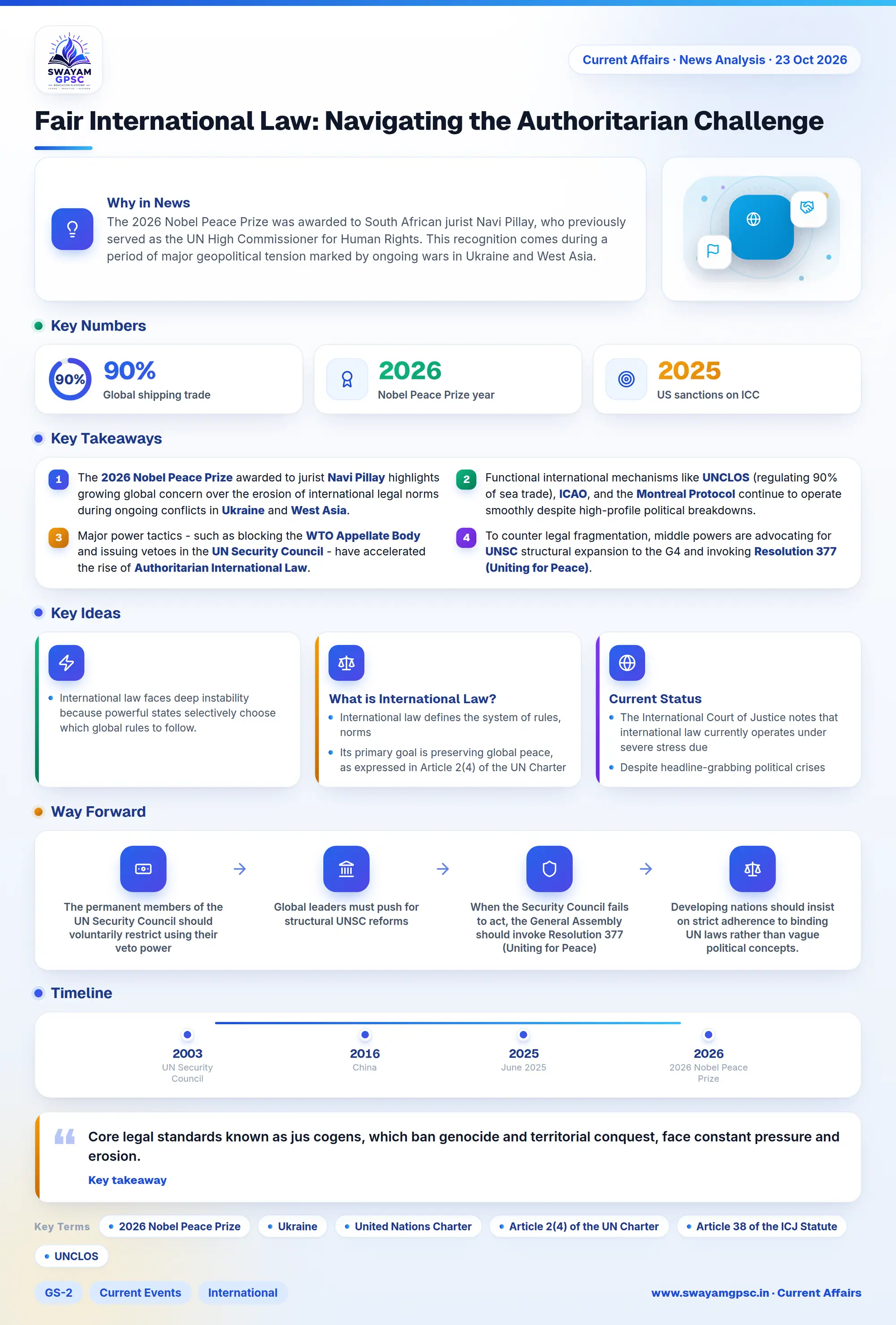
- The 2026 Nobel Peace Prize awarded to jurist Navi Pillay highlights growing global concern over the erosion of international legal norms during ongoing conflicts in Ukraine and West Asia.
- Functional international mechanisms like UNCLOS (regulating 90% of sea trade), ICAO, and the Montreal Protocol continue to operate smoothly despite high-profile political breakdowns.
- Major power tactics - such as blocking the WTO Appellate Body and issuing vetoes in the UN Security Council - have accelerated the rise of Authoritarian International Law.
- To counter legal fragmentation, middle powers are advocating for UNSC structural expansion to the G4 and invoking Resolution 377 (Uniting for Peace).
Why in News
- The 2026 Nobel Peace Prize was awarded to South African jurist Navi Pillay, who previously served as the UN High Commissioner for Human Rights.
- This recognition comes during a period of major geopolitical tension marked by ongoing wars in Ukraine and West Asia.
- These current conflict zones highlight repeated breaches of the core principles found in the United Nations Charter.
- The Nobel Committee emphasized that maintaining a fair, rights-based global legal system is essential to push back against Authoritarian International Law.
Summary
- International law faces deep instability because powerful states selectively choose which global rules to follow.
- Authoritarian regimes increasingly reframe global legal rules to protect their own political control and resist external scrutiny.
- A functioning legal system requires reformed global institutions, equal representation for developing nations, and consistent enforcement of legal standards.
- India can play a central role in renewing international law by advocating for reformed multilateralism and defending the UN Charter.
What is International Law?
- International law defines the system of rules, norms, and standards that govern relations between sovereign states and recognized global entities.
- Its primary goal is preserving global peace, as expressed in Article 2(4) of the UN Charter, which bans the threat or use of force against any country.
- Under Article 38 of the ICJ Statute, legal rules come from international treaties, customary practices, general legal principles, and court rulings.
- After World War II, the global legal framework expanded its scope to make individual human beings direct subjects of rights and protection.
Current Status
- The International Court of Justice notes that international law currently operates under severe stress due to aggressive power politics.
- Despite headline-grabbing political crises, large parts of functional international law operate quietly every day with high global compliance.
- The International Civil Aviation Organization (ICAO) and the International Telecommunication Union (ITU) manage cross-border flights and global GPS networks without major conflict.
- The UNCLOS framework governs 90 percent of international shipping, supported by agreements like the High Seas Treaty (BBNJ) and the Outer Space Treaty.
- Environmental agreements like the Montreal Protocol demonstrate successful global cooperation by healing the protective ozone layer.
- Agencies like WIPO, the Universal Postal Union, and the WHO enforce everyday rules for patents, international mail, and public health safeguards.
How are States Retooling International Law?
- Authoritarian governments use national sovereignty as a total shield to block international investigations into internal human rights actions.
- For example, China dismisses reports by the UN OHCHR regarding human rights in Xinjiang by claiming foreign interference.
- Similarly, Israel routinely rejects findings from UN human rights bodies regarding its operations in Gaza and the West Bank.
- Major powers like the US have previously pulled out of global agreements like the Paris Agreement and institutions like UNESCO when domestic interests conflicted.
- Some countries create weaker international forums without independent oversight bodies so that member states avoid institutional accountability.
- The US-backed Board of Peace for Gaza and the June 2025 US veto of a ceasefire resolution reflect attempts to bypass established UN processes.
- The Shanghai Cooperation Organisation (SCO) focuses on regime security while lacking an independent judicial body to hold governments accountable.
- Governments increasingly reject independent courts, preferring private bilateral talks where larger economies can exert greater leverage.
- In 2016, China ignored the binding Permanent Court of Arbitration (PCA) ruling that favored the Philippines in the South China Sea.
- In 2025, the US introduced targeted sanctions against ICC officials over ongoing war crime investigations, undermining judicial independence.
- Powerful countries undermine global economic rules by using national security claims to justify trade protectionism.
- The US blocked new judge appointments to the WTO Appellate Body, which completely paralyzed the global trade settlement process.
- Laws like the US Inflation Reduction Act (IRA) and the CHIPS Act provide large subsidies that challenge core WTO non-discrimination principles.
- Western governments frequently talk about a Rules-Based Order instead of binding international law, allowing flexible application of global standards.
- While Western powers condemn foreign invasions, they have historically bypassed the UN Security Council for past interventions like the 2003 Iraq War.
Implications
- Core legal standards known as jus cogens, which ban genocide and territorial conquest, face constant pressure and erosion.
- When powerful Western nations shield their allies from legal consequences, developing countries lose faith in global institutions.
- Abandoning universal legal rules risks dividing the world back into spheres of influence dominated by military power.
- India relies on established treaties like UNCLOS to maintain free trade and open sea routes across the Indo-Pacific.
- A breakdown in the WTO Dispute Settlement Mechanism exposes growing economies like India to sudden unilateral trade tariffs.
- India must balance its position between Western political narratives and aggressive Sino-Russian moves while keeping its strategic independence.
- India consistently supports global law by participating in UN peacekeeping forces and respecting international judicial decisions.
Authoritarian International Law
- Legal scholar Tom Ginsburg describes Authoritarian International Law as a framework designed to prioritize government survival over individual civil rights.
- Unlike the post-1945 liberal system that focuses on human dignity, authoritarian rules aim to protect state leaders from foreign criticism.
- This philosophy treats global agreements simply as tools to help autocratic governments maintain internal control.
Challenges in Preserving a Fair International Law
- International law lacks a global police force, leaving courts like the ICJ dependent on a veto-blocked UN Security Council (UNSC).
- Rising nationalist movements often label international legal rules as foreign interference to build domestic political support.
- Current global institutions like the UN still reflect political conditions from 1945, leaving regions like Africa and South Asia underrepresented.
- Nationalist pushback slows down the gradual adoption of global human rights norms within local legal systems.
Way Forward
- The permanent members of the UN Security Council should voluntarily restrict using their veto power during mass atrocity investigations.
- Global leaders must push for structural UNSC reforms, including expanded permanent seats for growing nations in the G4 group.
- When the Security Council fails to act, the General Assembly should invoke Resolution 377 (Uniting for Peace) to coordinate global action.
- Developing nations should insist on strict adherence to binding UN laws rather than vague political concepts.
- Trading nations should join alternative arrangements like the Multi-Party Interim Appeal Arbitration Arrangement (MPIA) to resolve commercial disputes.
- National courts can use universal jurisdiction to try major international crimes locally, similar to Germany's prosecution of foreign war crimes.
- Countries need to negotiate binding rules for modern challenges, including cyber defense limits based on the Tallinn Manual and updates to the 1967 Outer Space Treaty.
- International financial bodies like the IMF and World Bank need voting quota reforms to give developing nations equal influence.
- Middle powers can use platforms like the G20 to build consensus and bridge political divides between major power blocs.
Conclusion
- India is well positioned to act as a Vishwa Mitra by leading efforts toward a balanced global system.
- By backing reformed multilateral institutions, India can help build an international legal order that protects global rights and treats all nations fairly.