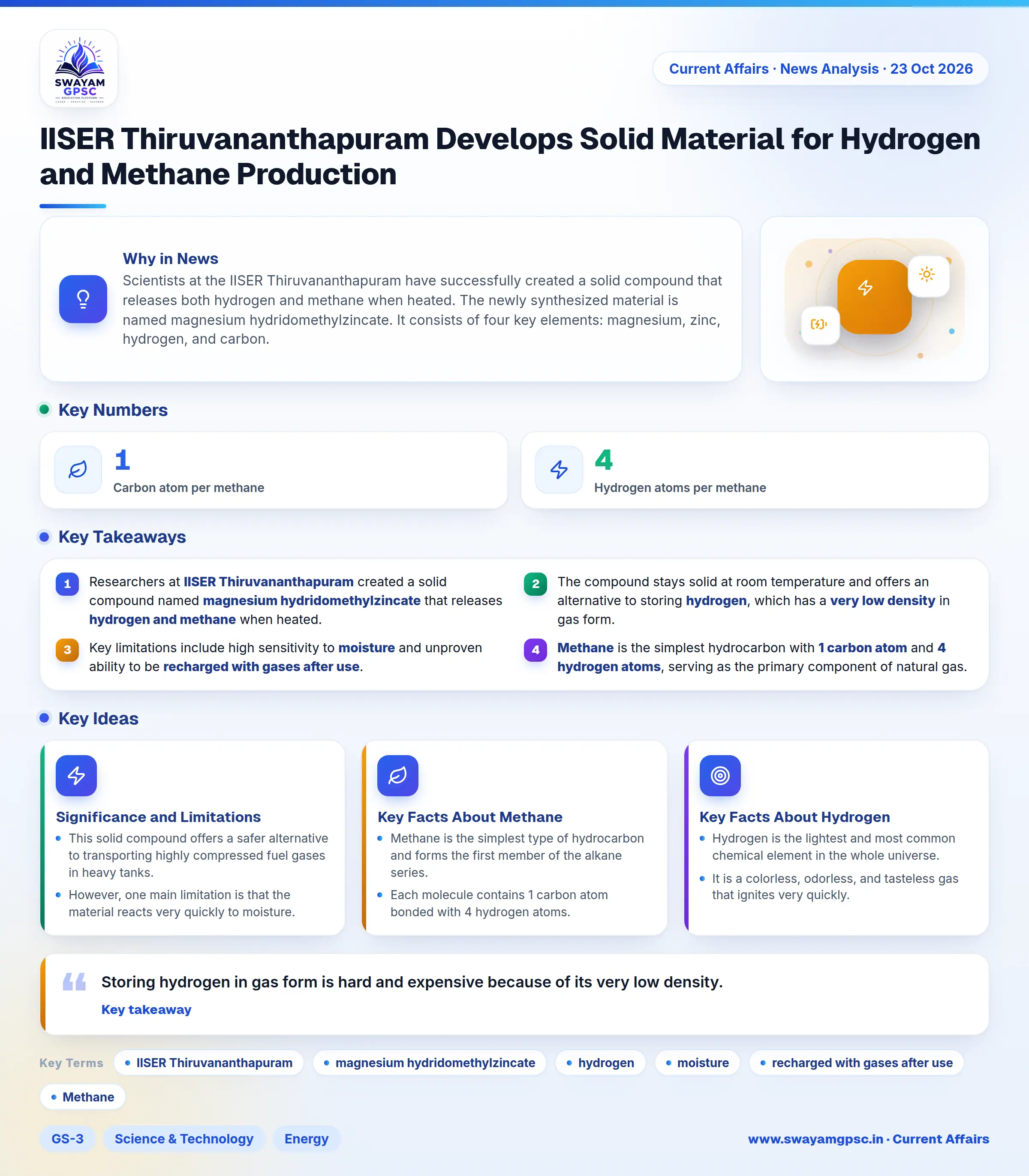
IISER Thiruvananthapuram Develops Solid Material for Hydrogen and Methane Production
#GS-3 #Science & Technology #Energy #Environment #Conservation #Growth & Development #Rapid Fire CA
Key takeaways
- Researchers at IISER Thiruvananthapuram created a solid compound named magnesium hydridomethylzincate that releases hydrogen and methane when heated.
- The compound stays solid at room temperature and offers an alternative to storing hydrogen, which has a very low density in gas form.
- Key limitations include high sensitivity to moisture and unproven ability to be recharged with gases after use.
- Methane is the simplest hydrocarbon with 1 carbon atom and 4 hydrogen atoms, serving as the primary component of natural gas.
- Green Hydrogen is produced by splitting water (H2O) using renewable energy, offering a low-emission fuel alternative.
Why in News
- Scientists at the IISER Thiruvananthapuram have successfully created a solid compound that releases both hydrogen and methane when heated.
- The newly synthesized material is named magnesium hydridomethylzincate.
- It consists of four key elements: magnesium, zinc, hydrogen, and carbon.
- This compound stays completely stable in solid form at room temperature.
Significance and Limitations
- Storing hydrogen in gas form is hard and expensive because of its very low density.
- This solid compound offers a safer alternative to transporting highly compressed fuel gases in heavy tanks.
- However, one main limitation is that the material reacts very quickly to moisture.
- Researchers still need to test if the compound can be recharged with gases after use.
Key Facts About Methane
- Methane is the simplest type of hydrocarbon and forms the first member of the alkane series.
- Each molecule contains 1 carbon atom bonded with 4 hydrogen atoms.
- It is a lighter than air, colorless, and odorless gas that catches fire very easily.
- This gas acts as the main component of natural gas.
- Natural gas deposits underground contain high amounts of methane, and decaying organic matter in low-oxygen areas also produces it.
- People commonly burn it for cooking, heating, and power generation, or use it to make methanol, hydrogen, and other chemicals.
Key Facts About Hydrogen
- Hydrogen is the lightest and most common chemical element in the whole universe.
- It is a colorless, odorless, and tasteless gas that ignites very quickly.
- Earth has very little pure hydrogen gas in the air, but vast amounts exist inside water (H2O) and organic material.
- Industries use it mainly for making ammonia, refining petroleum, powering rockets, and fueling fuel cells.
- Green Hydrogen comes from splitting water molecules using clean renewable power like solar or wind.
- This green variant creates zero carbon emissions, making it much cleaner than hydrogen made from fossil fuels.