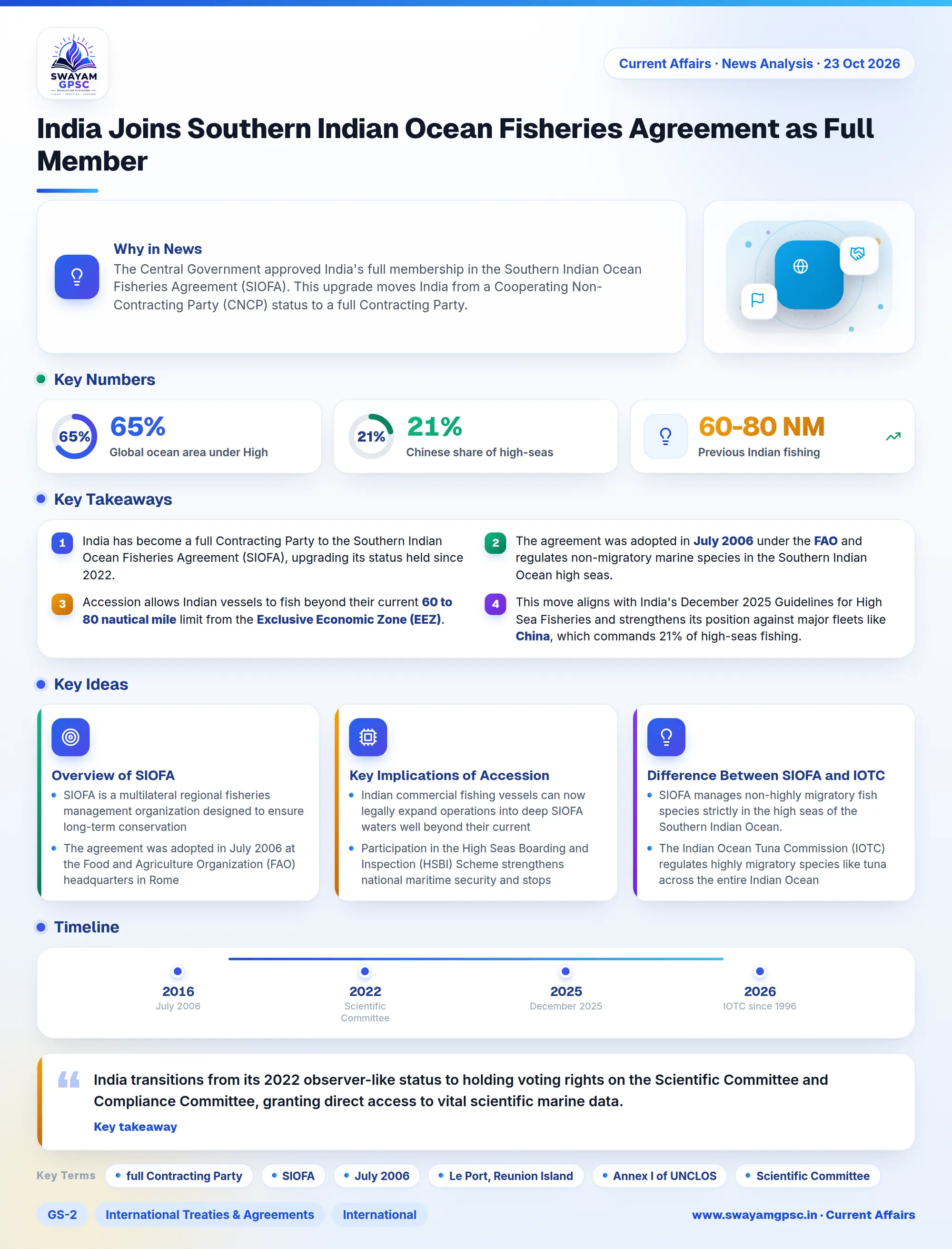
India Joins Southern Indian Ocean Fisheries Agreement as Full Member
#GS-2 #International Treaties & Agreements #International #Current Events #GS-3 #Environment #Resources #Water Resources #Quick Facts For Prelims
Key takeaways
- India has become a full Contracting Party to the Southern Indian Ocean Fisheries Agreement (SIOFA), upgrading its status held since 2022.
- The agreement was adopted in July 2006 under the FAO and regulates non-migratory marine species in the Southern Indian Ocean high seas.
- Accession allows Indian vessels to fish beyond their current 60 to 80 nautical mile limit from the Exclusive Economic Zone (EEZ).
- This move aligns with India's December 2025 Guidelines for High Sea Fisheries and strengthens its position against major fleets like China, which commands 21% of high-seas fishing.
Why in News
- The Central Government approved India's full membership in the Southern Indian Ocean Fisheries Agreement (SIOFA).
- This upgrade moves India from a Cooperating Non-Contracting Party (CNCP) status to a full Contracting Party.
- The strategic move elevates India's role in global ocean governance and deep-sea fisheries management.
Overview of SIOFA
- SIOFA is a multilateral regional fisheries management organization designed to ensure long-term conservation and sustainable use of high-seas marine resources in the Southern Indian Ocean.
- The agreement was adopted in July 2006 at the Food and Agriculture Organization (FAO) headquarters in Rome, entering into force in June 2012 and becoming operational in 2016.
- It was created to fill the void left by the abolition of the Indian Ocean Fisheries Commission (IOFC) in 1999, and its Secretariat operates from Le Port, Reunion Island.
- The core mandate focuses on multilateral cooperation for managing fishery resources while considering the development needs of coastal developing nations and Small-Island Developing States (SIDS).
- Species managed under this framework include non-migratory fish, molluscs, crustaceans, and various sedentary species within the high seas.
- It explicitly excludes highly migratory species like tuna listed in Annex I of UNCLOS and sedentary species under coastal state jurisdiction as per Article 77(4) of the 1982 UNCLOS.
- Since 2016, SIOFA enforces regulatory rules such as Vessel Monitoring Systems (VMS), protection of Vulnerable Marine Ecosystems (VMEs) against bottom fishing, and anti-IUU fishing listings.
Key Implications of Accession
- India transitions from its 2022 observer-like status to holding voting rights on the Scientific Committee and Compliance Committee, granting direct access to vital scientific marine data.
- Indian commercial fishing vessels can now legally expand operations into deep SIOFA waters well beyond their current 60 to 80 nautical mile limit near the Exclusive Economic Zone (EEZ).
- Participation in the High Seas Boarding and Inspection (HSBI) Scheme strengthens national maritime security and stops Illegal, Unreported, and Unregulated (IUU) fishing activities.
- The decision directly implements the Guidelines for High Sea Fisheries released in December 2025, driving India's broader Blue Economy roadmap.
- With high seas making up 65% of global oceans, full membership gives India a strategic presence to counterbalance distant-water fleets from countries like China, which controls 21% of global high-seas fishing.
Difference Between SIOFA and IOTC
- SIOFA manages non-highly migratory fish species strictly in the high seas of the Southern Indian Ocean.
- The Indian Ocean Tuna Commission (IOTC) regulates highly migratory species like tuna across the entire Indian Ocean region.
- India has been a full Contracting Party to the IOTC since 1996, whereas it joined SIOFA fully in 2026.