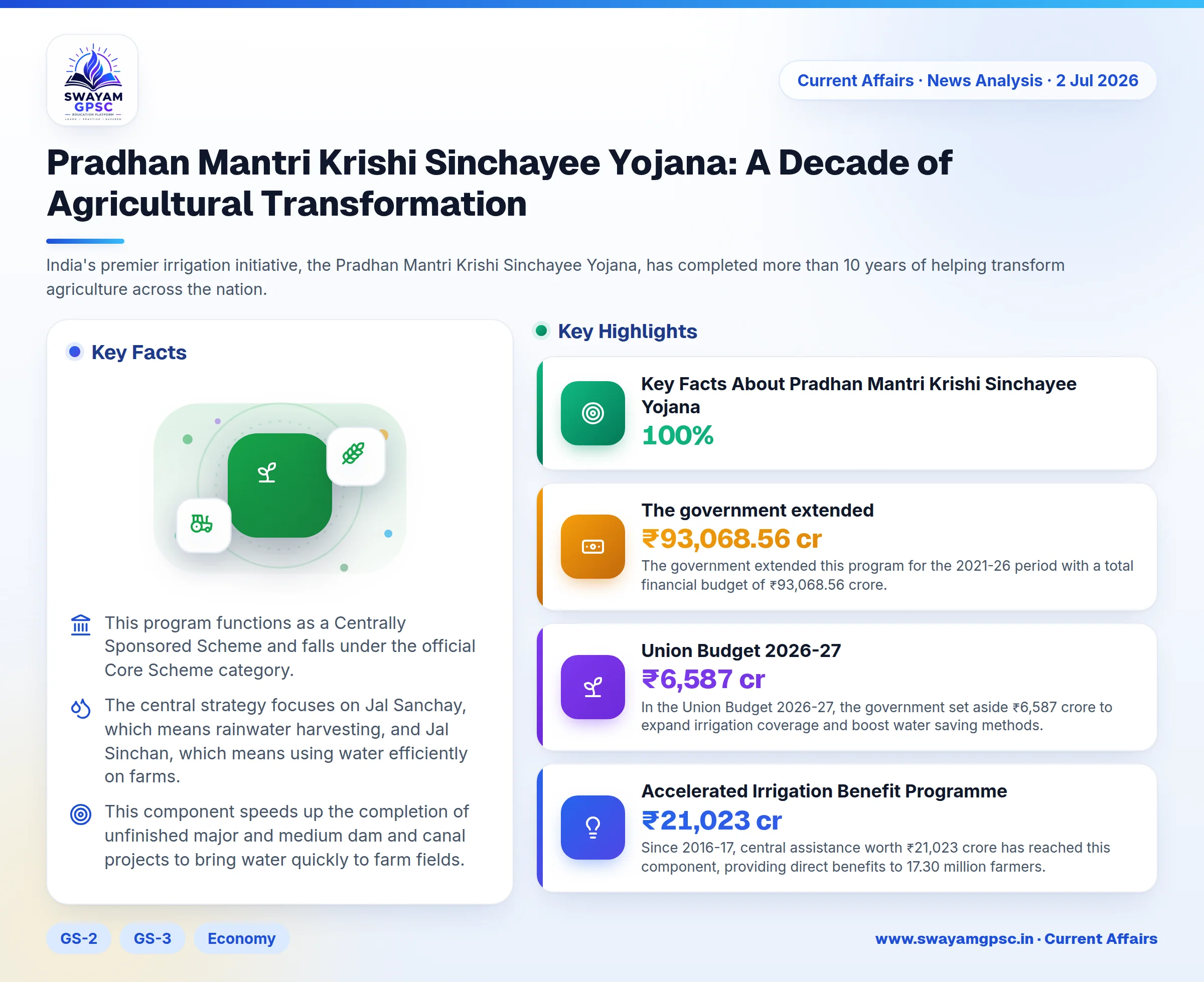
Pradhan Mantri Krishi Sinchayee Yojana: A Decade of Agricultural Transformation
#GS-2 #GS-3 #Economy #Agriculture #Infrastructure #Environment #Sustainable Development #Current Events #National
Why in News
- India's premier irrigation initiative, the Pradhan Mantri Krishi Sinchayee Yojana, has completed more than 10 years of helping transform agriculture across the nation.
Key Facts About Pradhan Mantri Krishi Sinchayee Yojana
- The government launched the Pradhan Mantri Krishi Sinchayee Yojana in 2015 to expand farming water access, increase protected farming land, and encourage efficient water use.
- This program functions as a Centrally Sponsored Scheme and falls under the official Core Scheme category.
- Funding is shared between the center and states in a 60:40 ratio for most states, 90:10 for northeastern and Himalayan states, and 100% central funding for Union Territories.
- The government created this master initiative by merging three older schemes: the Accelerated Irrigation Benefit Programme, the Integrated Watershed Management Programme, and On-Farm Water Management.
- The central strategy focuses on Jal Sanchay, which means rainwater harvesting, and Jal Sinchan, which means using water efficiently on farms.
- States execute this scheme through State Irrigation Plans and District Irrigation Plans to solve local water needs and coordinate funding at the ground level.
- The government extended this program for the 2021-26 period with a total financial budget of ₹93,068.56 crore.
- In the Union Budget 2026-27, the government set aside ₹6,587 crore to expand irrigation coverage and boost water saving methods.
Accelerated Irrigation Benefit Programme
- This component speeds up the completion of unfinished major and medium dam and canal projects to bring water quickly to farm fields.
- Since 2016-17, central assistance worth ₹21,023 crore has reached this component, providing direct benefits to 17.30 million farmers.
- In 2025-26, the government added the Modernization of Command Area Development and Water Management sub-scheme with an initial budget of ₹1,600 crore.
- This new sub-scheme uses underground pipelines and modern micro-irrigation systems to carry canal water straight to individual farm plots without waste.
Har Khet Ko Pani
- This project builds new water points using surface water and underground aquifers to bring regular irrigation to unwatered farmland.
- Under this initiative, 3,462 Surface Minor Irrigation projects have created 5.93 lakh hectares of irrigation capacity, while groundwater projects added 88.55 thousand hectares.
Watershed Development
- This section restores dry and degraded lands by building check dams, conserving topsoil, and storing local rainfall.
- Since 2016-17, the government has spent ₹12,432.09 crore under this head to benefit 1.34 million farmers across dryland zones.
Per Drop More Crop
- Initially part of this scheme from 2015-16 to 2021-22, this component moved into Pradhan Mantri Rashtriya Krishi Vikas Yojana in 2022-23 to push drip and sprinkler systems.
- Drip systems supply water and liquid fertilizer straight to plant roots, while sprinklers spray water evenly like natural rainfall to conserve water and boost crop yields.
- To help farmers buy this equipment, National Bank for Agriculture and Rural Development created the Micro Irrigation Fund, offering 55% subsidies to small farmers and 45% to others.
- This effort has brought 110.92 lakh hectares of land under micro-irrigation, covering nearly 7.98% of India's total cultivated crop area.
Frequently Asked Questions
- The government launched Pradhan Mantri Krishi Sinchayee Yojana on 1st July 2015 to ensure stable farm water supply and encourage smart water use.
- The core goal of the scheme is to bring more farmland under assured irrigation and reduce water wastage in agriculture.
- The four main pillars of this scheme are Accelerated Irrigation Benefit Programme, Har Khet Ko Pani, Watershed Development, and Per Drop More Crop.
- The Per Drop More Crop section helps farmers install drip and sprinkler setups to get high crop outputs with minimal water.
- The Har Khet Ko Pani section creates fresh local water sources through minor irrigation to cover left-out farm areas.