Pradhan Mantri Janjatiya Vikas Mission: Empowering Tribal Livelihoods
#GS-2 #Governance & Social Justice #Welfare Schemes #Social Justice #Vulnerable Sections #GS-3 #Economy #Agriculture #Employment #Current Events #National
Key takeaways
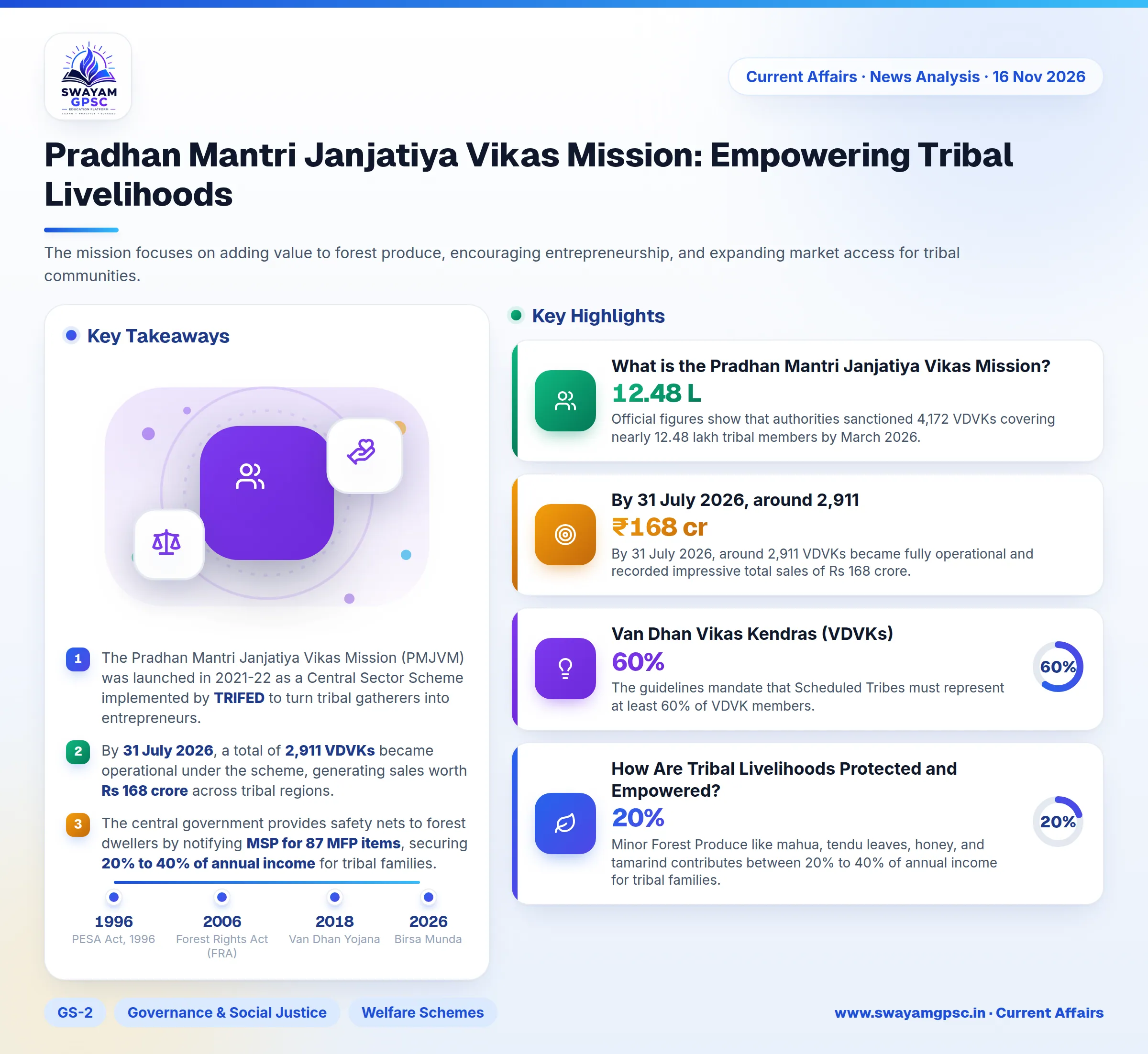
- The Pradhan Mantri Janjatiya Vikas Mission (PMJVM) was launched in 2021-22 as a Central Sector Scheme implemented by TRIFED to turn tribal gatherers into entrepreneurs.
- By 31 July 2026, a total of 2,911 VDVKs became operational under the scheme, generating sales worth Rs 168 crore across tribal regions.
- The central government provides safety nets to forest dwellers by notifying MSP for 87 MFP items, securing 20% to 40% of annual income for tribal families.
- Since 2013-14, state agencies have procured 2,67,954 metric tonnes of MFP valued at Rs 693.98 crore to prevent distress sales by intermediaries.
- During Janjatiya Gaurav Pakhwada 2026, the government inaugurated 228 tribal projects and launched the Jan-HIT Portal alongside the National FRA Digital Platform.
Why in News
- The Prime Minister paid rich tributes to Bhagwan Birsa Munda on his 151st birth anniversary on 15th November 2026.
- The nation celebrates this significant historical occasion as Janjatiya Gaurav Diwas to honor his lifelong fight for tribal freedom and dignity.
- Against this backdrop, the Pradhan Mantri Janjatiya Vikas Mission (PMJVM) serves as a key initiative for tribal economic self-reliance.
- The mission focuses on adding value to forest produce, encouraging entrepreneurship, and expanding market access for tribal communities.
What is the Pradhan Mantri Janjatiya Vikas Mission?
- The government launched the Pradhan Mantri Janjatiya Vikas Mission (PMJVM) during the financial year 2021-22 as a Central Sector Scheme.
- This scheme aims to enhance tribal incomes through skill training, modern technologies, product processing, and enterprise development.
- It aims to transform tribal forest gatherers into successful business owners rather than mere raw material sellers.
- The Tribal Cooperative Marketing Development Federation of India (TRIFED) executes the program in coordination with state-level agencies.
- Official figures show that authorities sanctioned 4,172 VDVKs covering nearly 12.48 lakh tribal members by March 2026.
- By 31 July 2026, around 2,911 VDVKs became fully operational and recorded impressive total sales of Rs 168 crore.
Van Dhan Vikas Kendras (VDVKs)
- A Van Dhan Vikas Kendra (VDVK) operates as a community enterprise formed by combining 15 Self-Help Groups with about 300 members.
- The guidelines mandate that Scheduled Tribes must represent at least 60% of VDVK members.
- The government originally launched the Van Dhan Yojana on 14 April 2018 to lay the foundation for these processing centers.
- Each center provides specialized training in sustainable harvesting practices, product processing, and modern packaging techniques.
- Every batch of 30 members receives practical training along with essential tools like decorticators, dryers, and starter raw materials.
- Financial support comes through commercial banks and the National Scheduled Tribes Finance and Development Corporation (NSTFDC).
- Local communities can establish processing centers inside Gram Panchayat structures or construct basic units near their homes.
Marketing and Business Support
- The mission links forest gatherers directly to commercial centers built around local Haat Bazaars across tribal belts.
- India has more than 5,000 Haats in tribal areas, which are undergoing modernization with shade structures, storage units, and weighing tools.
- VDVKs can partner with private corporations and non-profit organizations to improve product quality and reach distant buyers.
- The program funds national trade fairs, branding campaigns, artisan exhibitions, and official Geographical Indication (GI) registration.
- Through TRIFED, tribal entrepreneurs receive daily updates on market prices and digital selling opportunities.
How Are Tribal Livelihoods Protected and Empowered?
- Minor Forest Produce like mahua, tendu leaves, honey, and tamarind contributes between 20% to 40% of annual income for tribal families.
- In the past, middlemen exploited forest gatherers, forcing them to sell valuable forest items at low prices.
- The central government currently offers price security by setting MSP for 87 MFP items across the country.
- State procurement mechanisms operating since 2013-14 have purchased 2,67,954 metric tonnes of MFP valued at Rs 693.98 crore.
- The Forest Rights Act (FRA), 2006 legally empowers forest-dwelling tribes to collect, use, and sell non-timber forest produce.
- Similarly, the PESA Act, 1996 grants ownership rights over minor forest produce to local Gram Sabhas in Scheduled Areas.
Tribal Women Empowerment
- Since women handle most forest gathering work, these centers directly strengthen women's financial independence and leadership.
- For instance, the Nyigamane, Ho Yorbe, Medumhagdum VDVK in Arunachal Pradesh brings together 300 women SHG members.
- This group produces popular items like King Chilli pickle, bamboo shoot pickle, turmeric powder, and fruit squashes.
- Their enterprise generated over Rs 11 lakh in sales since 2022-23, helping members earn steady money outside traditional farming seasons.
Janjatiya Gaurav Diwas
- India marks 15th November as Janjatiya Gaurav Diwas every year to honor Bhagwan Birsa Munda and tribal freedom fighters.
- The Ministry of Tribal Affairs organized the Janjatiya Gaurav Pakhwada 2026 from 1-15 November 2026.
- The government scheduled more than 300 tribal development projects, including 228 project inaugurations and 74 foundation layings.
- Officials launched digital platforms like the Jan-HIT Portal and the National FRA Digital Platform to streamline service delivery.
- Tribal Research Institutes organized over 160 activities across 19 States/UTs to celebrate indigenous heritage and identity.
Way Forward
- The Pradhan Mantri Janjatiya Vikas Mission (PMJVM) creates a strong foundation for tribal growth through guaranteed prices and enterprise training.
- To achieve full success, authorities must fix ground-level implementation bottlenecks and ensure sustainable forest collection practices.
- Expanding women-led cooperative models will remain essential for creating a self-reliant forest economy.