Pradhan Mantri Formalisation of Micro Food Processing Enterprises Scheme
#GS-2 #GS-3 #Governance & Social Justice #Economy #Food Security #Agriculture #Employment #National #Food Processing #PMFME Scheme #Government Schemes
Key takeaways
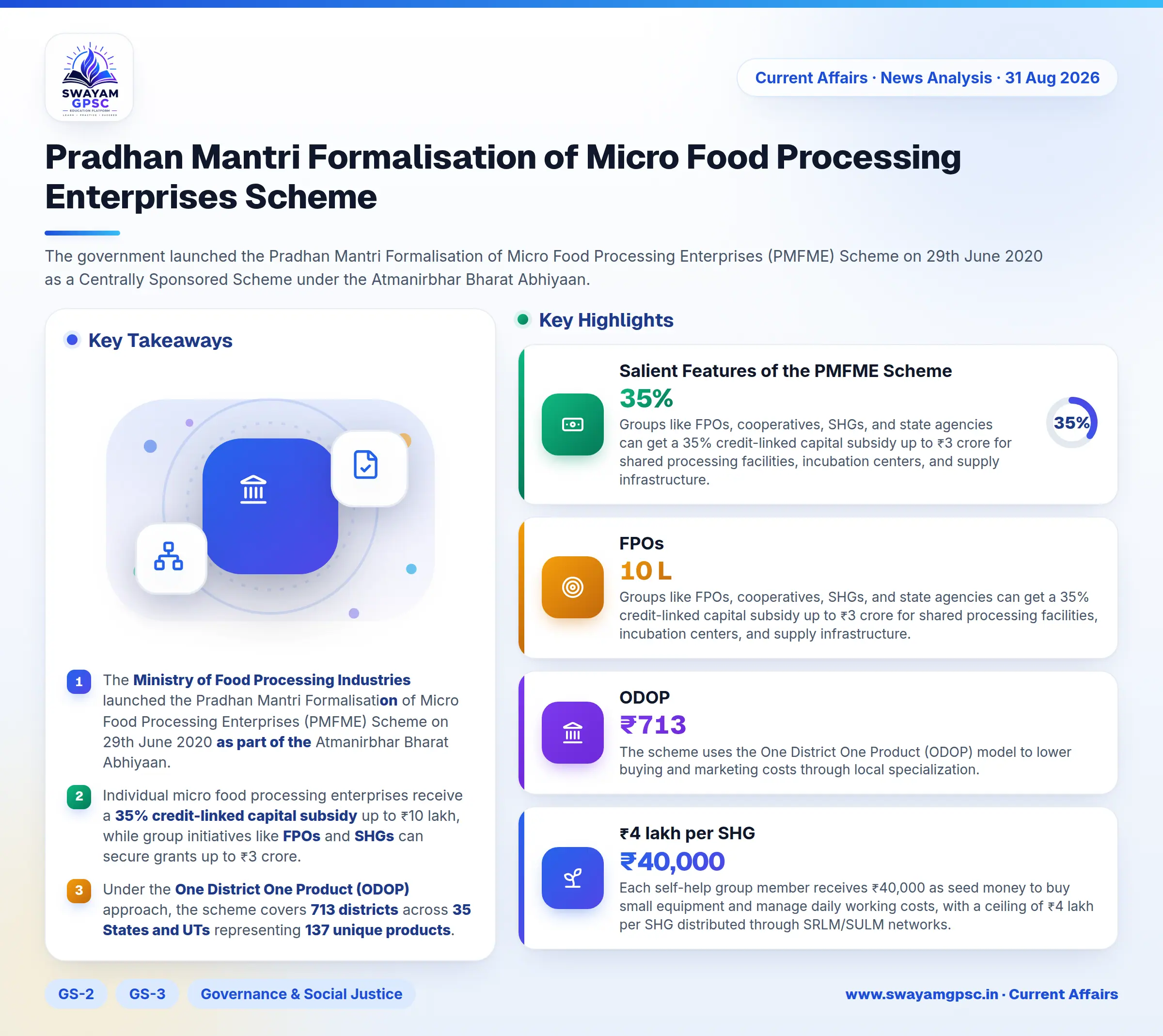
- The Ministry of Food Processing Industries launched the Pradhan Mantri Formalisation of Micro Food Processing Enterprises (PMFME) Scheme on 29th June 2020 as part of the Atmanirbhar Bharat Abhiyaan.
- Individual micro food processing enterprises receive a 35% credit-linked capital subsidy up to ₹10 lakh, while group initiatives like FPOs and SHGs can secure grants up to ₹3 crore.
- Under the One District One Product (ODOP) approach, the scheme covers 713 districts across 35 States and UTs representing 137 unique products.
- Self-help group members receive seed capital support of ₹40,000 per member up to a maximum limit of ₹4 lakh per SHG for operational equipment and working needs.
Why in News
- The Ministry of Food Processing Industries recently held the PMFME Bazaar at the India Habitat Centre in New Delhi. This event showcased products and successes of micro food processing businesses from across India.
- The event highlighted how the PMFME Scheme helps small food businesses grow. It provides financial aid, technical guidance, branding assistance, and direct connections to broader markets.
Salient Features of the PMFME Scheme
- The government launched the Pradhan Mantri Formalisation of Micro Food Processing Enterprises (PMFME) Scheme on 29th June 2020 as a Centrally Sponsored Scheme under the Atmanirbhar Bharat Abhiyaan.
- The main goal is to bring unorganized food businesses into the formal sector, boost their market competitiveness, and help new and existing food entrepreneurs with money, technology, and business training.
- Groups like FPOs, cooperatives, SHGs, and state agencies can get a 35% credit-linked capital subsidy up to ₹3 crore for shared processing facilities, incubation centers, and supply infrastructure. Beneficiaries must pay at least 10% of the cost themselves, while bank loans cover the rest.
- Individual entrepreneurs, small firms, partnerships, NGOs, and private firms get a 35% credit-linked capital subsidy to set up or upgrade processing units, capped at ₹10 lakh per unit.
- The scheme uses the One District One Product (ODOP) model to lower buying and marketing costs through local specialization. So far, ODOP covers 713 districts across 35 States and UTs, promoting 137 unique products.
- Each self-help group member receives ₹40,000 as seed money to buy small equipment and manage daily working costs, with a ceiling of ₹4 lakh per SHG distributed through SRLM/SULM networks.
- To boost marketing and brand building, the program funds 50% of total expenses for collective groups like FPOs, SHGs, and special purpose vehicles.
- The scheme delivers specialized training through Food Processing Entrepreneurship Development Programmes (FPEDP) to build technical knowledge and business leadership skills among small food producers.
- State nodal offices provide financial aid up to ₹5 lakh to prepare detailed project reports for branding and marketing, covering packaging, quality checks, pricing, and storage strategies.
- This initiative advances Atmanirbhar Bharat and Vocal for Local goals by creating rural jobs, reducing food spoilage, increasing value addition, and connecting regional foods to national and global consumers.
Frequently Asked Questions
- The PMFME Bazaar serves as a specialized platform where small food entrepreneurs display their products, negotiate with commercial buyers, and enter new regional markets.
- The PMFME Scheme is a government program launched in 2020 that strengthens micro food processing businesses through funding, infrastructure upgrade, technical training, and market support.
- The Ministry of Food Processing Industries acts as the central implementing authority for the entire scheme across India.
- Under the scheme's individual subsidy rules, micro food processing units can claim a 35% credit-linked capital subsidy up to ₹10 lakh.