Pradhan Mantri Fasal Bima Yojana Overview and Key Achievements
#GS-2 #GS-3 #Governance & Social Justice #Government Policies & Interventions #Economy #Agriculture #Current Events #National
Key takeaways
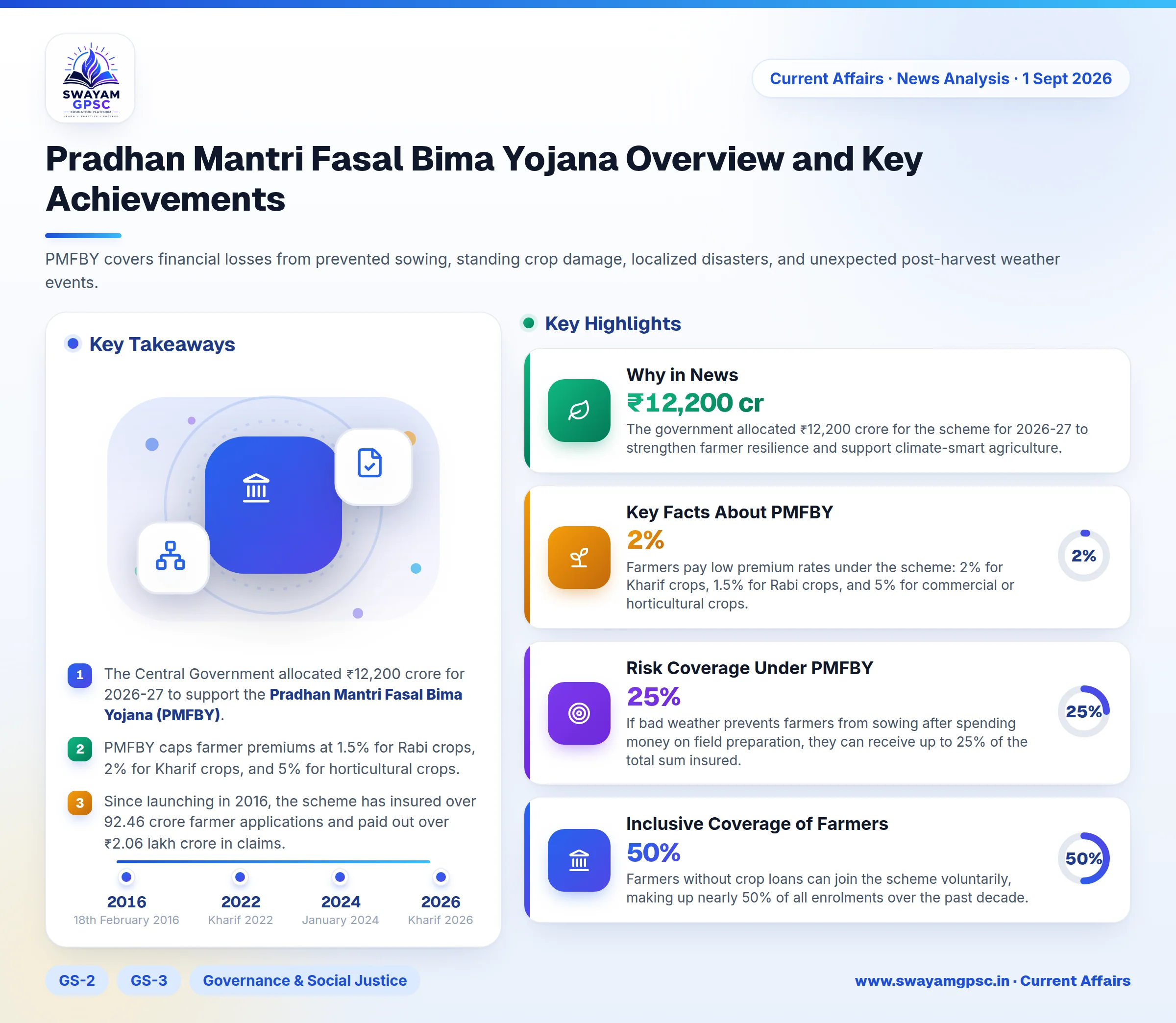
- The Central Government allocated ₹12,200 crore for 2026-27 to support the Pradhan Mantri Fasal Bima Yojana (PMFBY).
- PMFBY caps farmer premiums at 1.5% for Rabi crops, 2% for Kharif crops, and 5% for horticultural crops.
- Since launching in 2016, the scheme has insured over 92.46 crore farmer applications and paid out over ₹2.06 lakh crore in claims.
- In 2024-25, PMFBY recorded a peak enrolment of 15.23 crore applications covering 623 lakh hectares of farmland.
- The Krishi Rakshak Portal & Helpline (14447) has resolved 26.12 lakh farmer grievances with a 99.66% resolution rate.
Why in News
- The Union Government recently highlighted the key achievements of the Pradhan Mantri Fasal Bima Yojana (PMFBY).
- The government allocated ₹12,200 crore for the scheme for 2026-27 to strengthen farmer resilience and support climate-smart agriculture.
Key Facts About PMFBY
- The central government launched the Pradhan Mantri Fasal Bima Yojana on 18th February 2016 to deliver low-cost crop insurance against natural hazards and yield risks.
- Farmers pay low premium rates under the scheme: 2% for Kharif crops, 1.5% for Rabi crops, and 5% for commercial or horticultural crops.
- The Central and State Governments split the remaining premium balance on a 50:50 basis, while North-Eastern and Himalayan States receive a 90:10 subsidy split.
Risk Coverage Under PMFBY
- PMFBY covers financial losses from prevented sowing, standing crop damage, localized disasters, and unexpected post-harvest weather events.
- The scheme offers area-based protection against non-preventable risks such as drought, floods, cyclones, hailstorms, lightning, and pest attacks.
- If bad weather prevents farmers from sowing after spending money on field preparation, they can receive up to 25% of the total sum insured.
- Cut-and-spread crops left in fields to dry receive insurance coverage for up to 14 days against unexpected rainfall or cyclones.
- PMFBY compensates individual farms for localized events including hailstorms, landslides, cloudbursts, inundation, and natural fires.
- The policy does not cover losses resulting from war, nuclear hazards, riots, theft, farmer negligence, or avoidable risks.
Inclusive Coverage of Farmers
- The policy covers loanee farmers, non-loanee farmers, tenant farmers, and sharecroppers who submit valid land records or farming proof.
- Farmers without crop loans can join the scheme voluntarily, making up nearly 50% of all enrolments over the past decade.
- Banks automatically enroll farmers who hold active seasonal crop loans or Kisan Credit Card (KCC) facilities by deducting the premium directly.
- To qualify for claims, farmers must prove insurable interest, submit valid land documents, and complete registration before the deadline.
Progress and Achievements Under PMFBY
- During Kharif 2026, 25 States and Union Territories actively implemented PMFBY, showing its broad national reach.
- PMFBY has covered over 92.46 crore farmer applications since inception, disbursing more than ₹2.06 lakh crore across 26.33 crore claim payouts.
- In 2024-25, PMFBY recorded its highest enrolment of 15.23 crore applications, covering 4 crore farmers and 623 lakh hectares of land.
- PMFBY ensures equitable financial safety by extending full insurance protection to tenant farmers and sharecroppers.
Key Government Initiatives to Strengthen PMFBY
- The National Crop Insurance Portal (NCIP) simplifies online enrolment, subsidy handling, automated claim calculation, and direct fund transfers into farmer bank accounts.
- Linking state digital land registries with the NCIP helps verify farming plots across 10 States, validating about 85% of insured land in those areas.
- Launched in Kharif 2022, the Digiclaim module on NCIP uses the Public Finance Management System (PFMS) to disburse over ₹55,000 crore in direct claims.
- The CCE-Agri App allows field officers to upload digital crop yield data directly to NCIP, boosting accuracy, transparency, and processing speed for claims.
Digital Innovations Strengthening Crop Insurance Delivery
- The YES-TECH platform uses satellite imagery and remote sensing to estimate yields for paddy, wheat, and soybean, carrying up to 50% weightage in state payout decisions.
- The WINDS network uses automatic rain gauges and weather stations at the block level to deliver localized weather data for accurate insurance payouts.
- The CROPIC initiative analyzes geo-tagged crop photos to track plant health, evaluate disaster damage, and estimate harvests using digital analytics.
- Launched in January 2024, the Krishi Rakshak Portal & Helpline (14447) resolved 26.12 lakh farmer complaints with a 99.66% success rate.
- Digital support tools include the Learning Management System (LMS) for training, the AIDE App for doorstep registration, and the CLAP App for swift local damage checks.
Restructured Weather Based Crop Insurance Scheme
- The RWBCIS scheme uses weather indicators instead of direct yield measurements to estimate damage and trigger fast compensation when readings cross set thresholds.
- Weather stations track specific climate factors including deficit rainfall, heatwaves, excessive humidity, high winds, and cloudbursts to calculate payouts.
- The program operates across designated Reference Unit Areas (RUAs), adjusting payouts based on crop sensitivity across different growth stages.
- Farmers pay the same standard premiums (1.5% for Rabi, 2% for Kharif, and 5% for commercial crops), making it ideal for horticultural and fruit crops.
Conclusion
- The Pradhan Mantri Fasal Bima Yojana serves as a vital financial shield against climate risks, protecting rural incomes and strengthening national food security.