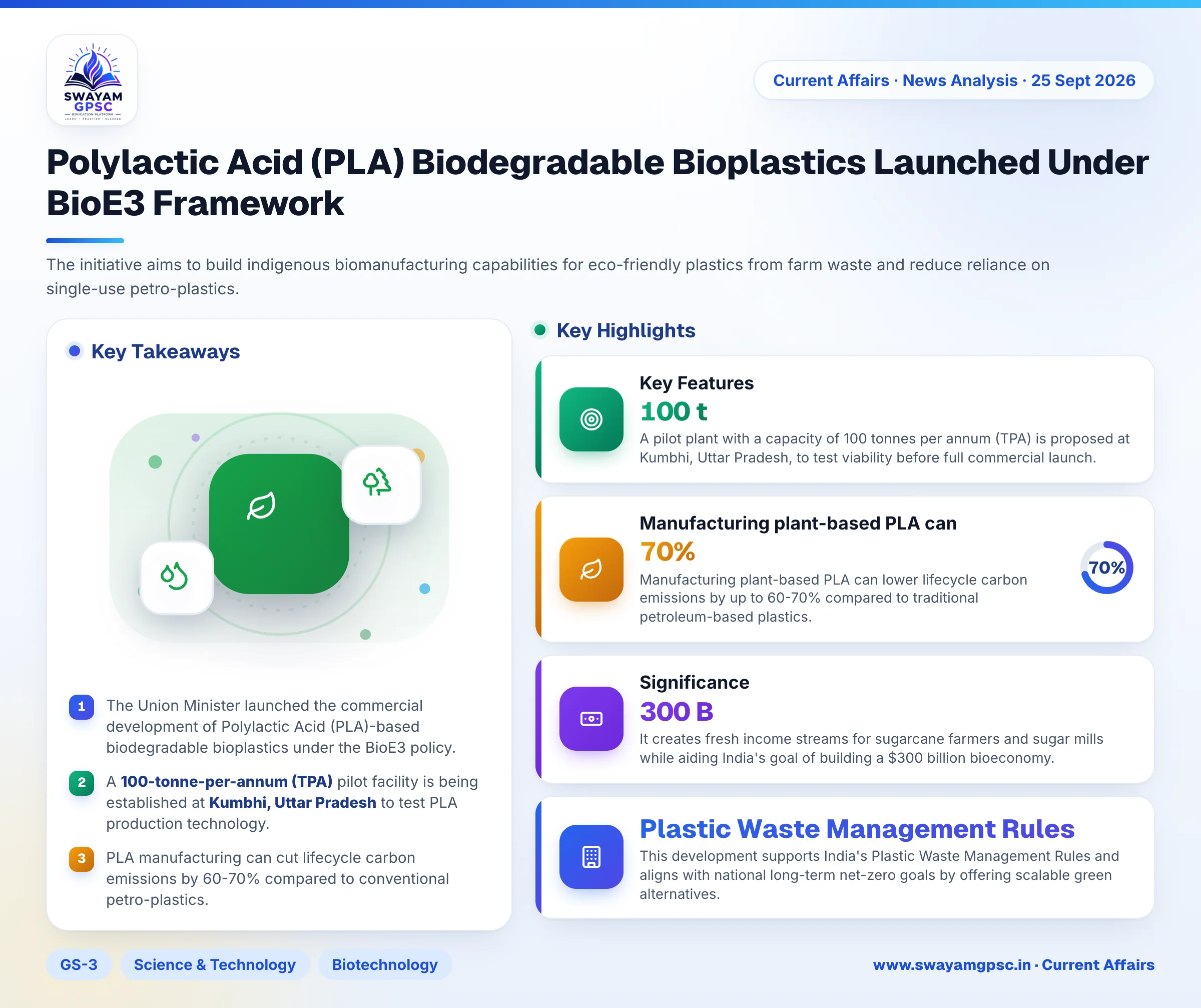
Polylactic Acid (PLA) Biodegradable Bioplastics Launched Under BioE3 Framework
#GS-3 #Science & Technology #Biotechnology #Environment #Sustainable Development #Economy #BioE3 Policy
Key takeaways
- The Union Minister launched the commercial development of Polylactic Acid (PLA)-based biodegradable bioplastics under the BioE3 policy.
- A 100-tonne-per-annum (TPA) pilot facility is being established at Kumbhi, Uttar Pradesh to test PLA production technology.
- PLA manufacturing can cut lifecycle carbon emissions by 60-70% compared to conventional petro-plastics.
- This bioplastic initiative supports India's target to achieve a $300 billion bioeconomy while supporting the Plastic Waste Management Rules.
Why in News
- The Union Minister formally launched the commercial development of Polylactic Acid (PLA)-based biodegradable bioplastics under India's BioE3 framework.
About Polylactic Acid (PLA) Bioplastics
- PLA is a compostable bioplastic made by fermenting plant sugars from sugarcane, corn starch, or cassava into lactic acid, which replaces traditional fossil-fuel plastics.
- This initiative is spearheaded under the Government of India's BioE3 policy, which stands for Biotechnology for Economy, Environment, and Employment.
- The initiative aims to build indigenous biomanufacturing capabilities for eco-friendly plastics from farm waste and reduce reliance on single-use petro-plastics.
Key Features
- The technology converts sugarcane juice, molasses, and agricultural residues into lactic acid, creating a waste-to-wealth model beyond standard ethanol production.
- Under proper industrial composting conditions, PLA fully breaks down into water, carbon dioxide, and organic biomass, eliminating long-lasting waste.
- A pilot plant with a capacity of 100 tonnes per annum (TPA) is proposed at Kumbhi, Uttar Pradesh, to test viability before full commercial launch.
- PLA offers useful strength, stiffness, and clarity, making it suitable for packaging materials, farm films, textiles, and medical threads.
- Manufacturing plant-based PLA can lower lifecycle carbon emissions by up to 60-70% compared to traditional petroleum-based plastics.
Significance
- This development supports India's Plastic Waste Management Rules and aligns with national long-term net-zero goals by offering scalable green alternatives.
- It creates fresh income streams for sugarcane farmers and sugar mills while aiding India's goal of building a $300 billion bioeconomy.