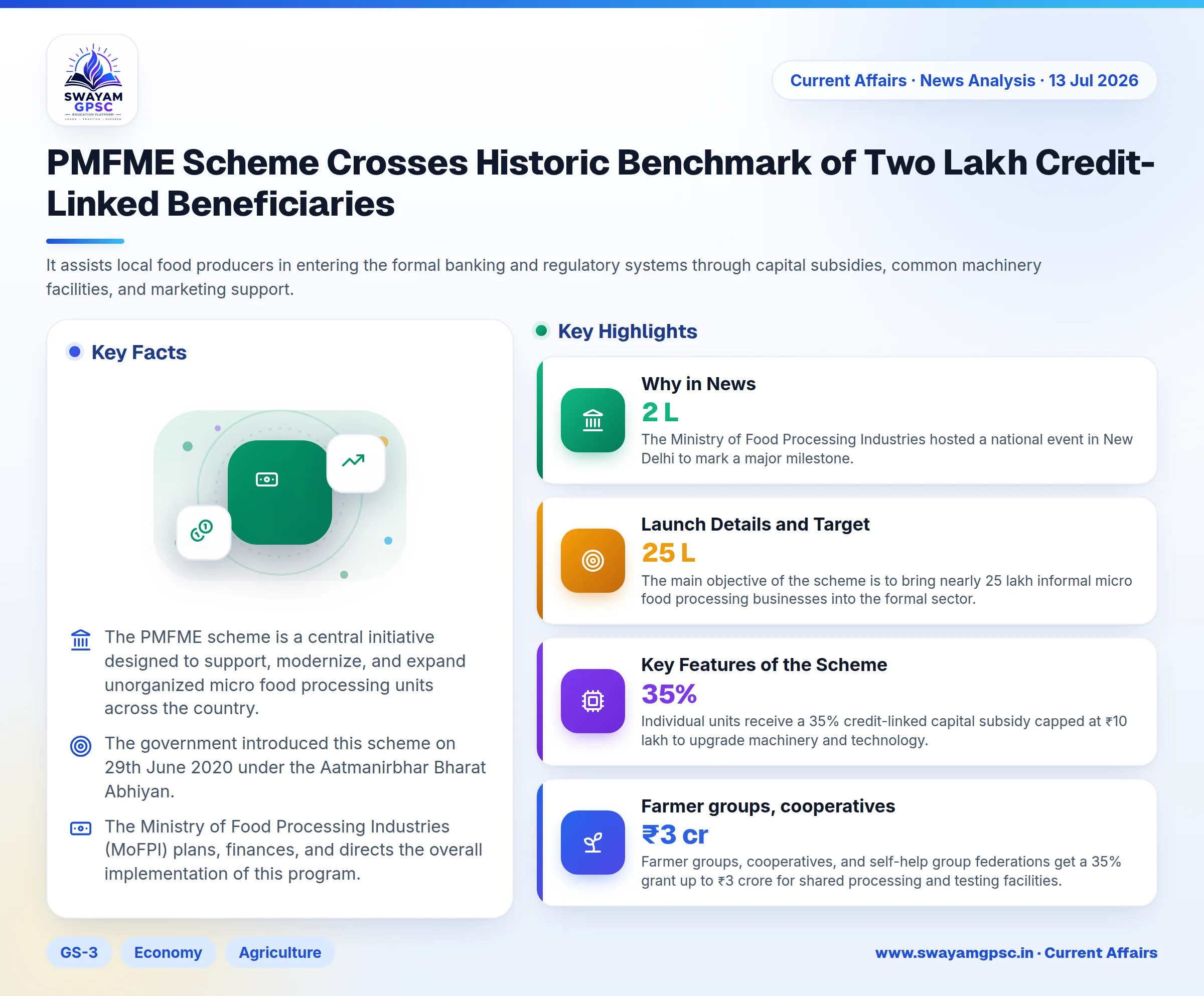
PMFME Scheme Crosses Historic Benchmark of Two Lakh Credit-Linked Beneficiaries
#GS-3 #Economy #Agriculture #Infrastructure #Growth #GS-2 #Governance & Social Justice #Current Events #National
Why in News
- The Ministry of Food Processing Industries hosted a national event in New Delhi to mark a major milestone. The Pradhan Mantri Formalisation of Micro Food Processing Enterprises (PMFME) scheme has now supported over two lakh credit-linked beneficiaries.
About the PMFME Scheme
- The PMFME scheme is a central initiative designed to support, modernize, and expand unorganized micro food processing units across the country.
- It assists local food producers in entering the formal banking and regulatory systems through capital subsidies, common machinery facilities, and marketing support.
Launch Details and Target
- The government introduced this scheme on 29th June 2020 under the Aatmanirbhar Bharat Abhiyan.
- The Ministry of Food Processing Industries (MoFPI) plans, finances, and directs the overall implementation of this program.
- The main objective of the scheme is to bring nearly 25 lakh informal micro food processing businesses into the formal sector.
Key Features of the Scheme
- Individual units receive a 35% credit-linked capital subsidy capped at ₹10 lakh to upgrade machinery and technology.
- Under the One District One Product (ODOP) approach, each district focuses on one primary food item to lower processing and marketing costs.
- Farmer groups, cooperatives, and self-help group federations get a 35% grant up to ₹3 crore for shared processing and testing facilities.
- Each eligible self-help group member receives ₹40,000 as seed capital for equipment purchases and daily working needs.
- The government provides 50% financial assistance to cooperatives and groups for product branding, packaging, and marketing.
- District Resource Persons (DRPs) guide rural entrepreneurs with paperwork, project reports, and official bank loan applications.
- Funding is shared on a 60:40 basis between the Centre and general states, a 90:10 ratio for North-Eastern and Himalayan states, and 100% central funding for union territories without assemblies.
Significance and Benefits
- The scheme helps informal business owners register under GST, FSSAI, and Udyam, making it easier to obtain bank loans instead of relying on high-interest local money lenders.
- Because women form a large portion of the beneficiaries, this initiative boosts grassroots business ownership and improves household incomes in rural areas.