PM SVANidhi Scheme Completes Six Years of Empowering Street Vendors
#GS-2 #Governance & Social Justice #Poverty #Good Governance #GS-3 #Economy #Employment #Current Events #National
Key takeaways
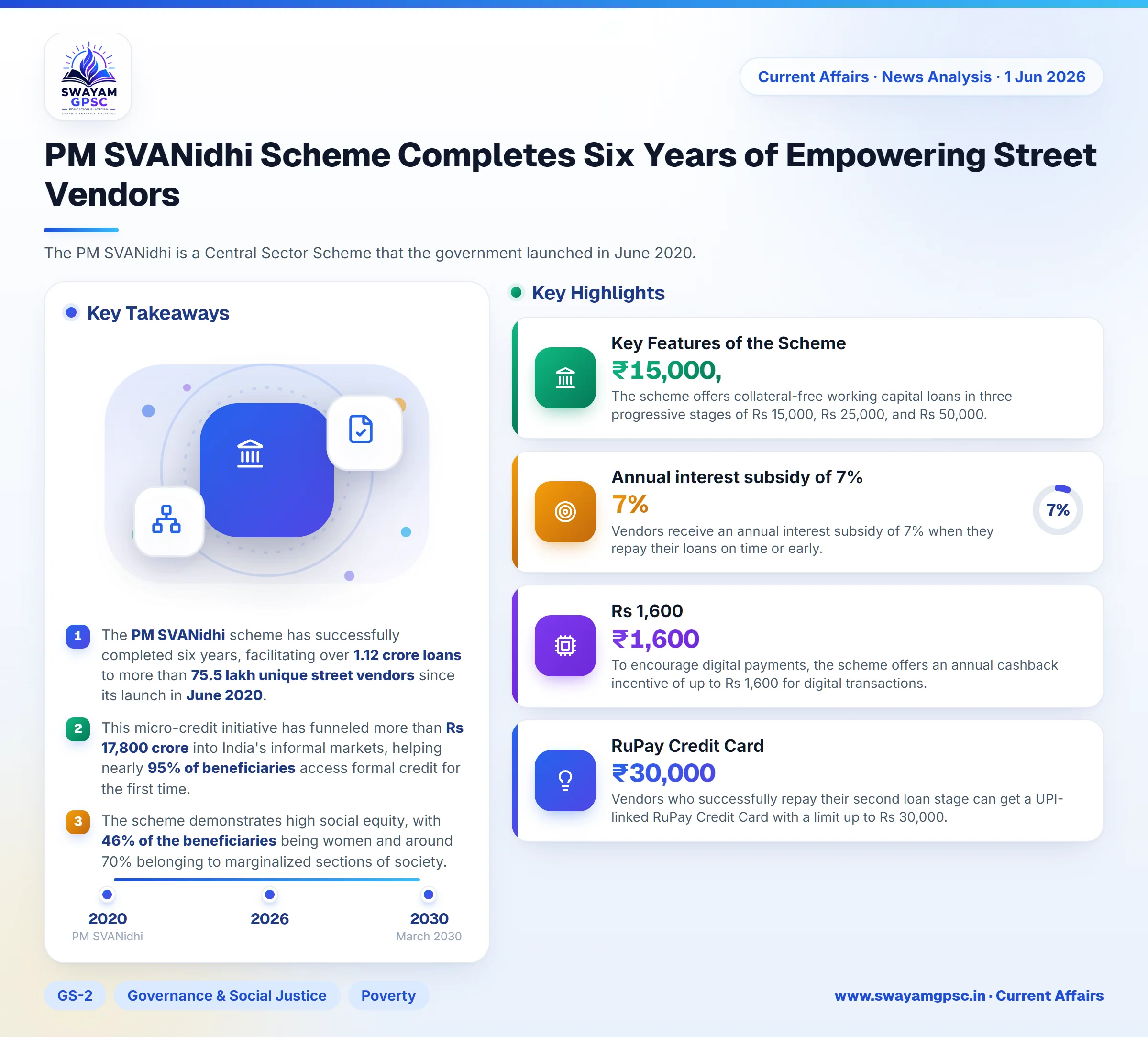
- The PM SVANidhi scheme has successfully completed six years, facilitating over 1.12 crore loans to more than 75.5 lakh unique street vendors since its launch in June 2020.
- This micro-credit initiative has funneled more than Rs 17,800 crore into India's informal markets, helping nearly 95% of beneficiaries access formal credit for the first time.
- The scheme demonstrates high social equity, with 46% of the beneficiaries being women and around 70% belonging to marginalized sections of society.
- The SVANidhi se Samriddhi initiative has successfully linked over 50 lakh vendor families to 1.52 crore formal benefits under eight major central welfare schemes.
Why in News
- The PM SVANidhi scheme recently reached a major milestone by completing six years of active implementation on June 1, 2026.
- To mark this occasion, the Ministry of Housing and Urban Affairs (MoHUA) highlighted how the scheme helps street vendors move from daily survival to self-reliance.
- This effort focuses on bringing informal vendors into the formal banking system and giving them complete social security coverage.
What is the PM SVANidhi Scheme
- The PM SVANidhi is a Central Sector Scheme that the government launched in June 2020.
- The Ministry of Housing and Urban Affairs (MoHUA) runs this scheme together with the Department of Financial Services (DFS).
- The government designed this program as a direct response to the economic hardships of the Covid-19 pandemic.
- It works as a unique micro-credit program that offers collateral-free loans to help street vendors restart their businesses.
- This scheme reduces the dependence of vendors on informal moneylenders who charge extremely high interest rates.
- The Small Industries Development Bank of India (SIDBI) acts as the main partner to implement and manage the credit system.
Key Features of the Scheme
- The scheme offers collateral-free working capital loans in three progressive stages of Rs 15,000, Rs 25,000, and Rs 50,000.
- Vendors receive an annual interest subsidy of 7% when they repay their loans on time or early.
- The system sends this interest subsidy directly to the vendor's bank account through digital transfer.
- To encourage digital payments, the scheme offers an annual cashback incentive of up to Rs 1,600 for digital transactions.
- Vendors who successfully repay their second loan stage can get a UPI-linked RuPay Credit Card with a limit up to Rs 30,000.
- The government has extended the lending period of this scheme until March 2030 to support more micro-entrepreneurs.
- This extension aims to benefit 1.15 crore street vendors across India, which includes 50 lakh new beneficiaries.
- The program partners with the Food Safety and Standards Authority of India (FSSAI) to train vendors in financial literacy and food hygiene.
SVANidhi se Samriddhi Initiative
- The government launched the SVANidhi se Samriddhi initiative to build a complete safety net for vendors beyond simple credit support.
- This program maps the socio-economic status of PM SVANidhi beneficiaries and their families to understand their needs.
- It helps these families gain easy access to 8 core central government welfare schemes.
- The safety net includes insurance coverage through the Pradhan Mantri Jeevan Jyoti Bima Yojana (PMJJBY) and the Pradhan Mantri Suraksha Bima Yojana (PMSBY).
- It also connects families to basic financial services under the Pradhan Mantri Jan Dhan Yojana.
- Construction workers among the vendors get registered under the Building and Other Construction Workers (BoCW) program.
- It links eligible vendors to pension benefits through the Pradhan Mantri Shram Yogi Maandhan Yojana.
- Families can secure food grains anywhere in the country under the One Nation One Ration Card (ONORC) system.
- Lastly, it assists mothers and pregnant women through the Janani Suraksha Yojana and the Pradhan Mantri Matru Vandana Yojana (PMMVY).
Achievements and Impact
- Financial institutions have sanctioned over 1.12 crore loans to more than 75.5 lakh unique street vendors.
- This extensive credit support has funneled more than Rs 17,800 crore directly into informal urban markets.
- Nearly 95% of the beneficiaries were able to access formal institutional credit for the first time in their lives.
- Around 30% of these vendors successfully improved their creditworthiness and secured additional loans beyond this scheme.
- The regular access to affordable cash helped hawkers grow their inventory and increase their annual incomes by 20% on average.
- The scheme promotes strong social inclusion, with 46% of the beneficiaries being women, representing 34.81 lakh individuals.
- Almost 70% of the total beneficiaries belong to marginalized communities, which helps them achieve financial independence.
- More than 55 lakh street vendors have joined digital platforms, carrying out over 841 crore digital transactions.
- These digital transactions have reached an estimated value of Rs 8.96 lakh crore, showcasing rapid digital adoption.
- The welfare extension program has profiled over 50 lakh families and delivered 1.52 crore formal benefits.
Challenges
- There are significant regional imbalances in how different states implement the program.
- For example, states like Uttar Pradesh show very high participation, while Tripura has recorded only 9,300 loan sanctions.
- Street vendors face administrative delays, as it takes an average of 23 days to process and approve an application.
- Extreme weather conditions and heavy monsoons during the June-to-September period cause severe seasonal income losses for outdoor vendors.
- These seasonal disruptions make it difficult for vendors to maintain their fixed daily loan repayment schedules.
- Sustaining long-term digital literacy remains a hurdle, as nearly 20.5 lakh vendors have not yet transitioned to active digital payments.
Way Forward
- The government can deploy advanced data dashboards to identify low-coverage areas and help local teams onboard lagging regions.
- We should expand food safety courses and offer extra low-interest micro-loans to help vendors buy clean, modern vending carts.
- The central application can use artificial intelligence (AI) to instantly approve higher loan tranches once a vendor repays their previous loan.
- Introducing flexible repayment schedules during heavy rainy seasons will help vendors protect their credit scores when sales are low.
Conclusion
- Over the last six years, PM SVANidhi has evolved from an emergency relief tool into a permanent driver of economic growth.
- By replacing high-interest informal loans with affordable institutional credit, the scheme has brought dignity to millions of street vendors.