PM Bhartiya Janaushadhi Pariyojana: Expanding Affordable Generic Medicines in India
#GS-2 #Governance & Social Justice #Health #Government Policies & Interventions
Key takeaways
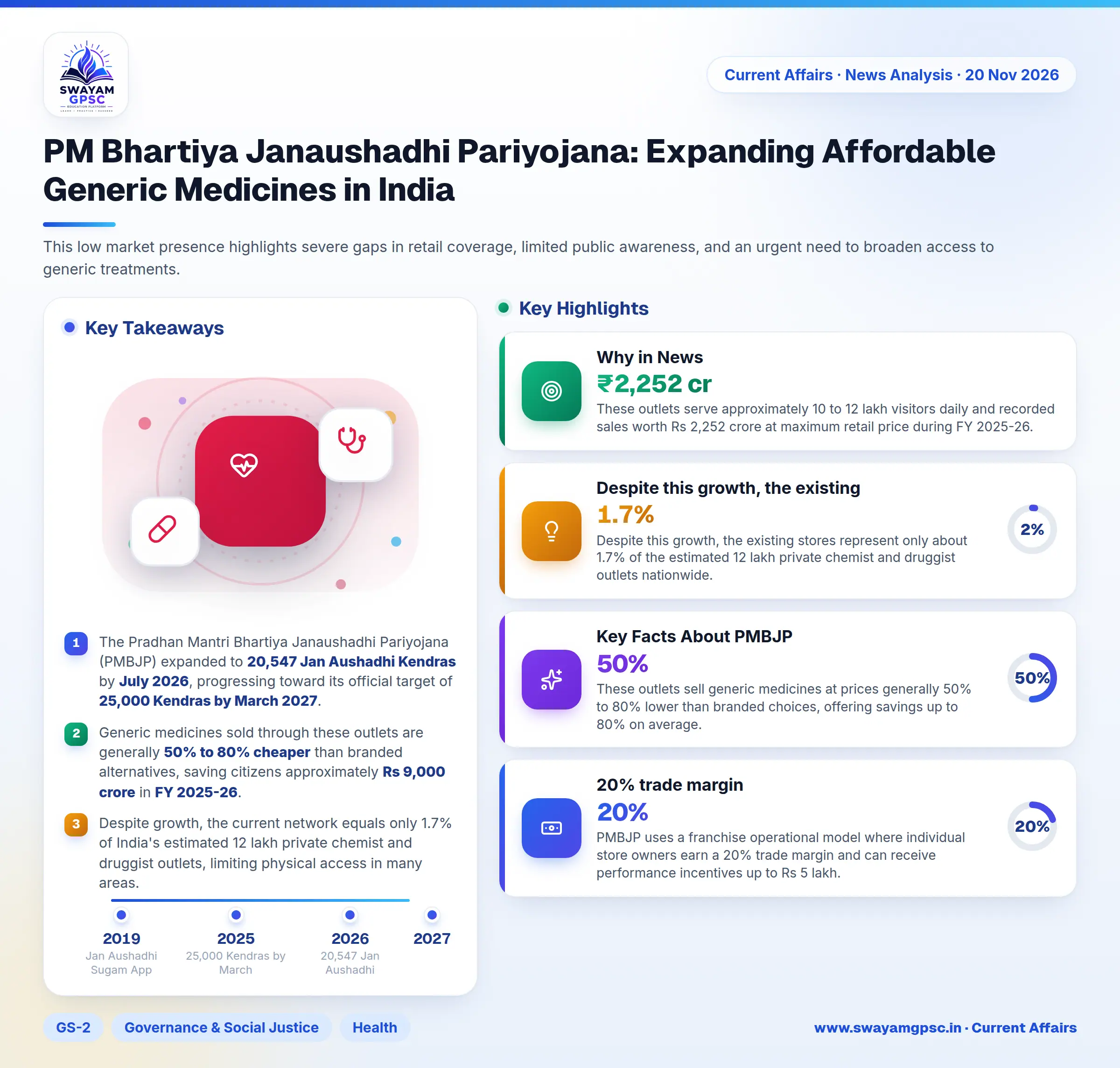
- The Pradhan Mantri Bhartiya Janaushadhi Pariyojana (PMBJP) expanded to 20,547 Jan Aushadhi Kendras by July 2026, progressing toward its official target of 25,000 Kendras by March 2027.
- Generic medicines sold through these outlets are generally 50% to 80% cheaper than branded alternatives, saving citizens approximately Rs 9,000 crore in FY 2025-26.
- Despite growth, the current network equals only 1.7% of India's estimated 12 lakh private chemist and druggist outlets, limiting physical access in many areas.
- Official quality testing demonstrates a low substandard medicine rate of 0.34% under PMBJP, compared to 3.70% in the open retail market.
- Government health expenditure stood at 1.43% of GDP in 2023-24, falling short of the National Health Policy, 2017 target of 2.5% of GDP by 2025.
Why in News
- The Pradhan Mantri Bhartiya Janaushadhi Pariyojana (PMBJP) has significantly grown its network to provide lower-cost generic medicines to citizens across the country.
- Data shows that 20,547 Jan Aushadhi Kendras were actively functioning across India as of July 2026.
- This network expanded steadily from 17,990 Kendras in December 2025, moving closer to the national target of 25,000 Kendras by March 2027.
- These outlets serve approximately 10 to 12 lakh visitors daily and recorded sales worth Rs 2,252 crore at maximum retail price during FY 2025-26.
- Despite this growth, the existing stores represent only about 1.7% of the estimated 12 lakh private chemist and druggist outlets nationwide.
- This low market presence highlights severe gaps in retail coverage, limited public awareness, and an urgent need to broaden access to generic treatments.
Key Facts About PMBJP
- The government established the flagship Pradhan Mantri Bhartiya Janaushadhi Pariyojana (PMBJP) to supply high-quality generic drugs at prices affordable for everyone.
- This program helps lower out-of-pocket medical bills and builds a more equal healthcare setup across the nation.
- The central government first launched this initiative as the Jan Aushadhi Scheme in 2008 and later revamped its design in 2015.
- The Pharmaceuticals and Medical Devices Bureau of India (PMBI) runs the program under the administrative guidance of the Department of Pharmaceuticals, Ministry of Chemicals and Fertilisers.
- The scheme relies on a network of dedicated retail stores named Pradhan Mantri Bhartiya Janaushadhi Kendras (PMBJKs).
- These outlets sell generic medicines at prices generally 50% to 80% lower than branded choices, offering savings up to 80% on average.
- The official product list includes 2,110 generic medicines alongside 315 surgical supplies, medical devices, and consumables.
- These items cover 29 key therapeutic areas, including care for diabetes, heart conditions, cancer, and infectious diseases.
- The government ensures quality by procuring products exclusively from WHO-GMP-compliant manufacturers.
- Every drug batch undergoes strict laboratory testing at facilities accredited by the NABL before entering the retail supply chain.
- PMBJP uses a franchise operational model where individual store owners earn a 20% trade margin and can receive performance incentives up to Rs 5 lakh.
- Special one-time grants of up to Rs 2 lakh assist women entrepreneurs, SC/ST business owners, Divyangjan individuals, and operators setting up stores in underserved regions.
- The official Jan Aushadhi Sugam App, introduced in 2019, allows users to locate nearby stores, search for medicines, and compare generic prices instantly.
- The government is connecting Primary Agricultural Credit Societies (PACS), public hospitals, and railway stations into the distribution network to improve rural availability.
- Under the Jan Aushadhi Suvidha initiative started in 2019, women can buy subsidized sanitary napkins at just Re 1 per pad to support menstrual health.
- The nation celebrates Jan Aushadhi Diwas every year on 7th March to spread public knowledge about affordable generic drugs.
- The program generated estimated savings of Rs 9,000 crore for households in FY 2025-26 and approximately Rs 45,000 crore over a span of 12 years.
Challenges Limiting PMBJP Effectiveness
- The network of 20,547 Kendras forms only 1.7% of India's 12 lakh private pharmacies, leaving vast rural and semi-urban populations without easy access.
- Out-of-pocket medicine costs make up 60% to 70% of total family healthcare spending, while insurance schemes like AB PM-JAY cover mostly hospital stays rather than outpatient medicines.
- Public knowledge remains low; a study of 200 outpatients in Port Blair revealed that only one-third knew about the scheme and just 6% had requested generic options from doctors.
- Many doctors hesitate to prescribe generic drugs over quality concerns, and the National Medical Commission (NMC) put its generic prescribing rule on hold following professional pushback.
- A lingering trust gap affects generic drugs, even though testing shows a substandard drug rate of 0.34% under PMBJP compared to 3.70% in the open market.
- Frequent stock shortages and unpredictable delivery schedules for chronic disease medicines frustrate buyers and drive them back to costly private pharmacies.
- Weak publicity and remote store locations create an unfair belief that these stores cater only to low-income groups, keeping broader middle-class consumers away.
Measures Needed to Strengthen PMBJP
- The government should order an independent, nationwide survey to evaluate real awareness levels, prescription patterns, product availability, and adoption hurdles.
- Authorities must publish regular batch testing data from the Indian Pharmacopoeia Commission (IPC) and laboratory verification details to prove product safety to doctors and consumers.
- Supply managers need to upgrade the digital tracking features in the Jan Aushadhi Sugam App to offer live stock updates and automated reordering to end stock shortages.
- Health authorities should work with medical colleges and doctors' groups to share bioequivalence studies and encourage generic prescribing practices.
- Publicity teams must launch inclusive campaigns that position Jan Aushadhi Kendras as smart, high-quality pharmacies suitable for every income level.
- The government must increase overall public health funding from 1.43% of GDP in 2023-24 to reach the National Health Policy, 2017 goal of 2.5% of GDP.
- Policy makers should consider expanding financial protection under welfare schemes to cover daily outpatient drug costs.
Conclusion
- The Pradhan Mantri Bhartiya Janaushadhi Pariyojana (PMBJP) provides a proven way to lower household drug spending by making full use of India's strong generic manufacturing sector.
- To reach its complete potential, India must combine store expansion with transparent quality disclosures, digital inventory tracking, and stronger doctor support.
- Addressing these practical obstacles will help lower out-of-pocket healthcare expenditure (OOPE) and bring the country closer to Universal Health Coverage (UHC).