PLI Scheme for Domestic Manufacturing of Medical Devices
#GS-3 #Economy #Infrastructure #Science & Technology #Current Events #National #PLI Scheme #Medical Devices
Key takeaways
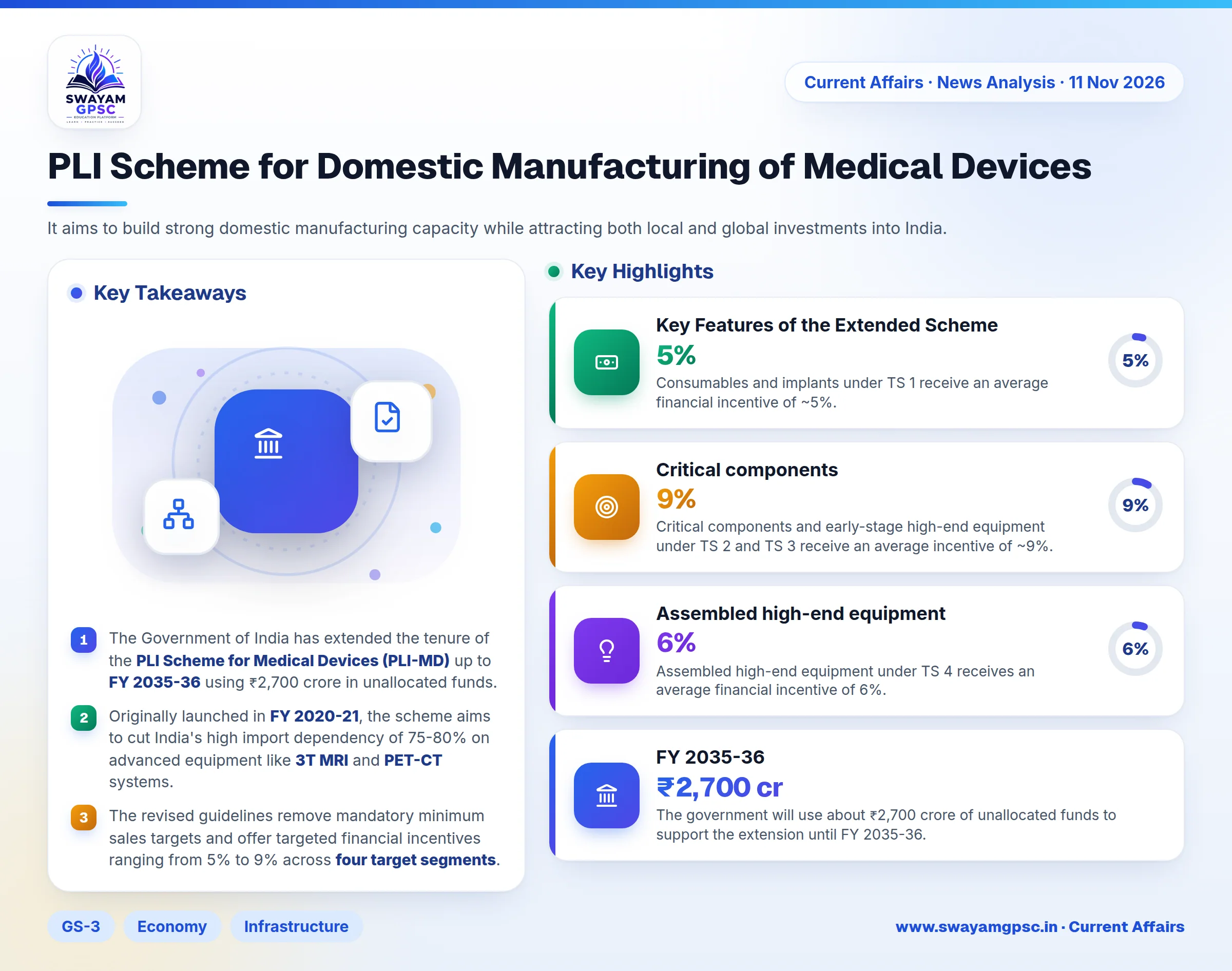
- The Government of India has extended the tenure of the PLI Scheme for Medical Devices (PLI-MD) up to FY 2035-36 using ₹2,700 crore in unallocated funds.
- Originally launched in FY 2020-21, the scheme aims to cut India's high import dependency of 75-80% on advanced equipment like 3T MRI and PET-CT systems.
- The revised guidelines remove mandatory minimum sales targets and offer targeted financial incentives ranging from 5% to 9% across four target segments.
- Selected companies get a 3-year gestation period to establish factory lines for advanced medical technology and components like X-ray tubes and RF coils.
Why in News
- The Government of India has reopened applications for the PLI Scheme for Promoting Domestic Manufacturing of Medical Devices (PLI-MD).
- The government has also extended the overall tenure of this financial incentive scheme up to FY 2035-36.
About the PLI-MD Scheme
- The PLI-MD is a key sectoral program that offers financial rewards on incremental sales of locally made medical devices and essential parts.
- It aims to build strong domestic manufacturing capacity while attracting both local and global investments into India.
- The Department of Pharmaceuticals under the Ministry of Chemicals and Fertilizers originally launched this scheme in FY 2020-21.
- The scheme supports the Aatmanirbhar Bharat and Make in India missions by reducing heavy reliance on imported medical devices.
- It focuses on creating strong local supply chains for advanced equipment like 3T MRI, PET-CT, and ultrasound systems.
Eligibility Criteria
- Both registered Indian and international companies setting up manufacturing plants in India under the target segments can apply.
- The government gives selected applicants a gestation period of 3 years to build their manufacturing units.
- The revised rules remove the strict minimum sales threshold required earlier to claim financial incentives.
- The government has also lowered the minimum capital investment requirements to help smaller businesses participate.
Key Features of the Extended Scheme
- The scheme categorizes medical manufacturing into four target segments (TS) to cover different technology levels.
- Target Segment 1 focuses on medical consumables, single-use disposables, and surgical implants.
- Target Segment 2 covers critical components and sub-assemblies to give a direct boost to MSMEs.
- Target Segment 3 supports high-end medical devices that currently have very limited manufacturing presence in India.
- Target Segment 4 targets complex medical devices that companies currently only assemble inside the country.
- The scheme offers a custom incentive structure based on technological difficulty.
- Consumables and implants under TS 1 receive an average financial incentive of ~5%.
- Critical components and early-stage high-end equipment under TS 2 and TS 3 receive an average incentive of ~9%.
- Assembled high-end equipment under TS 4 receives an average financial incentive of 6%.
- Removing the minimum incremental sales rule lowers entry barriers for new startups and smaller companies.
- The scheme promotes complete local manufacturing of key parts like X-ray tubes, detectors, and RF coils instead of simple assembly.
- The government will use about ₹2,700 crore of unallocated funds to support the extension until FY 2035-36.
- This longer timeline gives companies enough time to complete long research cycles, clinical trials, and regulatory approvals.
Significance
- India currently imports 75-80% of its high-end medical equipment, and local manufacturing will greatly lower this dependence.
- Replacing imports strengthens national healthcare security and saves valuable foreign exchange reserves for India.
- Offering ~9% incentives for core components strengthens small suppliers and advances the Aatmanirbhar Bharat vision.
- Building local capacity will help Indian manufacturers scale up production and boost high-tech medical exports globally.