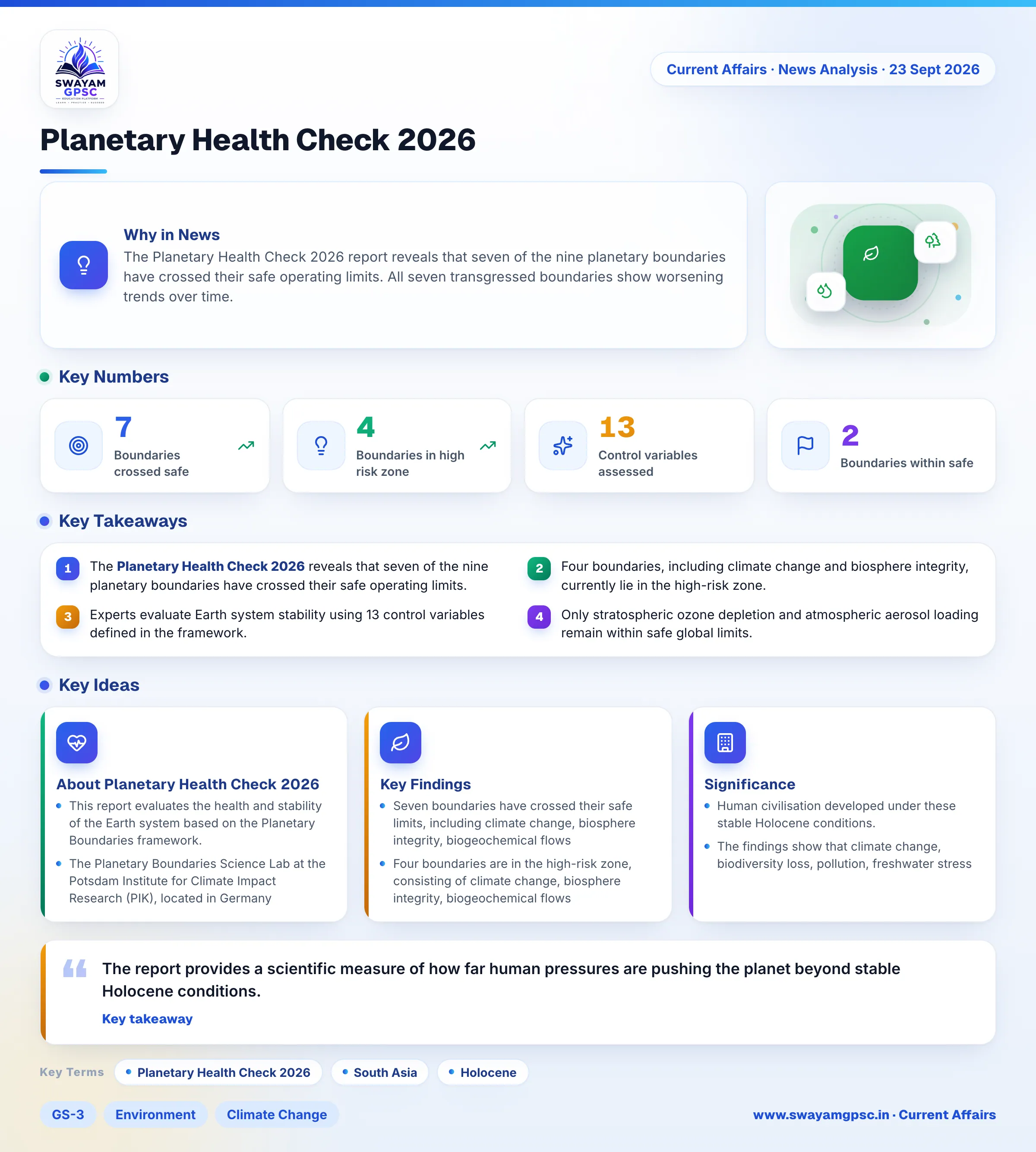
Planetary Health Check 2026
#GS-3 #Environment #Climate Change #Biodiversity #Sustainable Development #Pollution #GS-1 #Indian Society
Key takeaways
- The Planetary Health Check 2026 reveals that seven of the nine planetary boundaries have crossed their safe operating limits.
- Four boundaries, including climate change and biosphere integrity, currently lie in the high-risk zone.
- Experts evaluate Earth system stability using 13 control variables defined in the framework.
- Only stratospheric ozone depletion and atmospheric aerosol loading remain within safe global limits.
Why in News
- The Planetary Health Check 2026 report reveals that seven of the nine planetary boundaries have crossed their safe operating limits.
- All seven transgressed boundaries show worsening trends over time.
About Planetary Health Check 2026
- This report evaluates the health and stability of the Earth system based on the Planetary Boundaries framework.
- The Planetary Boundaries Science Lab at the Potsdam Institute for Climate Impact Research (PIK), located in Germany, releases this assessment.
- The framework highlights nine critical Earth-system processes that define a safe operating space for humanity.
- Experts evaluate these processes using 13 control variables.
Key Findings
- Seven boundaries have crossed their safe limits, including climate change, biosphere integrity, biogeochemical flows, novel entities, land-system change, freshwater change, and ocean acidification.
- Four boundaries are in the high-risk zone, consisting of climate change, biosphere integrity, biogeochemical flows, and novel entities.
- These four strongly transgressed boundaries indicate particularly high risks of destabilising Earth systems.
- Only two boundaries remain within safe limits, which are stratospheric ozone depletion and atmospheric aerosol loading.
- Atmospheric aerosols still show regional transgressions, including in South Asia.
- Climate change is progressing faster than experts previously expected.
- Declining biodiversity is weakening nature's ability to regulate carbon, water, nutrients, soils, and climate.
- Planetary boundaries are interconnected, so deterioration in one boundary can intensify others.
- This interconnection can trigger cascading impacts, tipping points, and irreversible Earth-system changes.
Significance
- The report provides a scientific measure of how far human pressures are pushing the planet beyond stable Holocene conditions.
- Human civilisation developed under these stable Holocene conditions.
- The findings show that climate change, biodiversity loss, pollution, freshwater stress, and land degradation cannot be handled as isolated environmental problems.