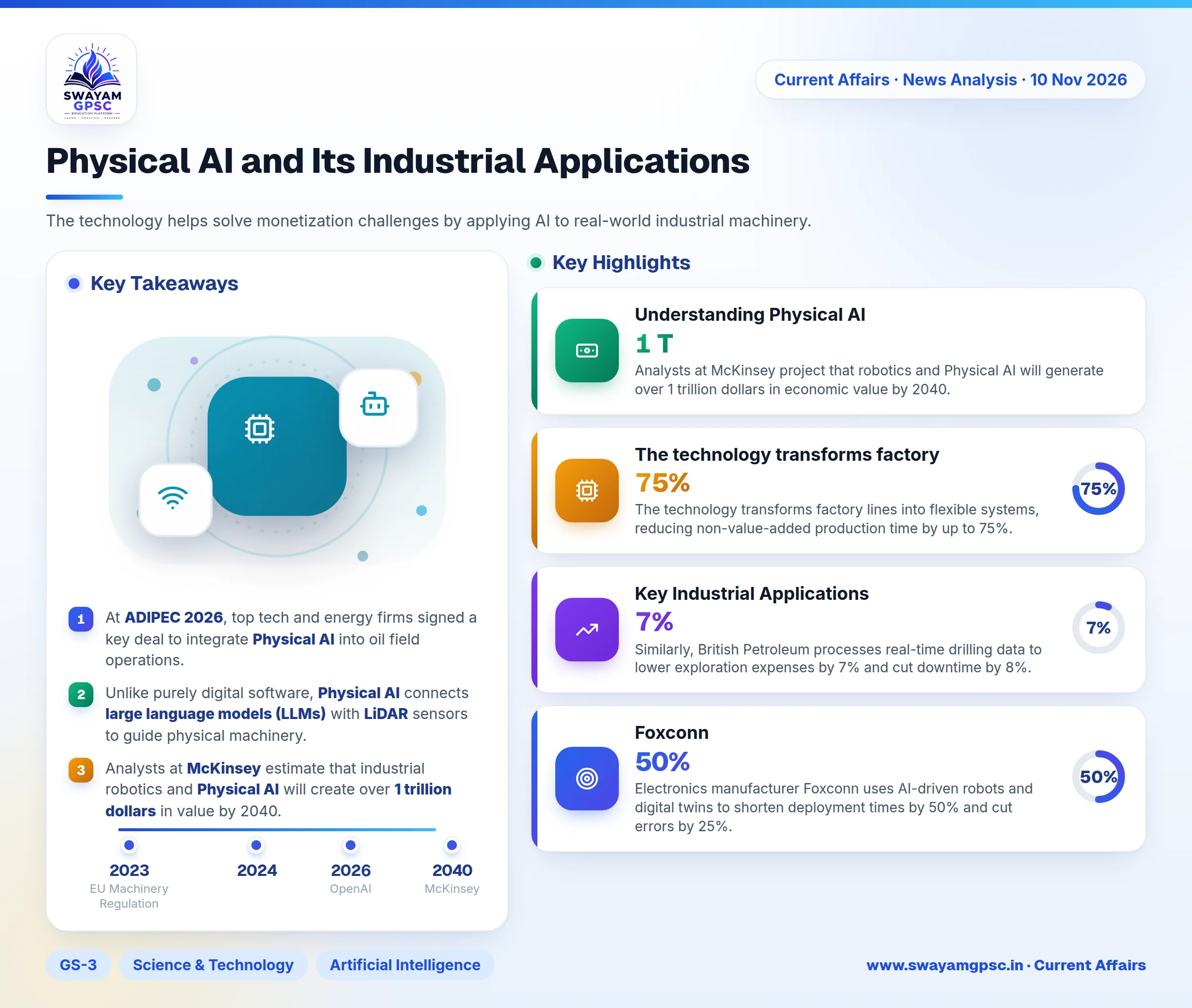
Physical AI and Its Industrial Applications
#GS-3 #Science & Technology #Artificial Intelligence #Economy #Infrastructure #Employment
Key takeaways
- At ADIPEC 2026, top tech and energy firms signed a key deal to integrate Physical AI into oil field operations.
- Unlike purely digital software, Physical AI connects large language models (LLMs) with LiDAR sensors to guide physical machinery.
- Analysts at McKinsey estimate that industrial robotics and Physical AI will create over 1 trillion dollars in value by 2040.
- Industrial adoption by firms like Foxconn shows that AI deployment times can fall by 50% while reducing assembly errors by 25%.
- New safety regulations, including the EU AI Act 2024, now mandate strict compliance for autonomous machines working alongside humans.
Why in News
- Major technology and energy companies, including OpenAI and ADNOC, signed an agreement at ADIPEC 2026 in Abu Dhabi.
- The agreement focuses on using artificial intelligence (AI) to improve operational efficiency in the oil and gas sector.
- This event marks a clear shift toward Physical AI, which Nvidia described as the ChatGPT moment for robotics.
- The technology helps solve monetization challenges by applying AI to real-world industrial machinery.
Understanding Physical AI
- Physical AI refers to artificial intelligence systems that interact directly with real-world physical objects rather than operating only in digital environments.
- It empowers autonomous machines like robots, camera-bots, and self-driving cars to sense, understand, and act in physical spaces.
- The system combines large language models (LLMs), LiDAR sensors, and control actuators to process information and execute tasks.
- It relies on computer vision, reinforcement learning, and virtual simulations to adapt to changing environments.
- Traditional factory robots follow fixed programs and fail if an object moves slightly out of position.
- In contrast, AI-driven robotic arms continuously adjust their grip and position based on an object's exact shape and placement.
- By expanding into industrial sectors, Physical AI offers clear return on investment for tech firms looking to monetize AI.
- Analysts at McKinsey project that robotics and Physical AI will generate over 1 trillion dollars in economic value by 2040.
- The technology transforms factory lines into flexible systems, reducing non-value-added production time by up to 75%.
- Safety improves because machines take over dangerous tasks, while robotic exoskeletons protect workers from physical strain.
- Deploying these systems allows models to log real-time sensor data and continuously improve their performance over time.
- Using digital twins and synthetic data enables safer training in virtual environments, cutting costs and real-world risks.
- Building and deploying high-precision robotic hardware remains extremely expensive and capital-intensive.
- Integrating autonomous machines into human spaces creates safety risks, prompting new rules like the EU Machinery Regulation 2023 and EU AI Act 2024.
- Widespread adoption faces public hesitation due to concerns about factory job displacement.
- A gap remains between simulation training and unpredictable real-world conditions, leading to unexpected errors.
Key Industrial Applications
- Energy company Chevron uses its internal generative AI tool, ApEX, to analyze seismic data in the Gulf of Mexico.
- Similarly, British Petroleum processes real-time drilling data to lower exploration expenses by 7% and cut downtime by 8%.
- Oil major Shell monitors over 13,000 machines using C3.ai software to predict equipment failures and reduce repair costs.
- Electronics manufacturer Foxconn uses AI-driven robots and digital twins to shorten deployment times by 50% and cut errors by 25%.
- At India's Vizhinjam port, AI systems track ship movements, flag hazards, and help operate automated cranes.