PHP Vulnerabilities: Cybersecurity Threats in the AI Era
#GS-3 #Science & Technology #Cyber Security #Artificial Intelligence #ICT #Infrastructure #Current Events #National #International #Quick Facts For Prelims #IT & Computers
Key takeaways
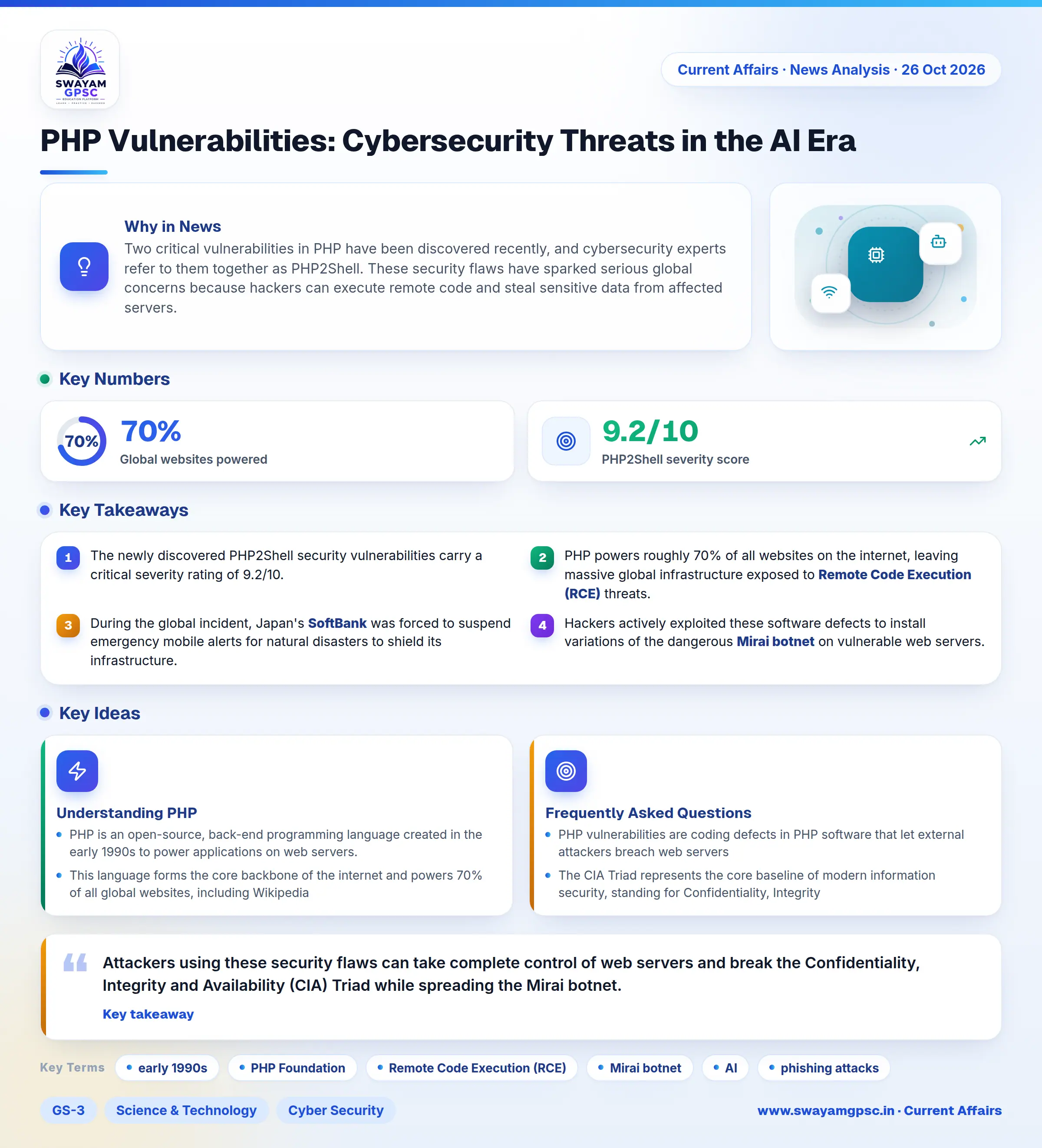
- The newly discovered PHP2Shell security vulnerabilities carry a critical severity rating of 9.2/10.
- PHP powers roughly 70% of all websites on the internet, leaving massive global infrastructure exposed to Remote Code Execution (RCE) threats.
- During the global incident, Japan's SoftBank was forced to suspend emergency mobile alerts for natural disasters to shield its infrastructure.
- Hackers actively exploited these software defects to install variations of the dangerous Mirai botnet on vulnerable web servers.
- The vulnerabilities highlight how modern AI tools are being used both to detect security bugs and to generate dangerous automated exploits against legacy systems.
Why in News
- Two critical vulnerabilities in PHP have been discovered recently, and cybersecurity experts refer to them together as PHP2Shell.
- These security flaws have sparked serious global concerns because hackers can execute remote code and steal sensitive data from affected servers.
Understanding PHP and the Vulnerability
- PHP is an open-source, back-end programming language created in the early 1990s to power applications on web servers.
- This language forms the core backbone of the internet and powers 70% of all global websites, including Wikipedia, WordPress, Laravel, and Drupal.
- The open-source community develops and maintains PHP with organizational support from the PHP Foundation.
- Security researchers track the two new PHP flaws as CVE-2026-109618 and CVE-2026-109619, which carry a high severity score of 9.2/10.
- The CVE-2026-109618 flaw stems from improper handling of out-of-memory errors, which corrupts memory during web request processing.
- The CVE-2026-109619 flaw lets attackers access previously freed memory, which allows them to execute unauthenticated Remote Code Execution (RCE).
- Attackers using these security flaws can take complete control of web servers and break the Confidentiality, Integrity and Availability (CIA) Triad while spreading the Mirai botnet.
- AI-powered code analysis tools helped identify these vulnerabilities, proving that AI can both improve security defenses and help construct cyberattacks.
- Backend developers must apply security patches immediately, but regular users should also watch out for phishing attacks during public cyber panics.
- The sudden disclosure forced emergency maintenance and temporary website shutdowns across global Critical Information Infrastructure (CII).
- Major institutions including Wikipedia, the UK government, the Finnish government, and large telecom firms had to pause their digital services.
- Japan's SoftBank had to temporarily stop emergency mobile alerts for natural disasters like earthquakes and tsunamis to protect internal systems.
- In India, Critical Information Infrastructure (CII) relies heavily on legacy software systems, making them easy targets for automated AI cyber exploits.
Frequently Asked Questions
- PHP vulnerabilities are coding defects in PHP software that let external attackers breach web servers through mechanisms like Remote Code Execution (RCE).
- The CIA Triad represents the core baseline of modern information security, standing for Confidentiality, Integrity, and Availability.
- The Indian Computer Emergency Response Team, known as CERT-In, serves as the national agency for handling cyber incidents and publishing security alerts.
- Critical Information Infrastructure or CII includes key computer systems whose failure would damage national security, public safety, or economic stability.
- The Mirai botnet is a family of malware that infects insecure IoT devices to execute massive Distributed Denial of Service attacks.