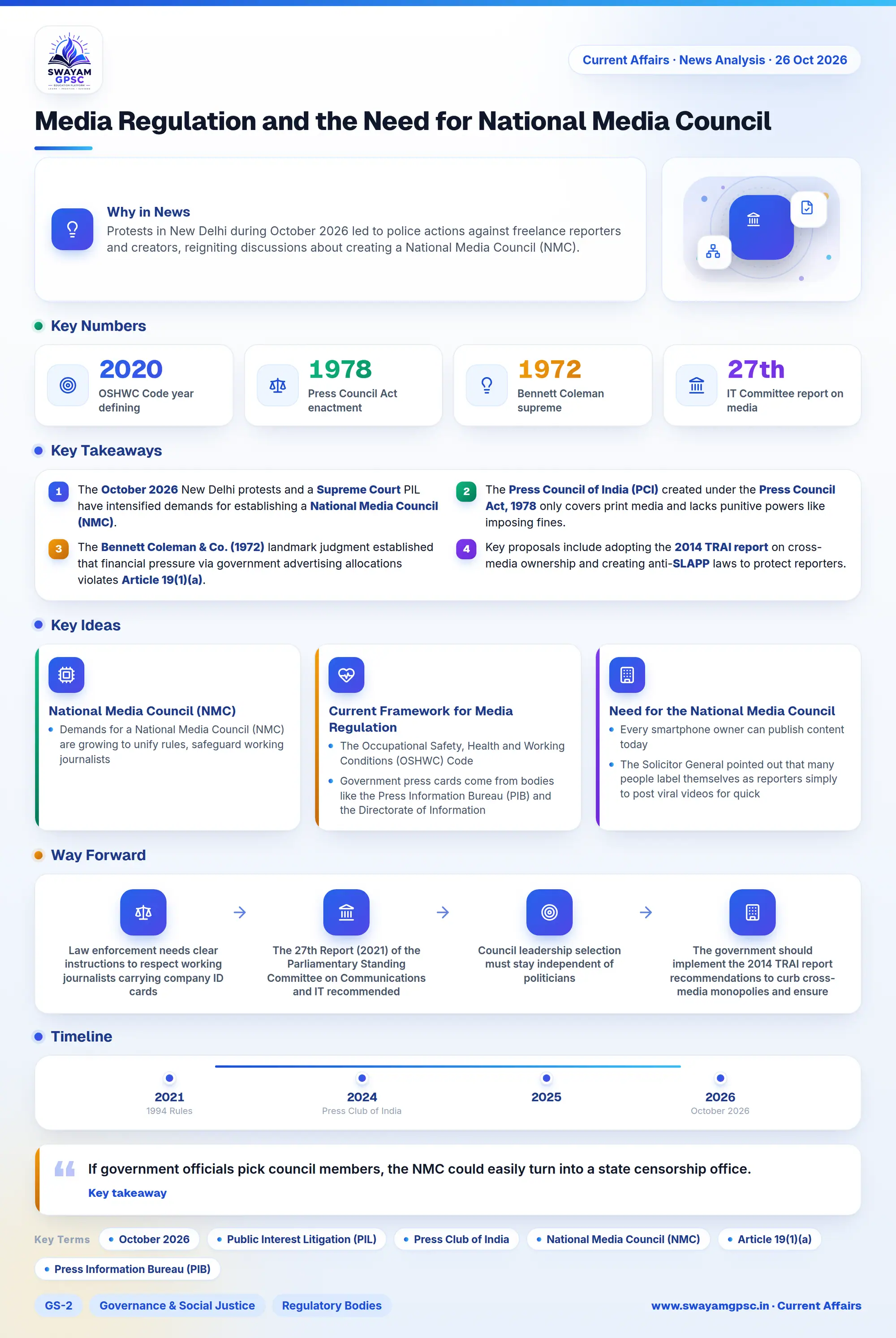
Media Regulation and the Need for National Media Council
#GS-2 #Governance & Social Justice #Regulatory Bodies #Civil Services #GS-3 #Science & Technology #ICT #Government Policies & Interventions #Role of Media & Social Networking Sites in Internal Security Challenges
Key takeaways
- The October 2026 New Delhi protests and a Supreme Court PIL have intensified demands for establishing a National Media Council (NMC).
- The Press Council of India (PCI) created under the Press Council Act, 1978 only covers print media and lacks punitive powers like imposing fines.
- The Bennett Coleman & Co. (1972) landmark judgment established that financial pressure via government advertising allocations violates Article 19(1)(a).
- Key proposals include adopting the 2014 TRAI report on cross-media ownership and creating anti-SLAPP laws to protect reporters.
Why in News
- Protests in New Delhi during October 2026 led to police actions against freelance reporters and creators, reigniting discussions about creating a National Media Council (NMC).
- While hearing a Public Interest Litigation (PIL) about protecting freelance reporters, the Supreme Court questioned how to define a journalist today and urged for a unified national regulation strategy.
- Back in 2024, the Press Club of India drafted the Media Transparency and Accountability Bill which formally recommended establishing a National Media Council (NMC).
Summary
- Demands for a National Media Council (NMC) are growing to unify rules, safeguard working journalists, and handle digital media hurdles.
- Rising concerns over press freedom and fake news highlight the need for an independent regulator that balances accountability with constitutional guarantees under Article 19(1)(a).
Current Framework for Media Regulation and Recognition
- The Occupational Safety, Health and Working Conditions (OSHWC) Code, 2020 defines a working journalist as anyone whose main occupation is journalism across print, electronic, or digital media, excluding managers.
- Government press cards come from bodies like the Press Information Bureau (PIB) and the Directorate of Information and Publicity (DIP).
- Official accreditation uses strict caps based on newspaper circulation, news agency subscriber bases, or website visitor traffic.
- These strict traffic rules prevent many genuine freelance and independent reporters from receiving official government credentials.
- The Press Council of India (PCI) regulates print under the Press Council Act, 1978 as an autonomous body, but it lacks power to punish violators.
- Television channels rely on self-regulation through the News Broadcasting & Digital Standards Authority (NBDSA), which was set up by the News Broadcasters & Digital Association (NBDA).
- TV regulation relies on the Cable Television Networks (Regulation) Act, 1995 alongside the 1994 Rules, with 2021 amendments establishing a three-tier complaint process involving broadcasters, self-regulatory panels, and central officials.
- Digital outlets and video streaming platforms fall under the Information Technology (Intermediary Guidelines and Digital Media Ethics Code) Rules, 2021, which use a three-tier review process but draw criticism for government overreach.
- Movies are checked and certified by the Central Board of Film Certification (CBFC) operating under the Cinematograph Act, 1952.
- Online material is governed by the Information Technology Act, 2000, where Section 69A allows online content blocking and Section 79(3)(b) addresses intermediate legal liability.
- The government uses the Sahyog portal as a direct channel to issue official takedown instructions to internet platforms.
Need for the National Media Council
- Every smartphone owner can publish content today, making it hard to separate true reporters from basic internet creators.
- The Solicitor General pointed out that many people label themselves as reporters simply to post viral videos for quick money.
- A formal National Media Council (NMC) could set clear professional standards to separate genuine reporters from malicious accounts.
- Just as the Bar Council of India regulates lawyers and ICAI regulates accountants, an NMC could issue professional cards based on journalism training to protect all reporters regardless of state quotas.
- Modern media conglomerates run print, TV, and web operations together, making separate regulators like the PCI, NBDSA, and IT Rules ineffective.
- A single regulatory authority like the NMC fits the modern era where print, broadcast, and web channels merge together.
- Critics call the PCI a toothless regulator because it cannot oversee TV or web content, nor can it fine bad actors or force prime-time apologies.
- Self-regulation on TV channels has failed to stop sensationalism, shouting matches, and high-rating chases at the expense of ethics.
- Online platforms face organized fake news and AI-driven deepfakes, which require a unified authority covering all communication channels.
- Large media groups face growing corporate and political ownership concentration, requiring clear rules on ownership transparency and algorithmic bias.
Challenges in Establishing an Independent NMC
- If government officials pick council members, the NMC could easily turn into a state censorship office.
- Depending on the Ministry of Information and Broadcasting (MIB) for funds weakens independence, but media companies oppose paying a industry tax.
- Governments use publicity budgets managed by the Directorate of Advertising and Visual Publicity (DAVP) to punish critical news outlets.
- The Supreme Court ruled in Bennett Coleman & Co. vs. Union of India (1972) that cutting off government funds to squeeze press finances violates Article 19(1)(a).
- Giving an NMC the power to issue licenses or fine reporters could restrict press freedom and conflict with fundamental speech rights under Article 19(1)(a).
- Big corporate media firms prefer loose self-regulatory groups like the NBDSA and will fight any unified regulator that limits their profits.
- The massive online creator economy and cross-border tech platforms make it extremely difficult for a local regulator to enforce penalties.
Way Forward
- Law enforcement needs clear instructions to respect working journalists carrying company ID cards, even without official government press passes.
- The 27th Report (2021) of the Parliamentary Standing Committee on Communications and IT recommended a co-regulation model combining statutory support with industry participation.
- Council leadership selection must stay independent of politicians, using a panel with the Chief Justice of India, the Leader of the Opposition, and media experts.
- The government should implement the 2014 TRAI report recommendations to curb cross-media monopolies and ensure owner disclosures.
- Holding an official NMC media card should offer reporting access during events without becoming a compulsory requirement to publish stories.
- India needs clear laws against Strategic Lawsuits Against Public Participation (SLAPP) to protect investigative reporters from baseless lawsuits.
- The 2025 Parliamentary Standing Committee recommended setting up fact-checking groups, newsroom ombudsmen, and clear legal rules for tracking misinformation.
- News organizations should hire independent news ombudsmen to review reader complaints and maintain editorial standards.
- India can adapt Australia's News Media Bargaining Code to ensure big tech companies pay news publishers for their reporting.
- The EU's Digital Services Act (DSA) provides a global model for making tech platforms disclose algorithms and take down hate speech.
Conclusion
- Reforming media governance requires a delicate balance between free speech under Article 19(1)(a) and reasonable limits under Article 19(2).
- Protecting ground reporters from police harassment and keeping newsrooms free from political influence will keep Indian journalism strong.