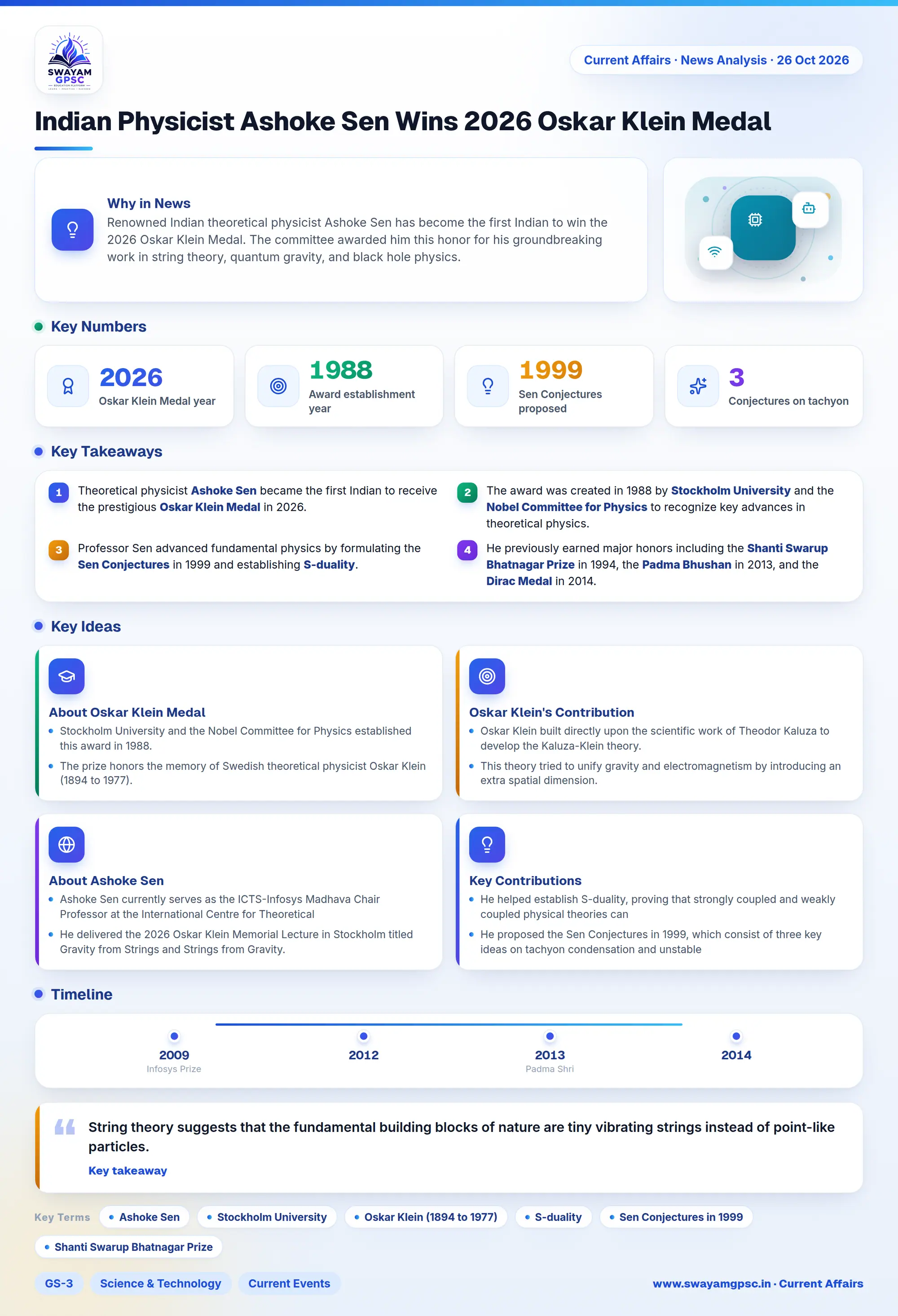
Indian Physicist Ashoke Sen Wins 2026 Oskar Klein Medal
#GS-3 #Science & Technology #Achievements of Indians in Science & Technology #Current Events #National #Rapid Fire CA #Quick Facts For Prelims
Key takeaways
- Theoretical physicist Ashoke Sen became the first Indian to receive the prestigious Oskar Klein Medal in 2026.
- The award was created in 1988 by Stockholm University and the Nobel Committee for Physics to recognize key advances in theoretical physics.
- Professor Sen advanced fundamental physics by formulating the Sen Conjectures in 1999 and establishing S-duality.
- He previously earned major honors including the Shanti Swarup Bhatnagar Prize in 1994, the Padma Bhushan in 2013, and the Dirac Medal in 2014.
- String theory models elementary particles as vibrating strings to unify quantum mechanics and general relativity, though it remains experimentally unverified.
Why in News
- Renowned Indian theoretical physicist Ashoke Sen has become the first Indian to win the 2026 Oskar Klein Medal.
- The committee awarded him this honor for his groundbreaking work in string theory, quantum gravity, and black hole physics.
About Oskar Klein Medal
- Stockholm University and the Nobel Committee for Physics established this award in 1988.
- The prize honors the memory of Swedish theoretical physicist Oskar Klein (1894 to 1977).
- It recognizes scientists around the world who make outstanding contributions to theoretical physics.
Oskar Klein's Contribution
- Oskar Klein built directly upon the scientific work of Theodor Kaluza to develop the Kaluza-Klein theory.
- This theory tried to unify gravity and electromagnetism by introducing an extra spatial dimension.
- His ideas laid an important foundation for modern developments in string theory.
About Ashoke Sen
- Ashoke Sen currently serves as the ICTS-Infosys Madhava Chair Professor at the International Centre for Theoretical Sciences in Bengaluru.
- He delivered the 2026 Oskar Klein Memorial Lecture in Stockholm titled Gravity from Strings and Strings from Gravity.
Key Contributions
- He helped establish S-duality, proving that strongly coupled and weakly coupled physical theories can be mathematically equivalent.
- He proposed the Sen Conjectures in 1999, which consist of three key ideas on tachyon condensation and unstable D-branes.
- He advanced the mathematical understanding of string field theory to explain how strings interact.
- He developed innovative methods to calculate black hole entropy by counting microscopic quantum states.
Major Honours
- His career achievements include the ICTP Prize in 1989 and the Shanti Swarup Bhatnagar Prize in 1994.
- The Indian government honored him with the Padma Shri in 2001 and the Padma Bhushan in 2013.
- He also won the Infosys Prize in 2009, the Breakthrough Prize in Fundamental Physics in 2012, and the Dirac Medal in 2014.
About String Theory
- String theory suggests that the fundamental building blocks of nature are tiny vibrating strings instead of point-like particles.
- Different vibration patterns of these strings represent different fundamental particles in nature.
- The primary goal of string theory is to combine quantum mechanics and general relativity into one single framework.
- This framework helps scientists better understand gravity, fundamental physical forces, and complex black hole physics.
- A major limitation of string theory is that researchers have not yet verified it through physical experiments.