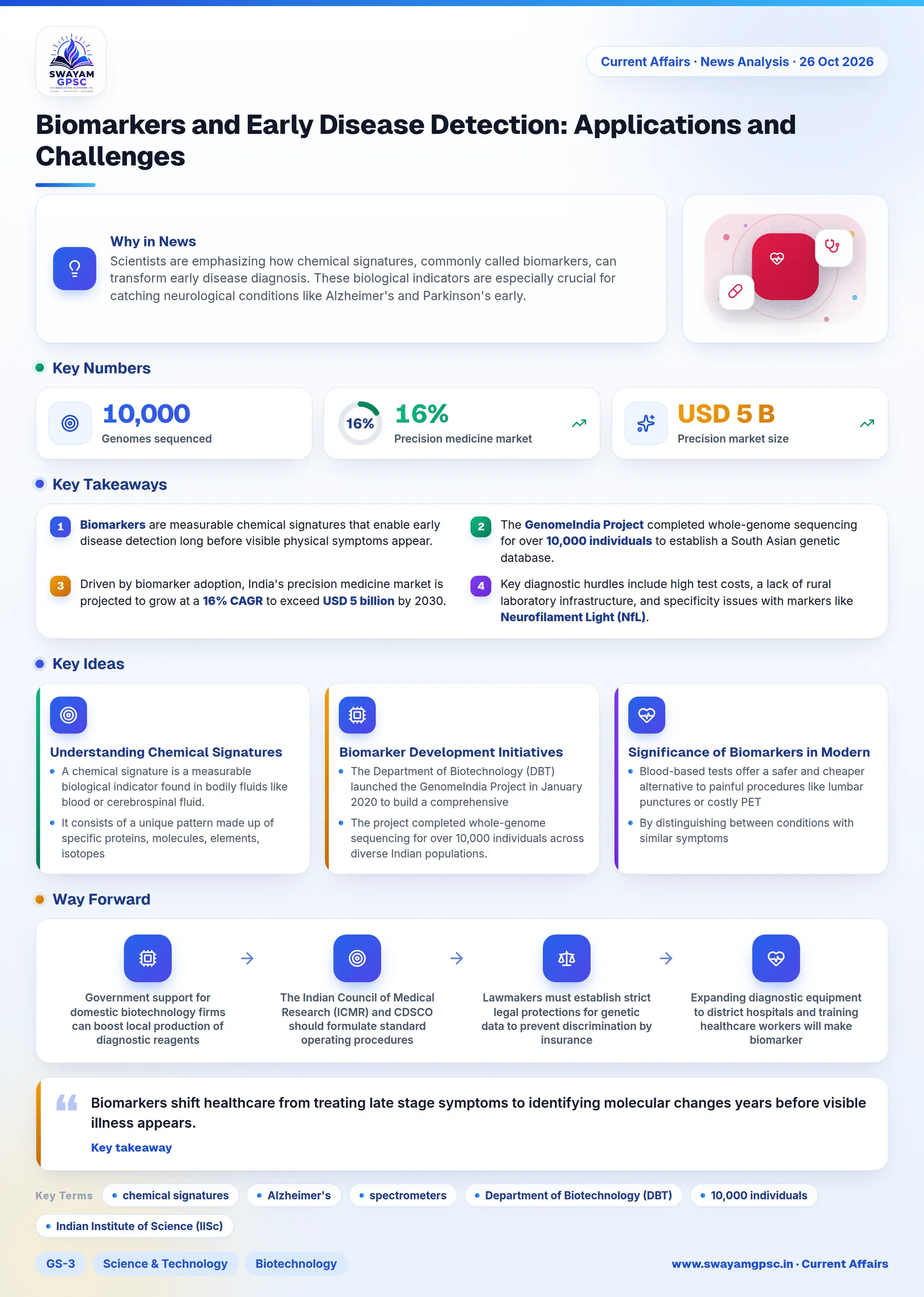
Biomarkers and Early Disease Detection: Applications and Challenges
#GS-3 #Science & Technology #Biotechnology #GS-2 #Governance & Social Justice #Health #Current Events #National #Government Policies & Interventions #Scientific Innovations & Discoveries
Key takeaways
- Biomarkers are measurable chemical signatures that enable early disease detection long before visible physical symptoms appear.
- The GenomeIndia Project completed whole-genome sequencing for over 10,000 individuals to establish a South Asian genetic database.
- Driven by biomarker adoption, India's precision medicine market is projected to grow at a 16% CAGR to exceed USD 5 billion by 2030.
- Key diagnostic hurdles include high test costs, a lack of rural laboratory infrastructure, and specificity issues with markers like Neurofilament Light (NfL).
- The ICMR and CDSCO must establish standardized operating procedures while legal frameworks safeguard individual biomarker data privacy.
Why in News
- Scientists are emphasizing how chemical signatures, commonly called biomarkers, can transform early disease diagnosis.
- These biological indicators are especially crucial for catching neurological conditions like Alzheimer's and Parkinson's early.
- However, integrating these diagnostic tools into daily medical practice faces major hurdles due to high costs, low accessibility, and precision concerns.
Understanding Chemical Signatures and Biomarkers
- A chemical signature is a measurable biological indicator found in bodily fluids like blood or cerebrospinal fluid.
- It consists of a unique pattern made up of specific proteins, molecules, elements, isotopes, or biological by-products.
- This indicator provides objective data on whether the body is experiencing normal functions, a disease state, or a response to medicine.
- When a disease begins, it causes measurable changes at the molecular level long before physical symptoms appear.
- By analyzing the presence or altered levels of specific proteins, medical staff can identify underlying physical changes early.
- Specialized instruments like spectrometers and chromatographs are used to detect these tiny chemical signatures.
Biomarker Development Initiatives in India
- The Department of Biotechnology (DBT) launched the GenomeIndia Project in January 2020 to build a comprehensive genetic database.
- The project completed whole-genome sequencing for over 10,000 individuals across diverse Indian populations.
- As a massive genetic database, the GenomeIndia Project helps researchers discover South Asian specific biomarkers and disease risks.
- The Indian Institute of Science (IISc) initiated the BHARAT Study under its Longevity India Programme.
- The BHARAT Study aims to establish a local baseline to measure aging among Indians without relying on Western population data.
- Because biological aging depends on molecular, cellular, and social factors, calendar age does not always reflect biological health.
Significance of Biomarkers in Modern Healthcare
- Biomarkers shift healthcare from treating late stage symptoms to identifying molecular changes years before visible illness appears.
- Blood-based tests offer a safer and cheaper alternative to painful procedures like lumbar punctures or costly PET scans.
- By distinguishing between conditions with similar symptoms, biomarkers help doctors prescribe precise treatments instead of generic drugs.
- India's precision medicine market is expected to grow at a 16% CAGR and cross USD 5 billion by 2030.
- Regular blood tests allow doctors to monitor continuously how well a patient responds to experimental or standard medical treatments.
Common Biomarkers and Associated Diseases
- Testing for Tau (p-tau217) and Amyloid-beta helps monitor abnormal plaque buildup associated with Alzheimer's Disease.
- Detecting misfolded Alpha-synuclein protein clumps helps diagnose nerve cell degradation linked to Parkinson's Disease.
- Measuring Neurofilament Light (NfL) serves as a general signal for nerve cell damage across multiple neurological disorders.
- Identifying Neuronal Surface Antibodies helps diagnose Autoimmune Encephalitis to guide targeted anti-inflammatory therapies.
Major Global Genome Sequencing Projects
- The All of Us Research Program in the USA uses genomic data to advance personalized health treatments.
- The Human Microbiome Project in the USA studies human microbes to understand their role in health and disease.
- The 100,000 Genomes Project in the UK uses genomic sequencing to diagnose rare diseases and various cancers.
- The 1+ Million Genomes (1+MG) initiative in the European Union facilitates secure cross-border sharing of genomic research data.
- The Emirati Genome Program in the UAE aims to strengthen national preventive healthcare through population genetics.
Challenges in Biomarker Testing and Diagnosis
- Many biomarkers lack high specificity; for instance, Neurofilament Light (NfL) indicates general nerve damage without identifying the exact disease.
- Confounding factors such as patient age, kidney function, or concurrent medications can distort biomarker levels and cause inaccurate results.
- High test costs and limited advanced lab infrastructure restrict biomarker diagnostic tools mostly to major metropolitan cities.
- District and rural healthcare centers lack the automated machinery required to process complex biomarker assays.
- A lack of standardized laboratory protocols creates inconsistency when interpreting biomarker test results across different diagnostic centers.
- Diagnosing diseases years before symptoms appear can trigger severe psychological stress and create lingering anxiety for individuals.
- Having positive biomarker data on record risks exposing asymptomatic individuals to workplace bias or insurance denial.
Way Forward
- Government support for domestic biotechnology firms can boost local production of diagnostic reagents and lower testing costs.
- The Indian Council of Medical Research (ICMR) and CDSCO should formulate standard operating procedures for uniform lab results.
- Lawmakers must establish strict legal protections for genetic data to prevent discrimination by insurance providers or employers.
- Expanding diagnostic equipment to district hospitals and training healthcare workers will make biomarker testing accessible to everyone.