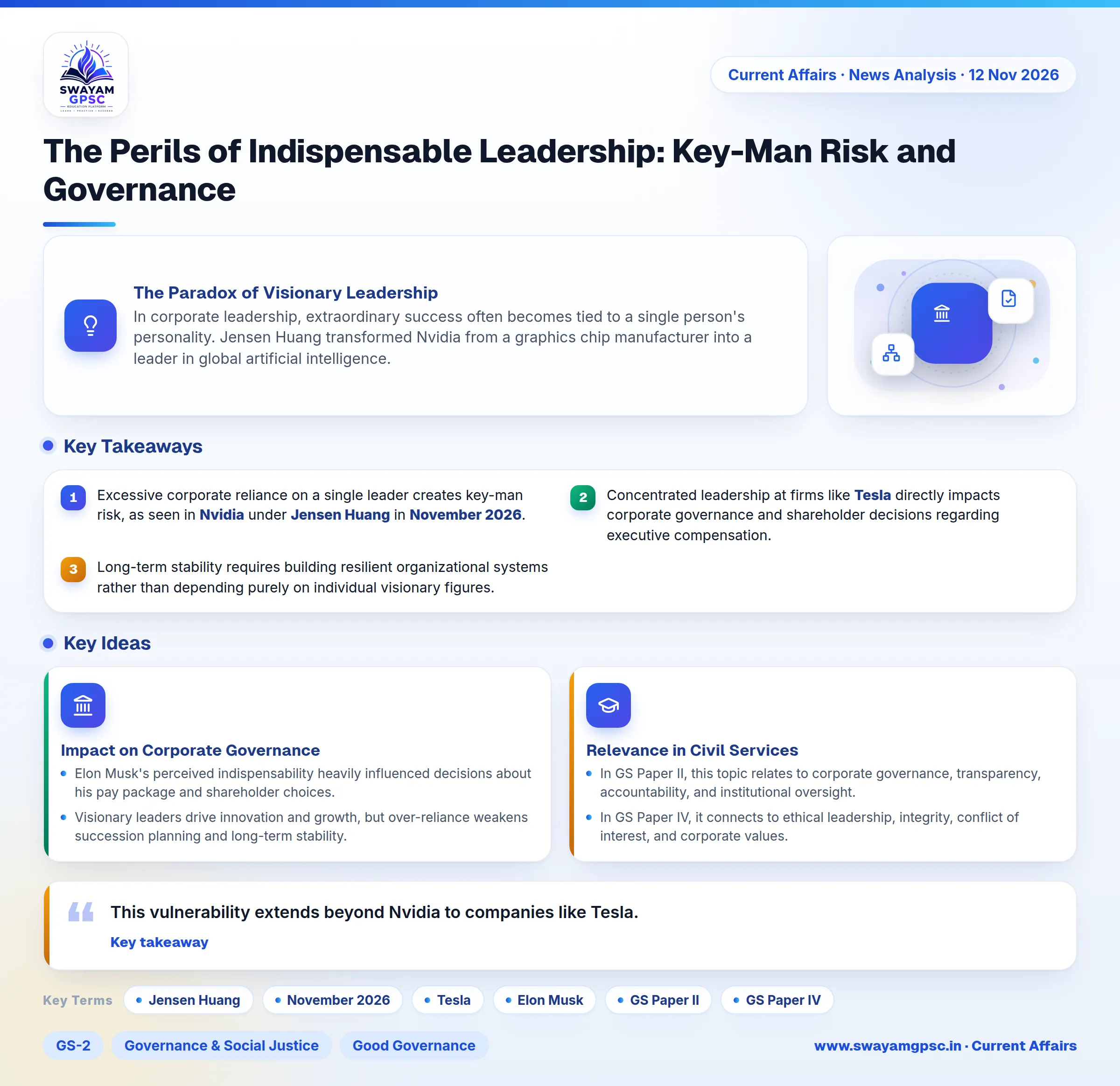
The Perils of Indispensable Leadership: Key-Man Risk and Governance
#GS-2 #Governance & Social Justice #Good Governance #GS-4 #Ethics #Ethical Dilemmas #Corporate Governance #Key-Man Risk
Key takeaways
- Excessive corporate reliance on a single leader creates key-man risk, as seen in Nvidia under Jensen Huang in November 2026.
- Concentrated leadership at firms like Tesla directly impacts corporate governance and shareholder decisions regarding executive compensation.
- Long-term stability requires building resilient organizational systems rather than depending purely on individual visionary figures.
The Paradox of Visionary Leadership
- In corporate leadership, extraordinary success often becomes tied to a single person's personality.
- Jensen Huang transformed Nvidia from a graphics chip manufacturer into a leader in global artificial intelligence.
- In November 2026, controversies around Huang raised serious concerns among investors about the company's future.
- Investors questioned if a massive company could stay stable if its main leader suddenly left.
- Analysts refer to this vulnerability as key-man risk, where an organization relies too heavily on one individual.
Impact on Corporate Governance and Institutions
- This vulnerability extends beyond Nvidia to companies like Tesla.
- Elon Musk's perceived indispensability heavily influenced decisions about his pay package and shareholder choices.
- Visionary leaders drive innovation and growth, but over-reliance weakens succession planning and long-term stability.
- True institutional strength comes from building resilient systems that thrive beyond any single leader.
Relevance in Civil Services Examination
- In GS Paper II, this topic relates to corporate governance, transparency, accountability, and institutional oversight.
- In GS Paper IV, it connects to ethical leadership, integrity, conflict of interest, and corporate values.
- In the Essay paper, it fits themes like individual excellence versus collective resilience and institutional sustainability.