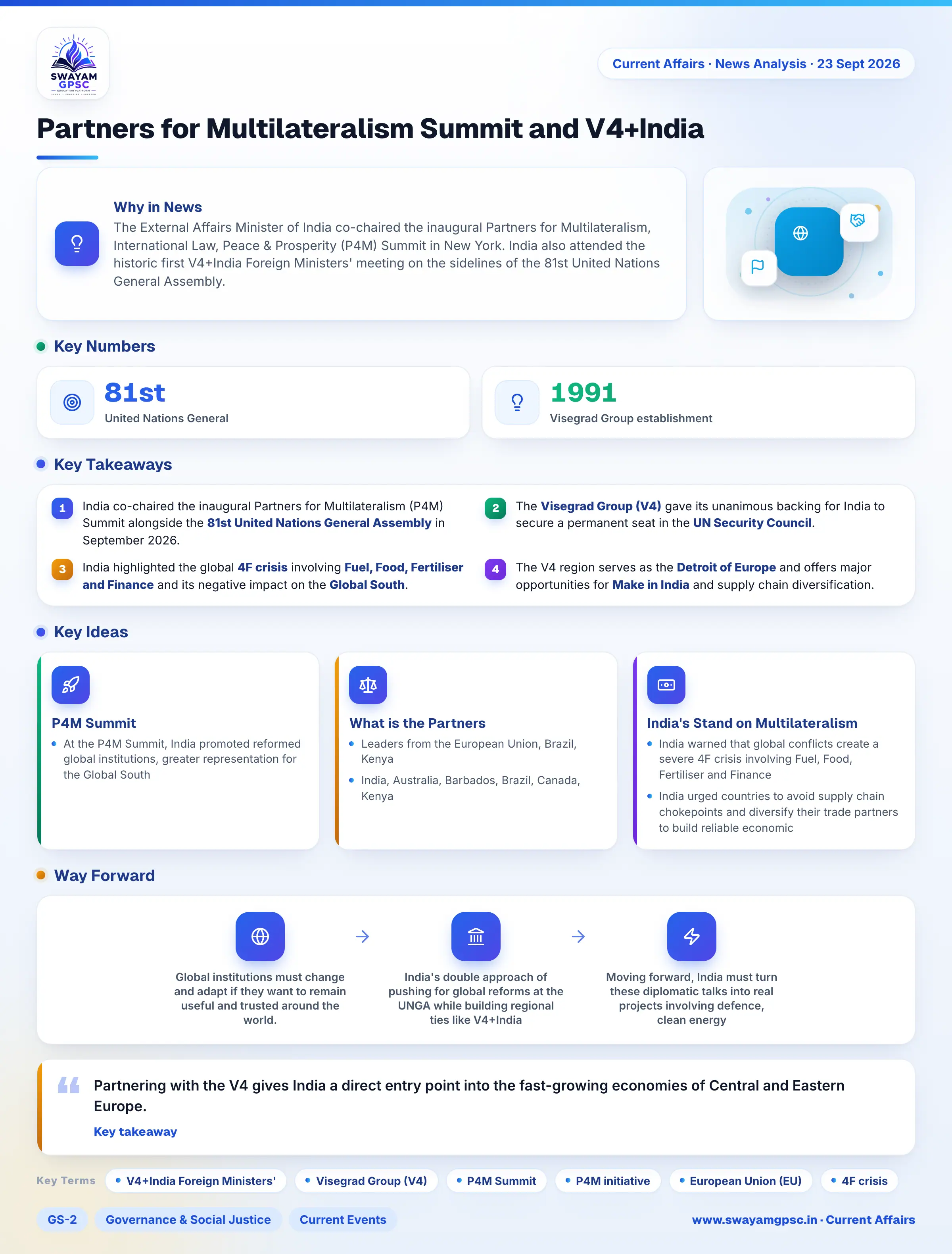
Partners for Multilateralism Summit and V4+India
#GS-2 #Governance & Social Justice #Current Events #International #Economy #Infrastructure
Key takeaways
- India co-chaired the inaugural Partners for Multilateralism (P4M) Summit alongside the 81st United Nations General Assembly in September 2026.
- The Visegrad Group (V4) gave its unanimous backing for India to secure a permanent seat in the UN Security Council.
- India highlighted the global 4F crisis involving Fuel, Food, Fertiliser and Finance and its negative impact on the Global South.
- The V4 region serves as the Detroit of Europe and offers major opportunities for Make in India and supply chain diversification.
Why in News
- The External Affairs Minister of India co-chaired the inaugural Partners for Multilateralism, International Law, Peace & Prosperity (P4M) Summit in New York.
- India also attended the historic first V4+India Foreign Ministers' meeting on the sidelines of the 81st United Nations General Assembly.
- During these diplomatic talks, India pushed for major global reforms and built stronger ties with Central European countries.
- The Visegrad Group (V4) gave its full support for India to become a permanent member of the UN Security Council.
Summary
- At the P4M Summit, India promoted reformed global institutions, greater representation for the Global South, and new rules for space and digital technologies.
- Through the V4+India Foreign Ministers' Meeting, India partnered with Central Europe on defence, trade, clean energy, and secure supply chains.
What is the Partners for Multilateralism Summit
- Leaders from the European Union, Brazil, Kenya, and Canada first proposed the P4M initiative to protect international law and peaceful cooperation.
- India, Australia, Barbados, Brazil, Canada, Kenya, and the European Union (EU) co-sponsored the first summit in September 2026.
- The group made it clear that it is not a closed club or a new bureaucracy, but rather a flexible platform for countries to build partnerships.
India's Stand on Multilateralism
- India warned that global conflicts create a severe 4F crisis involving Fuel, Food, Fertiliser and Finance, which harms the Global South the most.
- India urged countries to avoid supply chain chokepoints and diversify their trade partners to build reliable economic networks.
- India pointed out that political tensions and global competition are putting the current international order under heavy pressure.
- India stated that the UN Security Council is outdated and paralyzed by the veto power of a few powerful nations.
- India repeated its demand for a permanent seat at the UNSC to give fair representation to Africa, Latin America, and Asia.
- India asked for new international rules and safety guardrails to manage Artificial Intelligence, space security, and digital tools.
What is the Visegrad Group
- The Visegrad Group (V4) is a political and cultural alliance connecting the Czech Republic, Hungary, Poland and Slovakia.
- Leaders met in the Hungarian town of Visegrad in 1991 after the fall of the Soviet bloc to boost regional teamwork.
- The group works together on military, cultural, and energy issues while supporting each other inside the European Union (EU) and NATO.
- During the V4+India Meeting, the four member nations gave unanimous backing for India to join the UN Security Council as a permanent member.
- Slovakia noted that India is an upcoming superpower in the Indo-Pacific region and deserves a seat at the table.
- The leaders agreed to launch an Annual Business Forum and hold yearly V4+India Foreign Ministers' meetings.
Significance of the V4 for India
- Partnering with the V4 gives India a direct entry point into the fast-growing economies of Central and Eastern Europe.
- The V4 acts as a strong voting block inside the European Parliament, which can help revive the stalled India-EU Broad-based Trade and Investment Agreement (BTIA).
- The region is known as the Detroit of Europe due to its large automotive and electric vehicle battery hubs in Hungary and Slovakia.
- Working with these manufacturing clusters helps Indian companies put a successful China Plus One business strategy into practice.
- India can use the technical expertise of the Czech Republic in aviation and Poland in agri-tech to boost Make in India and Atmanirbhar Bharat.
- As V4 countries face aging populations, Migration and Mobility Partnership Agreements (MMPAs) can help skilled Indian professionals find jobs in Central Europe.
Way Forward
- Global institutions must change and adapt if they want to remain useful and trusted around the world.
- India's double approach of pushing for global reforms at the UNGA while building regional ties like V4+India shows a smart way to strengthen international cooperation.
- Moving forward, India must turn these diplomatic talks into real projects involving defence, clean energy, and secure supply chains.